
 Argentina
In this article
I came to South America almost 10 years ago, after I quit my corporate consulting job in the US. A decade later, I speak Spanish fluently, I've invested here, I've married a South American, and I've lived in almost every country on the continent.
I found freedom in South America, and you may too. That decade includes 6 months in Argentina, which I count among my favorite places on Earth.

On October 2, 2026, Argentina's economy ministry put a price on its citizenship: US$350,000, before service fees and administrative costs. You may have seen the news already, but I waited on purpose, for 2 reasons.
Why I Waited to Write about Argentina's $350,000 Citizenship
1. The program hasn't launched. The government has work to do before it can accept a single file. By the way, we're getting overwhelming interest from clients, enough to create a waitlist for the service. Add yourself to the waitlist, with no commitment or obligation.
2. I wanted to read what everyone else sent out first. Most of it was AI slop with a sales pitch attached. That's not the Freedom Files style. I'd rather give you my raw, unfettered opinion, with the pros and the cons side by side, so you can make up your own mind.
So here's everything you need to know.
Argentina Citizenship by Investment: Rules and Requirements
If you're new to citizenship by investment, this is typically how it works:
- You apply for direct citizenship.
- You prove your source of funds, your source of wealth and a clean criminal record.
- You pass due diligence.
- You donate to or invest in the country.
- With proof of your contribution, you're granted citizenship and a passport, typically within 6 to 18 months.
Argentina offers just 2 ways to pay:
- Donation: A non-refundable $350,000 to the Argentine National Treasury. For months, the industry predicted a $500,000 minimum, so we're thrilled with this level.
- Bond: You lend Argentina $800,000 through a zero-rate bond created for this program, and your principal comes back at the end of the term, with no interest. We expect the term to be 7 years, although the government hasn't published it.
Service fees and administrative costs come on top of either amount.
Those prices are for a single main applicant. If your family comes with you, they add a lower but substantial amount. A spouse adds $100,000, and so does each unmarried child aged 18 to 25. Each child under 18 adds $25,000. So a couple with 2 young children on the donation route contributes $500,000 in total, plus service fees and administrative costs.
Important note: After Sierra Leone, Argentina will be only the second citizenship by investment program that lets same-sex couples invest and file together.
One eligibility rule to check first: Applicants need an active US or EU visa to apply. If your passport already gets you into the US or the Schengen Area without a visa, which covers Americans, Canadians, Britons, EU citizens, Japanese and most other developed-world passports, you meet this without doing anything. If it doesn't, you'll need a valid US or EU visa in hand before you file.
Now, residency. Argentine law normally requires 2 years of living in the country before you can naturalize, one of the shortest timelines on Earth, usually through the Rentista visa. The citizenship by investment program removes that requirement.
That ordinary route is worth a look if you'd enjoy living in Buenos Aires or Mendoza for a couple of years. You show qualifying passive income, you spend 2 years of continuous legal residence in the country, and temporary residency counts toward the clock. With filing and processing on top, plan on 2 to 3 years to the same passport. Reason 4 in the next section covers when that's the better buy.
On tax, Argentina had to pass a law to amend its rules. Law 27.802 of 2026 says a citizen by investment doesn't become an Argentine tax resident by naturalizing alone. Reason 6 below covers this in more detail.
The program also has a ceiling. It's capped at 5,000 main applicants over 2 years, and the consulting consortium behind it has a mandate for that same period. We expect the first applications to go in this quarter.
This program was designed with intent. Every payment must move through the formal financial system, with source of funds and source of wealth to back it up. Expect substantial due diligence, which protects the program's integrity and the value of your citizenship.
What We're Waiting On
- The opening date
- The documentation list
- The excluded nationalities
- Biometrics and any visits to Argentina
- The bond option's final terms
- The Supreme Court's decision on the decree behind the program
While we wait, we're accepting clients. Join the waitlist and we'll let you know what to expect.
11 Reasons to Buy Argentine Citizenship
1. Affordability
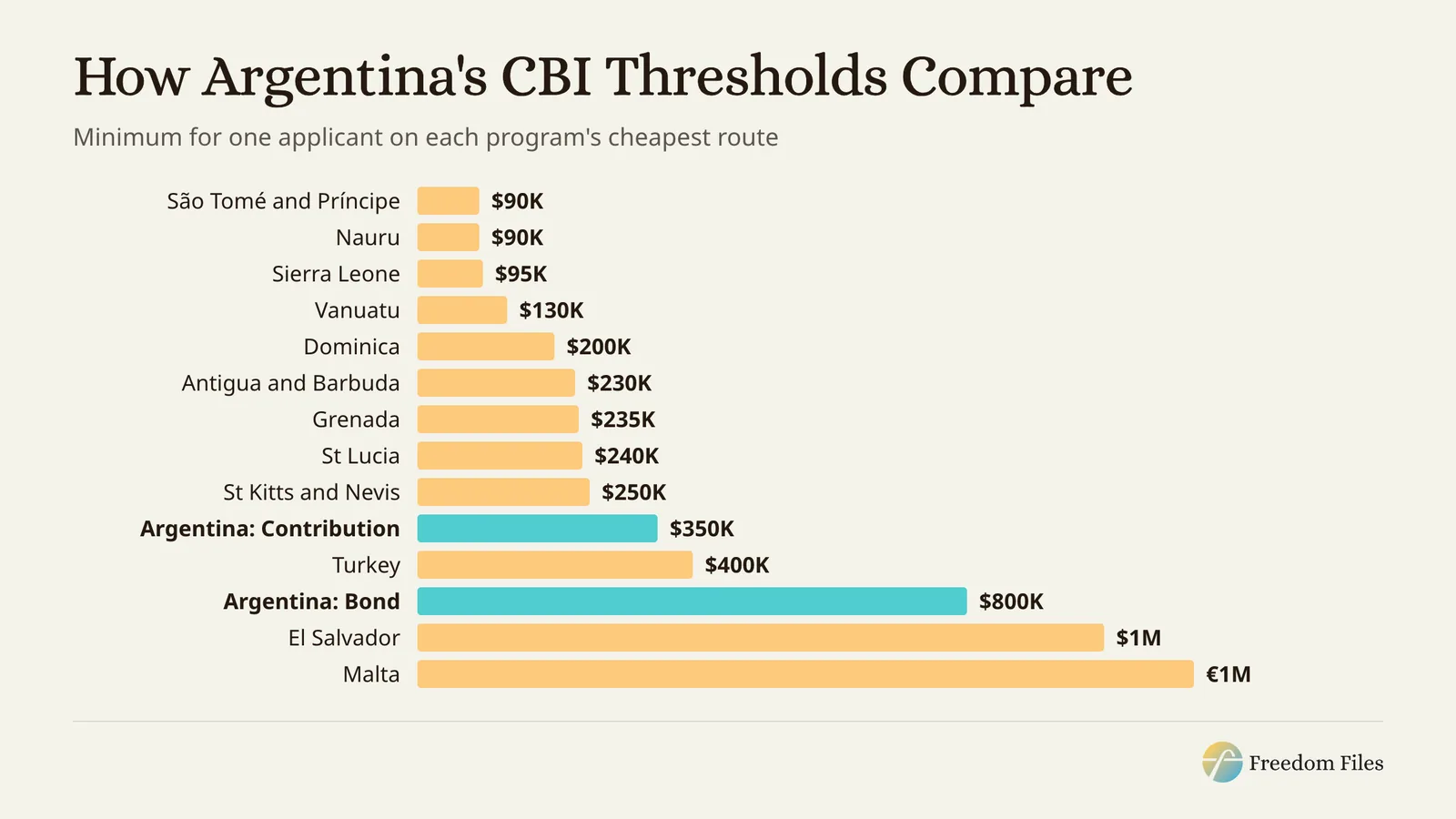
$350,000 is six figures lower than we expected the minimum to be. For comparison, the 5 Caribbean citizenship programs cost up to $250,000 for one applicant on their donation routes, and Turkey requires $400,000 in property. In every case, service fees and administrative costs come on top.
Argentina's price falls between them, and it offers the benefits I explain below: a stronger citizenship, MERCOSUR residency rights, a place you'd want to live and a good global reputation. No other program matches its value.
2. No Residency Required
Become an Argentine citizen and, apart from any biometrics visit, you don't have to live there or set foot in the country again. For an American with a business and a family at home, that's the whole point of a Plan B.
All of this while the Caribbean citizenship programs discuss mandatory physical presence. Antigua & Barbuda already requires you to spend 5 days in your first 5 years as a citizen.
3. Family Inclusion
Two children under 18 add only $50,000 to the bill. So a family of 4 pays $500,000 in total, which is what a single applicant expected to pay last year. On a per-person basis, that's $125,000 each, with service fees and administrative costs on top.
And recall that this will be only the second citizenship by investment program in the world that lets same-sex couples apply on the same application. In the Caribbean, they'd have to invest twice.
4. A Strong Passport
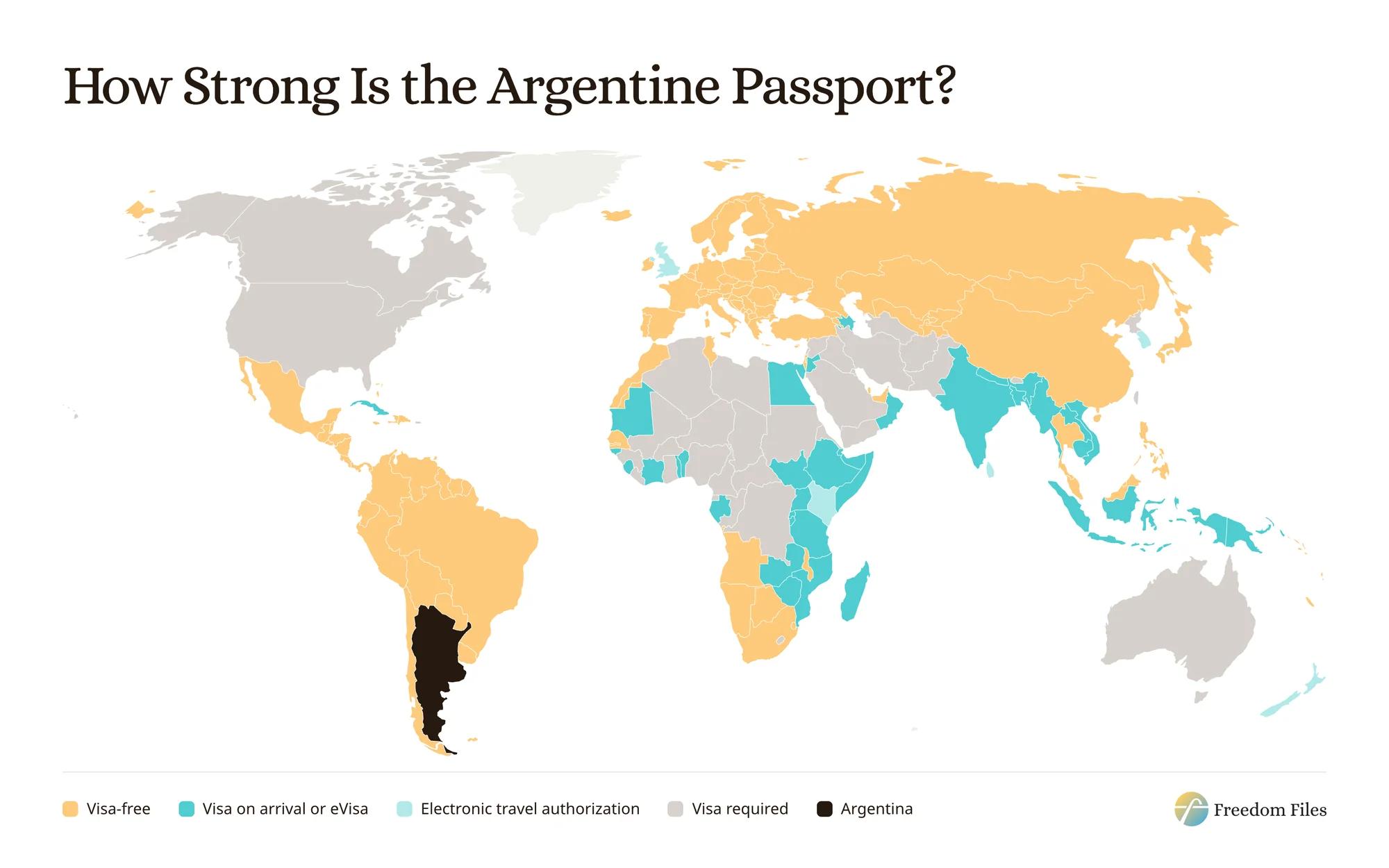
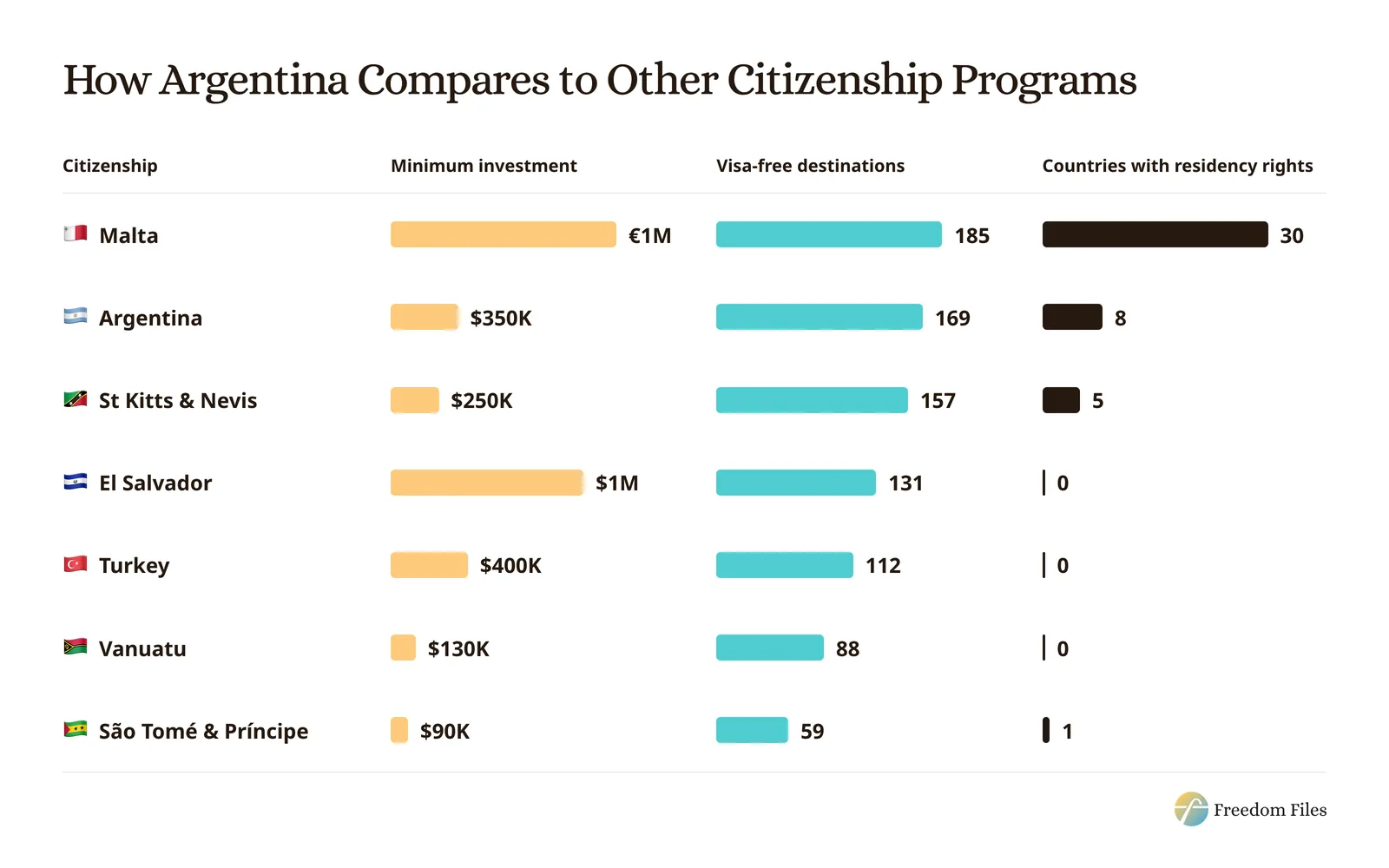
This reason alone should lift Argentina to the top tier of citizenship by investment programs from day one. Argentine citizens can enter 169 destinations without a visa. Compare that with the alternatives, before service fees and administrative costs:
- St Kitts & Nevis charges $250,000 for 157 destinations.
- Turkey charges $400,000 for 112 destinations.
- El Salvador charges $1 million for 131 destinations.
More important than the raw number of destinations is their quality, and most people ignore this. Argentine citizens can visit Europe's Schengen Area, China, the UAE and almost any other place you're likely to vacation in or do business.
5. MERCOSUR Access
In my view, this is the most overlooked benefit of Argentine citizenship. You know the European Union. Well, South America has MERCOSUR.
A citizen of a member state can apply for a 2-year temporary residency permit in 8 other South American countries, then convert it to permanent residency. You show an identity card and a clean criminal record. So once you're an Argentine citizen, you can move to most of South America and claim residency.
Sure, it's more bureaucratic than moving within open-border Europe. But it's a win: Bolivia, Brazil, Chile, Colombia, Ecuador, Paraguay, Peru and Uruguay. I put the country-by-country table, including where naturalized Argentines are confirmed, in my full breakdown of the program.
6. Taxes
Argentina treats its own citizens as tax residents by default. Citizens by investment get an exception under Law 27.802: They become tax residents only if they live in the country for 12 months first.
Also, this is Argentina, not the United States with the strongest military force in the world. I wouldn't worry about the Argentine government's capacity to chase its citizens around the world.
This is not legal, immigration, tax or financial advice.
7. Plan B Potential
Would you move to São Tomé & Príncipe or Vanuatu? How about Nauru or Jordan? These can be great Plan C and Plan D citizenships. But a great Plan B, in our opinion, is a country you'd move to by choice, with:
- Good schools
- Great healthcare
- A high quality of life
- Self-sufficient food and energy
- Safe communities
- Little involvement in global conflicts
- A functioning, sizable economy
Americans are moving to Argentina. We've helped some. After the time I've spent there, I understand why, and I'll be back in a few weeks. Argentina answers the question of where you'd go if you had to leave home.
8. Reputation
Argentina is the second G20 country to sell citizenship, after Turkey. It has a good reputation on the global stage and isn't a "flag on a beach" jurisdiction. This is a serious country.
Customs officers are unlikely to look twice at an Argentine passport. That may not be the case with a Saint Christopher and Nevis passport that most of them have never seen.
The Caribbean citizenship programs are changing because the EU and the US are telling them to. They're under the thumb of Ursula von der Leyen and the US State Department. My guess is that the powers that be go easier on a G20 trading partner than on a small Caribbean nation with little to offer them.
9. Speed
Again, this deserves a caveat. Welcome to Latin America, where things cost twice as much and take twice as long as you think they will.
The whole citizenship by investment process is expected to take about 6 months, but it may extend to 9 months or so. The sooner you get in, the sooner we can get you an Argentine passport.
10. A Buy-Low Bet
Argentina spent the last half century in economic turmoil, with several defaults and inflation as high as 200%. That was the state of things the last time I was in Buenos Aires. Restaurants laminated their menus and wrote prices in dry-erase marker because they changed by the hour. I had a tomahawk steak and a bottle of wine at a famous steakhouse for US$25.
When he was elected in late 2023, President Milei set out to end the country's misery with the largest free-market experiment in recent memory. Annual inflation was down to 30% in August 2026, and the government regularly posts a surplus.
So you're buying at the bottom. If the reforms work, you have citizenship in a country on its way up. If they don't, Argentina's good reputation outlasts the state of its economy and currency.
Voters decide again next year whether the experiment continues or Argentina goes back to its old habits.

11. Diversification
If your businesses, assets, family, identity and future depend on a single country's rules and regulations, I have bad news for you. One politician or one law could change everything for you overnight.
That's why we exist: To help entrepreneurs and investors diversify their lives and assets internationally. This is optionality. This is freedom.
Argentina gives you a quick, easy and affordable route to it. Once you're granted citizenship, you suddenly have the right to live, work, bank, invest and study in 2 countries, not just 1.
4 Reasons Not to Buy Argentine Citizenship
1. You Can Never Renounce It
Article 16 of Decree 3213/84 makes Argentine nationality unrenounceable. A naturalized citizenship ends only if a federal judge annuls it for fraud, so once you're Argentine, you're Argentine for life.
2. Taxes That Follow Nationality
Law 27.605 of December 2020 was a one-off wealth levy of 3% to 5.25% on assets abroad, and it treated Argentine nationals living in low-tax jurisdictions as tax residents. If you're a US citizen, you and I already know how a tax that follows your passport feels.
The risk is smaller than it sounds. Most investors won't live in Argentina full time, and Argentina's record of collecting from citizens abroad and enforcing its laws internationally is thin.
3. Supreme Court Challenges
In 2026, the National Electoral Chamber declared President Milei's decree that created the citizenship by investment agency and program null. The government appealed and says the decree is in force while the appeal is pending.
4. You'd Move to Argentina Anyway
If Buenos Aires or Mendoza already appeals to you, the donation is the expensive way in. Two years of continuous legal residence on the Rentista visa ends in the same passport, with the same MERCOSUR rights and the same 169 destinations, for a fraction of $350,000.
You show qualifying passive income, you live there, and your temporary residency counts toward the clock. With filing and processing on top, plan on 2 to 3 years.
So the $350,000 buys 2 things: Speed, and the option to never move. If neither is worth that much to you, take the slower route and spend the difference on an apartment in Palermo.
What I'd Do Right Now
Between the 2 routes to direct Argentine citizenship, I'd pay the donation over the bond. The bond pays 0%, and on a 7-year term, that's a hell of an opportunity cost.
I also wouldn't wait. The cap is 5,000 main applicants, and the program has a mandate for only 2 years.
We're jurisdiction agnostic, so the first step we take with clients is finding the right program and country for their situation and goals. Then we help them move or invest as seamlessly as possible.
You have 2 options:
- You know Argentina is your lane: Add yourself to the waitlist, and we'll tell you shortly what to expect.
- You're unsure about your options: For a holistic look at your goals, book a free one-on-one consult with me.
FAQ
How Much Does Argentine Citizenship by Investment Cost?
US$350,000 for one applicant as a non-refundable donation to the National Treasury, or US$800,000 lent to Argentina through a zero-rate bond. A spouse adds $100,000, so does each unmarried child aged 18 to 25, and each child under 18 adds $25,000. Service fees and administrative costs come on top.
Do You Have to Live in Argentina to Get Citizenship by Investment?
No. The program removes the 2 years of residence that ordinary naturalization requires. The government hasn't said yet whether you'll need 1 trip to Argentina for biometrics.
How Long Does Argentine Citizenship by Investment Take?
About 6 months is the expectation, and it may extend to 9 months or so. Applications are expected to open in the fourth quarter of 2026.
Can Same-Sex Couples Apply for Argentine Citizenship by Investment Together?
Yes. After Sierra Leone, Argentina will be only the second citizenship by investment program that lets same-sex couples invest and file together on one application.
Can You Renounce Argentine Citizenship?
No. Article 16 of Decree 3213/84 makes Argentine nationality unrenounceable. A naturalized citizenship ends only if a federal judge annuls it for fraud.
Who Can Apply for Argentine Citizenship by Investment?
Applicants need an active US or EU visa to apply. Passports with visa-free access to the US or the Schengen Area, which includes Americans, Canadians, Britons, EU citizens and Japanese, already satisfy this. The government has yet to publish its list of excluded nationalities.
Is There a Cheaper Route to Argentine Citizenship?
Yes. The Rentista visa leads to the same passport after 2 years of continuous legal residence, and 2 to 3 years once you add filing and processing. It costs a fraction of $350,000, but it requires you to live in Argentina.
Video Transcript
Click to read the full transcript
Video Transcript
Click to read the full transcript
$350,000 for an Argentine passport, a powerful one at that, and zero days required in the country. Is it worth it? I lived in Argentina for about a year and I've spent 10 years in the citizenship business. Here are 11 reasons I'd buy it, four I wouldn't, and the last one gets you the same passport with no donation at all.
Let's go to number one, the price. When Argentina's Economy Ministry finally announced the price in October, it came in at $350,000. That's six figures lower than most of us in the industry expected, because for about a year the government had been floating around $500,000, and that's a huge difference, obviously. Now, there are two ways to pay. The first is a donation, meaning a non-refundable $350,000 to the national treasury. The second is a bond, where you lend Argentina $800,000 at 0% interest and get your money back at the end of the term, which we expect to be around seven or eight years. That's a lot of trust to place in a financial system that has crashed several times before, which is why most of the interest we've seen so far is in the donation.
So, how does that stack up against its alternatives? The five Caribbean programs cost between $200,000 and $250,000 for a single applicant, from Dominica at the low end to St Kitts & Nevis at the top. Turkey, the only other G20 country selling citizenship today, wants $400,000 in property or $500,000 in a bank deposit or a real estate investment fund. Just remember that service fees come on top of every figure I give you today. Across the industry, you can expect mid five figures for one person and the higher five figures for a family, although nothing is final yet. By the way, Argentina was the honorable mention in my video on the cheapest passports you can buy in 2026. I'll link that at the end.
So, what does that extra $100,000 over St Kitts & Nevis citizenship buy you in Argentina? A stronger passport, residency rights across South America, a country you'd actually want to live in, and a good name on the world stage. We'll go through each of those one by one later.
The number two reason I would buy Argentine citizenship is because you never have to live there, not a single day. Normally, Argentine law requires two years of living in the country before you can naturalize, and this program removes that requirement altogether. Hang on to that two-year rule, though, because it comes back in a big way at the end of the video. The only open question is whether you'll need one trip for biometrics, meaning your fingerprints and your photo. So plan on one visit to Buenos Aires, and trust me, worse things have happened. Buenos Aires is incredible, one of my favorite cities in the world.
Meanwhile, the Caribbean is heading the other way. Antigua & Barbuda requires five days in your first five years, with a bill to raise that number to 30. And St Kitts & Nevis announced mandatory physical presence in January of 2026, and we don't know where these programs are heading. By the time you see this video, actually, there may be some news. As I always say, prices only go up, programs only disappear, and restrictions only get stricter in this industry, so the time is right. So for an American with a business and a family at home, zero days is the whole point of a plan B, right?
Number three is family inclusion. Now, to be clear, Argentina's fees for dependents are significant compared with other programs. A spouse adds $100,000. Each unmarried child aged 18 to 25 adds $100,000, and each child under 18 adds $25,000 to the total bill. So a couple with two young kids pays $500,000 in total as a donation. What makes Argentina special, though, is who it lets you bring at all. First, you can bring a same-sex spouse into the fold. Argentina will be only the second citizenship by investment program in the world that lets same-sex couples file together on a single application and single investment. In the Caribbean, they'd have to apply and pay twice. Second, you can bring, as I mentioned, unmarried children up to 25 years old, which is rare in citizenship by investment. So, if you have a kid in college, they come along on the same file. So, the whole family fits on one application, and to me, that's a big deal.
If you already know you want in on this program, our waitlist is at freedomfiles.co/argentina/citizenship-by-investment, or you can check the link in the description, and I'll explain how it works a bit later.
Number four is the passport itself, and this reason alone puts Argentina in the top tier of citizenship by investment programs from day one. Argentine citizens can enter about 170 destinations with no visa in advance. And in my opinion, it's a top 15 passport in the world. Compare that with, again, St Kitts & Nevis, which charges $250,000 for 157 destinations. And as we know, the European Union might take away 30 of those before 2028, if not sooner. El Salvador charges $1 million for 131 destinations, and Turkey wants $400,000 for just 110 destinations, with no visa-free entry to Europe's Schengen area. Again, that's a big difference.
And the quality beats the count as well. With an Argentine passport, you can, of course, visit the Schengen area in Europe, the UK, Japan, China, Russia, UAE, and Mexico with no visa in advance. So, you get the West and the East, all the military blocs on one document. Now, there is one weak spot. Argentines currently need a visa for the United States, Canada, and Australia. If you're a US citizen, your US passport covers that unless you ever decide to give it up. Argentina applied in 2025 to rejoin the US Visa Waiver Program, but it isn't in yet. Hopefully soon. So, the only gap is a country you already have a passport for.
And that brings me to number five, which is, in my view, the most overlooked benefit of Argentine citizenship. You know the European Union, right? Well, South America has a union of its own. It's called MERCOSUR, the bloc that gives citizens of one member country a simple route to residency in all the others. As an Argentine citizen, you can apply for a two-year temporary residency in Bolivia, Brazil, Chile, Colombia, Ecuador, Paraguay, Peru, or Uruguay, and then convert it to permanent residency. All you show is your ID card at the door and a clean criminal record, with no investment or income test needed. And the naturalization period can actually be faster than if you were applying as an American, let's say.
I came to South America almost 10 years ago, and I've lived in almost every country on this continent, all the ones I just named. So when I tell you this is a big deal, I mean it. With one purchase, you get a legal path to live anywhere from the beaches of Brazil to the coffee regions of Colombia to the desert and highly developed country of Chile. Heck, you could even naturalize again in as little as three years in Bolivia.
Now, if you read or watch somewhere that these rights only start five years after you naturalize, that's a mix-up. That five-year rule is Argentina's rule for citizens of other MERCOSUR countries who move to Argentina, naturalized citizens of those countries who move to Argentina. And once you're Argentine, you're on the other side of it, so it doesn't affect you. Now, compare that with, again, St Kitts & Nevis, which gives you residency rights in five small island states, which is valuable, or Turkey and El Salvador, which give you none. So with one citizenship, you get a legal path to live in nine countries, not just one, very similar to the European Union.
And if you're finding this useful, subscribe and tell me in the comments which country you want us to cover next, warts and all, because that's what we do on this channel.
Okay, number six is taxes, and there's kind of a pro and con here. But in terms of the pro, Argentina's Congress went out of its way for you. By default, Argentina treats its own citizens as tax residents. So in 2026, Congress passed a law with an exception for citizens by investment. You don't become an Argentine tax resident just by naturalizing. No, you only become one after 12 months of living in the country. That means you could spend most of the year in Buenos Aires and owe Argentina nothing on your income from abroad. Super strong. Now, if you watch this channel, you know what I'm about to say. As a US citizen, you still owe the IRS on your worldwide income, whichever passport or bank account you add. I'm not a tax advisor, but we work with them in all 42 countries we offer services in. So if you're looking for help, we can offer that.
Now, number seven is, in my opinion, the most important reason on this list, because this is citizenship in a country you'd actually want to live in. Would you move to São Tomé & Príncipe? How about Nauru? Those can be great plan C and plan D citizenships, but our clients who buy them don't move there. A great plan B is instead a place you'd move to by choice. And again, I've spent about a year in Argentina and it's one of my very favorite countries in the entire world. You're only one to two hours ahead of New York and about 11 hours away on a direct flight, with four seasons and a very European lifestyle at a slight discount.
How big of a discount? Well, I lived there in 2023 at peak inflation. So this isn't exactly an analogy for today, but it was when restaurants laminated their menus and wrote the prices in dry erase marker because they changed by the hour. I had a tomahawk steak dinner and a bottle of wine in a fairly upscale restaurant for about $20 total. You can live very different lives there, from Buenos Aires to the wine country of Mendoza and the lakes of Patagonia, in a country with its own food and energy and very little involvement in global conflicts. To me, those latter reasons are the most important.
In fact, I just got back from about a month in Buenos Aires meeting our partners and clients who want in, because Americans are moving there by choice. And if you'd love to live there yourself, pay close attention to my last reason not to buy, because it could save you at least $350,000. So Argentina answers the question of where you'd go if you had to leave home.
Number eight is reputation, and I want you to think about this one. Argentina is said to be the second G20 country to sell citizenship after Turkey. It's South America's second largest economy, with more than 45 million people. So nobody would call this a flag on a beach. A customs officer won't look twice at an Argentine passport, and nobody at the border can tell you got yours by investment, just by looks.
Here's some news from my trip to Buenos Aires, though. Every applicant will need a visa to the United States or the Schengen area, or visa-free access to either. Americans, Canadians, and most of the developed world, you're fine. Everyone else will not qualify. Why? Argentina is getting ahead of Brussels, which has spent years accusing the Caribbean and other citizenship by investment programs of selling European access to anyone. And it answers the opposition at home, which warns the program could cost Argentines their visa-free European access. On top of that, the vetting is going to be heavy. A new agency screens every file with the intelligence service and the Financial Crimes Unit, and every dollar has to move through the formal banking system. So the vetting is the selling point, because it protects the value of what you're buying. So reputation is critical.
Number nine is speed, because the whole process should take about six months from application to passport. Once the agency sends its report on you, the immigration office has just 30 business days to decide. Of course, there's a caveat. Welcome to Latin America, where things cost twice as much and take twice as long as you think they will. So let's say six to nine months once due diligence really gets going. But even so, compare that with Portugal's Golden Visa, where processing alone has stretched to about 40 months, or with the free route I'll cover at the end, which takes about three years. It's night and day.
Now, number 10 is a buy-low bet. And for this one, we need to talk politics for a second. The first time I went to Argentina, it was a shock, honestly. I'd lived in plenty of other Latin American countries where the markets are more business friendly and the culture is more traditional, conservative, and religious. Argentina is not that, and it shows. You can make of that what you will, because it can be a beautiful thing or a terrible thing depending on your beliefs and values.
But here's what I think. At the start of the 20th century, Argentina was one of the richest countries in the world. And over the last 100 years, socialism has destroyed the country and its culture. Thanks to the near constant rule by the Peronists, Argentina has spent the last half century in economic turmoil, and this is not a secret. With several defaults and inflation above 200%, that's the Argentina of my $20 steak and bottle of wine. Great for a visitor with dollars, but miserable for Argentines earning pesos.
Then at the end of 2023, voters elected Javier Milei, a libertarian economist who campaigned with a chainsaw, literally, for government spending. And guess what? He used it. The government now posts regular surpluses, and annual inflation was down to about 30% in August 2026, a fraction of what he inherited. And having just spent a month there in Buenos Aires, my $20 tomahawk and wine is gone too. Is the experiment finished? No, not yet. Argentines vote for president again in 2027, and the race is actually wide open. Here's the thing, though. A citizenship is the one Argentine asset the peso cannot devalue, because you pay for it once in dollars. So if the reforms last, you bought into a country on its way up. And if they fail, you'd have a strong passport, a route into eight neighboring countries, and a country that has been through worse.
Finally, number 11 is diversification, which is the reason this channel, the Freedom Files, exists, right? If your business, your assets, and your family all depend on a single country's rules, one politician or one rule can change everything overnight. You'd never put 100% of your net worth in one stock, and a second citizenship applies that same logic to your life, your identity, the right to live, work, bank, invest, get healthcare, and study in two countries where today you have one. Now, it doesn't have to be Argentina. You can take our Plan B Blueprint at freedomfiles.co/begin and you'll get your top five destinations and programs matched to your money and your goals. But that's optionality. That's freedom.
Now, those are the 11 reasons I'd buy. Now, the four reasons I would not, and please weigh these as heavily as the first 11, because they're important, and any one of them could be a deal breaker for the wrong person or the right person.
Number one, you can never give Argentine citizenship back. Article 16 of a decree from 1984 says you can't renounce Argentine nationality. So there's no form you can sign and no office you can visit to end it. Under the law as it's written today, a naturalized citizenship ends only if a federal judge annuls it for fraud. So once you are Argentine, you're Argentine for life. And so is every family member on your application, including your kids, who maybe didn't even get a vote in this strategy.
Number two, Argentina has taxed by nationality before. Now, to be clear, this isn't citizenship-based taxation like we have in the United States. Argentina taxes by residence, and it doesn't send a bill to every Argentine around the world. But in 2020, a one-off wealth levy charged 3% to 5.25% on Argentines' assets abroad. And it treated Argentine nationals who lived in low-tax countries as tax residents. They were inside the net with no exit. So put number one and number two together, and you'd have a citizenship you can't shed from a state that used nationality as a tax hook within recent memory. It was 2020. Can a future government do it again? Yeah. And as Americans, you and I already know how a tax that follows you around the world feels. With that said, though, I think this risk is smaller than it sounds, because the 2026 law protects citizens by investment who don't live there. And Argentina's record of collecting from citizens abroad is thin. This is Argentina, after all. It doesn't have the IRS or the strongest military in the world behind it, but you should weigh this with your own worldview.
Number three is the biggest one today, because the legal ground underneath this program is playing out like a telenovela. Here's what happened. The program was created by presidential decree by Milei, with no vote in Congress. And actually, that's how laws are traditionally created in a lot of Latin American countries, by presidential decree. Then on June 30th, the National Electoral Chamber of Federal Appeals Court declared that decree null. And in my view, that ruling covers the investment route too. The government appealed to the Supreme Court, which has not ruled yet. On top of that, the government is going it alone. It canceled its own tender in April, and it now works with just five advisory firms, firms we know very well and work with, in fact.
And then Congress got involved. Since August, the opposition has filed bills in both chambers to ban citizenship by investment, and the two main bills treat you very differently. The Senate bill sends pending applications back to the two-year residency route and leaves granted citizenships alone. The Lower House bill, however, goes much farther, because pending applications count as withdrawn, and granted citizenships are declared invalid with your documents canceled. Neither bill, obviously, offers a refund. So the worst case goes like this. You pay a non-refundable $350,000, the law changes, and you're left with no citizenship and no money. Woof.
The one safeguard, though, is that nobody pays that $350,000 before approval, right? So you have months before you actually invest. Now, both bills are in committee. To become a law, a bill has to pass both chambers. President Milei can veto it, and overriding his veto takes two-thirds of each chamber. Our team in Argentina, in fact, doesn't see either of these bills passing easily under this government, and says canceling granted citizenships would almost certainly face a constitutional challenge. The 2027 election is where the math changes.
So here's what we're doing about it while the opening date, the document list, and the bond terms are pending. Our waitlist is open, and a refundable deposit, fully credited toward our service fees, secures your spot in line before pricing is final. It's first come, first served, and if you decide the program is not for you, you get 100% of it back. And if the bills stall and the Supreme Court sides with the government, the program survives and you're clean in.
And that brings me to the number four reason I would not buy, the one I teased at the top. You can get this same citizenship with no donation at all. Remember the two-year rule from earlier? Argentina has one of the shortest naturalization timelines on earth. You live there as a legal resident for two years, usually on the Rentista visa, a residency for people with passive income, and then you petition a federal judge for citizenship. So if you'd enjoy two years in Buenos Aires, you can save the full $350,000, and this route is safe under every bill I just described.
But there's a big but here, and the price is time. The Rentista takes about six months to process currently, before your two years on the ground even start, and you need to spend nearly all of your time in the country during those two years. Then comes the judge. So it's six months plus two years plus the court, about three years in total, let's say, against about six months on the investment route. There's a tax cost, too, because after 12 months in the country, a resident becomes an Argentine tax resident, which the citizen by investment avoids altogether. So with your $350,000, you're buying back about three years, the right to skip the move entirely, and the taxes, of course.
So is it worth $350,000 on value? Absolutely. For the right person, I think it's the best deal in citizenship by investment today. On legal certainty, though, it isn't there quite yet. We are going to wait and see. But I wouldn't wait to get in line, because the cap is just 5,000 main applicants over two years. So prepare your source of funds file now, join the waitlist at freedomfiles.co/argentina, and we will sort you out.
Now, who's this for? If you're an American who wants a second citizenship with no plan to move, or a family who wants one for everyone, this is a very strong fit, as I just said. And if you want a base in South America in place before you need it, one citizenship opens nine countries on the continent. So who should skip it? If you'd happily live in Buenos Aires for two years, take the residency route and save your $350,000. And if you want the right to live in Europe or a smaller US tax bill, Argentina gives you neither.
So, if you know Argentina is for you, join the waitlist at freedomfiles.co/argentina/citizenship-by-investment, or you can head over to freedomfiles.co/contact and get a free 60-minute one-on-one with yours truly. We can talk through things. And if that two-year route got you thinking, watch my video on how to get a second citizenship without buying one. Or if $350,000 is more than you want to spend, my ranking of the cheapest passports is right next to it. Both are on screen now. Thanks so much for watching. Talk to you soon.




 Costa Rica

 Panama
 Sierra Leone

 United States

 Portugal