A Caribbean passport used to be one of the safest purchases in the second-citizenship world. In 2026, that changed. The European Commission has sent letters to the government leaders of all five Caribbean countries with citizenship by investment programs, Antigua & Barbuda, St Kitts & Nevis, Grenada, Dominica, and St Lucia, with one short message: phase out your citizenship by investment program by June 1, 2028, or risk losing visa-free access to Europe's Schengen Area.
That ultimatum changes what a Caribbean passport is worth, especially for the American investors who make up a large share of the buyers. Below: exactly what the EU demanded, the precedent that proves the threat is real, the two very different buyer profiles a second passport serves, and the three cheaper citizenship by investment programs worth pricing against the Caribbean in 2026.
Or watch the full breakdown here:
What the EU Demanded from the Caribbean Citizenship Programs
In 2026, the European Commission wrote to the Prime Minister of Antigua and Barbuda and to the leaders of every Caribbean nation with an active citizenship by investment program. Each country received a 24-month window to wind its program down, with a hard deadline of June 1, 2028, plus a list of vetting and due diligence measures Europe wants in place by September 2026.
The most important detail is buried in the framing. Under Europe's new visa-suspension rules, simply having a citizenship by investment program is now grounds on its own for suspending a country's visa-free access. Not evidence of abuse. Not weak vetting. The existence of the program itself. However clean, however well-managed, however strengthened the due diligence has become since the price hikes of recent years, the program is the offense.
Antigua's prime minister has said publicly that he will not be pushed into shutting his program down, and his position is understandable. Citizenship by investment revenue has funded hospitals, schools, disaster recovery, and infrastructure across the Eastern Caribbean for years. But wanting to preserve a program and being allowed to preserve Schengen access at the same time are two different things, and only one of them is within a Caribbean government's control.
Vanuatu Already Proved the EU Is Not Bluffing
If the threat sounds theoretical, look at Vanuatu. The Pacific nation sold the same promise the Caribbean sells today: fast citizenship, under 3 months, with visa-free access to Europe attached. Investors wired money in specifically for that access. Then Europe pulled it. The suspension began in 2022, and by 2025 Vanuatu's visa-free access to the European Union was gone permanently.
Picture the buyer who paid for a Vanuatu citizenship in 2021 because of European travel access. The passport works. The reason they bought it does not exist anymore. That is the structural risk in any citizenship whose value rests on one benefit that a foreign bloc can revoke by decree: the value can swing hard from one year to the next, and you feel it only on the day you go to use it and cannot.
What a Second Citizenship Is Really For
A second citizenship is a 20-year decision, often longer. It is not simply a travel document. You are buying a second place your family can belong to if the first one stops working for you, or if you decide to give it up. The question is not which passport opens the most airport gates this year. The question is what the citizenship does for your family over decades.
With every family we advise, we evaluate five measures, among others:
- Livability: would you want to spend time there, and could you move there quickly if you had to?
- Tax: does the country tax you in a way that helps or hurts your broader position?
- Healthcare and education: what do your children and your parents get access to?
- Descent: do your children inherit the nationality, and does that open opportunities or create problems?
- Family inclusion: who does the program cover? Spouse, children, parents, siblings, even business partners in the case of Sierra Leone.
Notice what is not on that list: visa-free travel. That omission is deliberate, and the reason becomes obvious once you separate the two kinds of buyers.
Buyer One: Replacing Your US Passport (Plan A)
The smaller group of buyers is considering renunciation: done with worldwide taxation, the politics, the direction of the country, or all three. For this buyer, the second citizenship is not a backup. It becomes the plan A, the document handed to every border agent for the rest of their life and inherited by their children.
For a renouncer, travel access and the reputation of the document are the most serious considerations on the list. A weak passport as your only passport is not a plan B. The Caribbean programs are strong here today: St Kitts & Nevis reaches roughly 155 destinations visa-free, including the full Schengen zone and the UK.
Which is exactly why the renouncer has the most to lose from Brussels. If Europe pulls the visa waiver in 2028, a plan A built on a Caribbean passport loses its core function overnight, and renunciation is irreversible. You cannot un-renounce your way back to an American passport.
If you are on this path, one citizenship is probably not enough. Pair the Caribbean document with residency in a country you would want to live in anyway, a European residency by investment or relocation being the obvious candidate, so your Schengen access does not depend on a letter from Brussels. Our residency library covers the main routes, and our guide to Europe's 15 special tax regimes maps the tax side of basing yourself there. Before any of it, understand the reasons many American expats choose not to renounce.
Buyer Two: Adding a Plan B While Retaining Your US Passport
The larger group, probably including you, has no intention of renouncing. You want a plan B, and behind it a plan C and a plan D, for yourself, your children, and your assets.
Here is what changes: your American passport is already one of the strongest travel documents on Earth. It reaches most of the world visa-free, including Europe. So a $200,000+ Caribbean citizenship whose headline benefit is European visa-free travel is selling you something you already own. The travel access is redundant. What you are really buying is the other five factors, and none of them require a top-tier travel document.
Once travel drops out of the equation, the price of admission falls to the floor. That is why the cheapest citizenship by investment programs are absorbing so much attention right now:
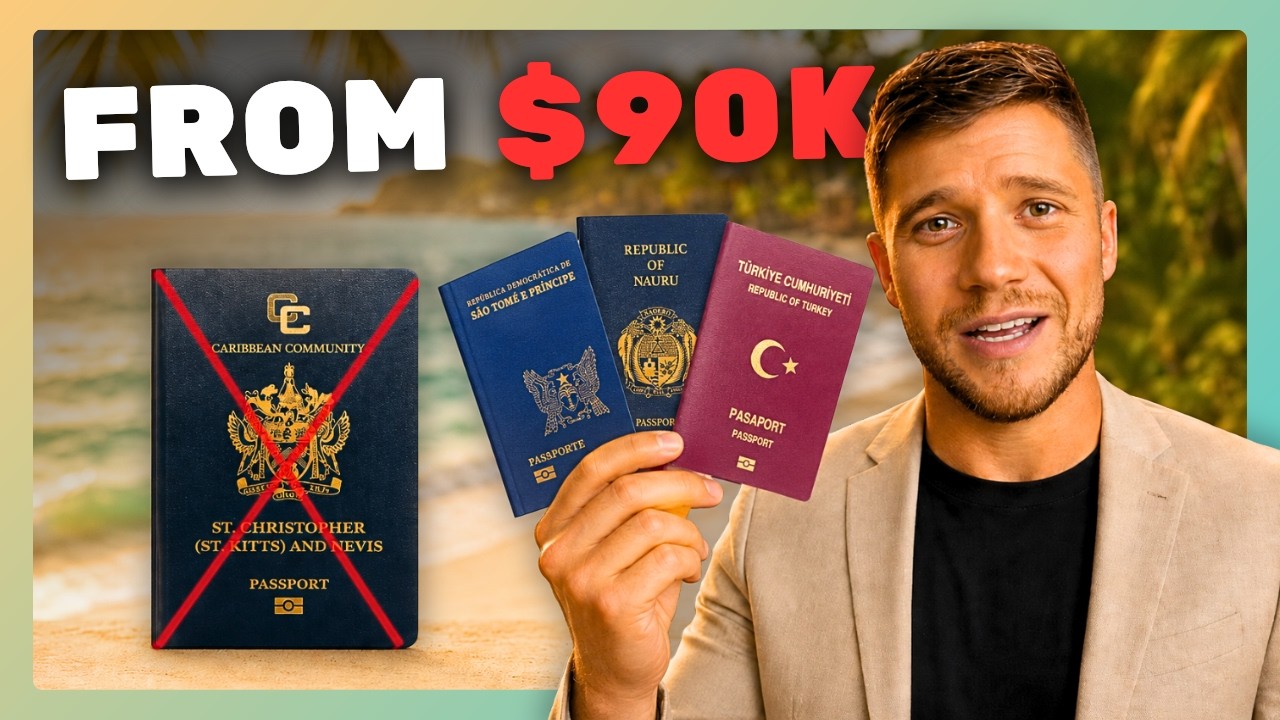
- São Tomé & Príncipe: $90,000 for a single applicant, around $95,000 for a family of four
- Nauru: in the same neighborhood
- Vanuatu: around $130,000
- Sierra Leone: around $140,000, or $100,000 with proven African descent, with ECOWAS access attached
- Turkey (asset-backed) and eventually Argentina: around half a million dollars
Line the sub-$150K options up against $200,000 to $250,000 in the Caribbean and the difference is $100,000 to $150,000 in savings. None of these are good travel documents. São Tomé reaches roughly 60 destinations; Nauru reaches neither Europe, the UK, the US, nor Canada. The buyers do not care, because they are not buying travel. They are buying the passport for the job it does. Our full ranking of the cheapest citizenships by investment compares these programs line by line.
The Outcome Nobody Is Discussing: The Caribbean Goes Its Own Way
Here is a potentially controversial thought. What if the Caribbean tells Brussels, Washington, and Ottawa to pound sand and governs citizenship by investment on its own terms?
Right now, the five countries price their programs, vet their applicants, and shape their rules substantially to please foreign capitals. They doubled prices a few years ago for exactly that reason, extended and strengthened due diligence, and are weighing residency requirements for new citizens. That is a leash. The moment they stop trying to appease the European Union, the leash is gone. Prices could fall back to competitive levels. Vetting could be set on sovereign terms. The programs could be governed as the sovereign instruments they are.
Yes, Schengen access would go, and that would sting. But a cheaper Caribbean citizenship, free of foreign pressure and priced for what it truly is, a base, a tax position, a family fallback in a region Americans can reach in a few hours, might serve the right buyer better than the Europe-dependent version sold today. Nobody in the industry is framing it that way yet. They should.
So, Is a Caribbean Passport Worth Buying in 2026?
If you are renouncing US citizenship: a Caribbean passport remains one of the strongest travel documents money can buy at this price point, and it is also the precise target Brussels is aiming at. Do not build a plan A on it alone. Pair it with a European residency you would enjoy using, and consider naturalizing there over time.
If you are retaining US citizenship: you already own the travel access. Buy São Tomé, Nauru, or Sierra Leone instead and pocket the $100,000+ difference. That is what a rational plan B, C, and D looks like in 2026.
If you want the Caribbean for the region itself: a base, low taxes, a life your family enjoys, then buy it clear-eyed, knowing the easy travel to Europe may not survive the decade. Also read our breakdown of the hidden costs of Caribbean citizenship by investment before you price any of the five programs.
Whatever you choose, choose it for what it does over 20, 50, and 100 years, not for what it does at the airport this year.
Where to Go from Here
If you are weighing several of these programs and not sure which fits, book a Freedom Consult: 60 minutes, your goals, your family structure, and your budget mapped against every program we track, with a written roadmap within 48 hours. If you already know your target and want a plain answer to a specific question, a free 15-minute call may be enough. Either way, we are program agnostic. We simply want the best fit for you and your family.
For the asset-backed alternative at the half-million level, read our Turkey citizenship by investment guide, and pair it with the 20-year foreign-income tax shelter Turkey passed in Law 7582.