
If you want a second citizenship and have no plan to move, Argentina made you an offer today: $350,000, with no residence requirement. That's $150,000 under the number the government floated for a year.
We think Argentina citizenship by investment is now the best value in the market for Americans who want a strong Plan B. Applications open in the fourth quarter of 2026. Argentina is also the second G20 country to sell citizenship, which tells you where this market is heading.
The Price Came in $150,000 Under What Argentina Floated
The pricing is the pleasant surprise in the official announcement.
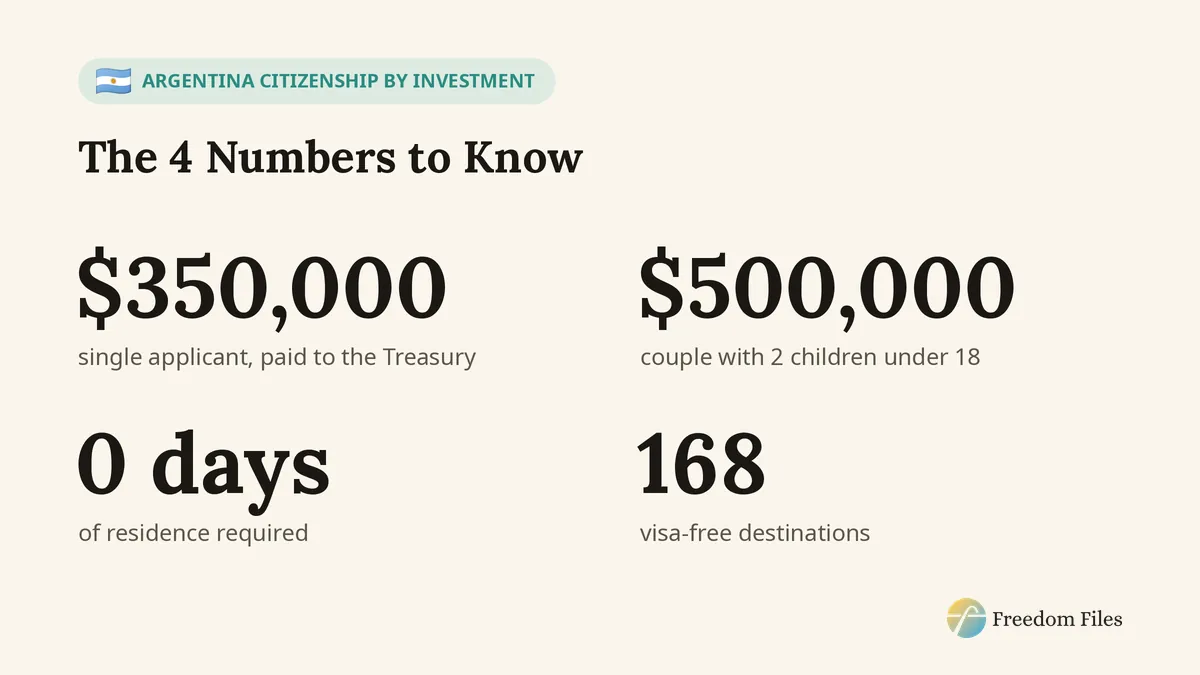
- Single applicant: A non-refundable $350,000 contribution to the Treasury buys citizenship, against the $500,000 the government floated in 2025.
- Bond route: You lend Argentina $800,000 through a zero-rate bond created for the program, so your principal comes back but earns nothing.
- Family of 4: A couple with 2 minor children pays $500,000 in total, because each child under 18 adds a family-friendly $25,000.
- Who counts as family: Same-sex spouses qualify on the same terms as any spouse, something most citizenship programs don't offer, and you can include unmarried children up to age 25.
- Zero residence: The announcement sets no residence requirement, and a law Congress passed in March says investor citizens don't become tax residents by naturalizing alone.
- Start date: Applications open in the fourth quarter of 2026, and the program is capped at 5,000 main applicants over 2 years.
$350,000 Buys More of the World than Any Caribbean Citizenship
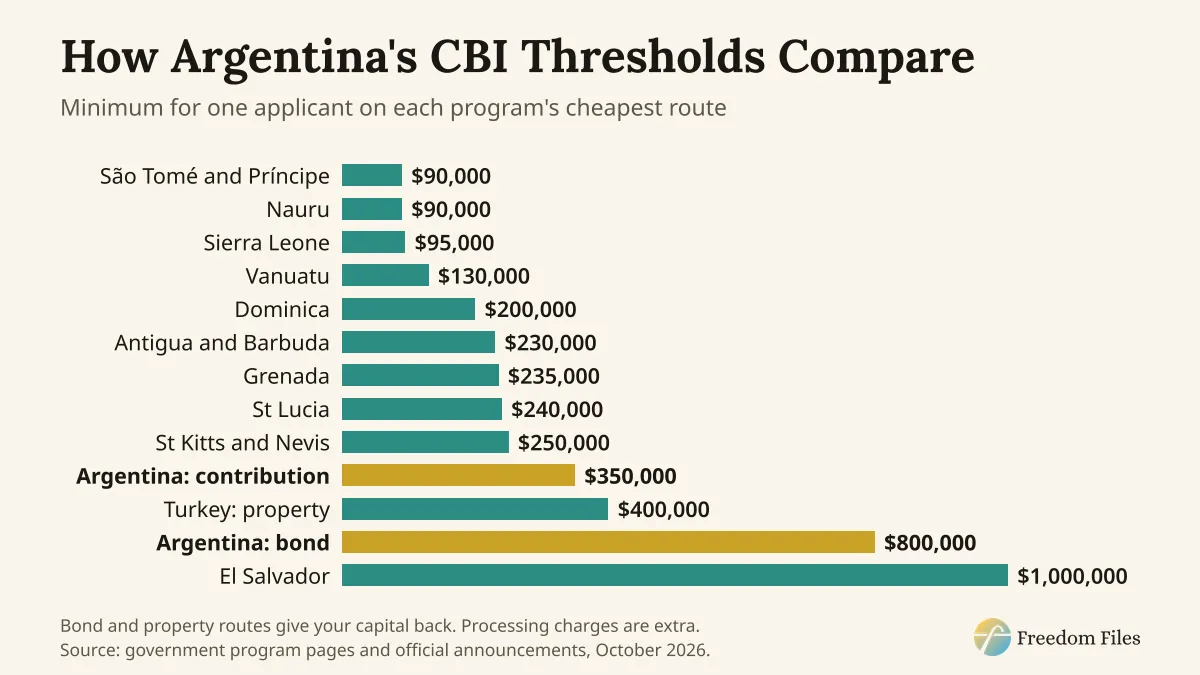
On value, this is the strongest offer in the market. The 5 Caribbean programs cost $200,000 to $250,000 for one applicant, and Turkey, the only other G20 seller, requires $400,000 in property. Argentina's price falls between them, but its travel document beats both.
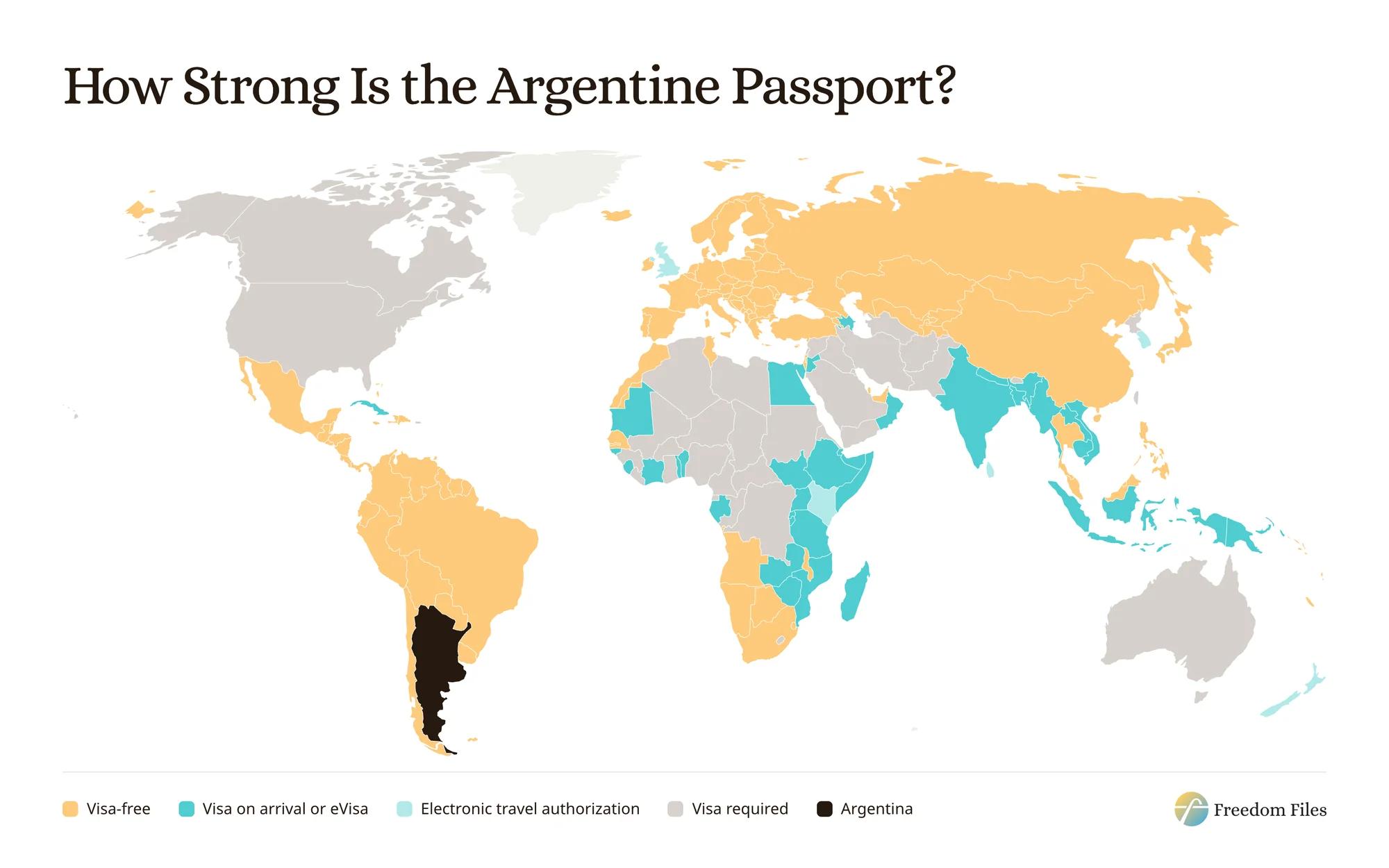
Argentine citizens enter 169 destinations without a prior visa, including the Schengen Area and Japan. Turkish citizens need a visa for Schengen, and Caribbean programs are adding residence rules to protect their access.
The part I'd underline is Mercosur. One citizenship gives you a simple route to residence across most of South America, a region that grows its own food and is far from the world's flashpoints. So it answers where you'd go if you had to leave home.
I like what it does to the market too. A G20 economy with published terms pushes every smaller program to justify its value, and every dollar raised comes from a buyer who chose to pay it.
How the Argentine Passport Compares with Other Citizenship Programs
Price is only half of the comparison. What you get for it comes down to 2 numbers: how many places you can visit without a visa, and how many other countries you could move to on the strength of the passport alone. Here's how Argentina compares with the programs Americans weigh most often.
| Citizenship | Visa-Free Destinations | Countries with Residency Rights | Through |
|---|---|---|---|
| Malta | 185 | 30 | EU and EEA free movement, plus Switzerland |
| Argentina | 169 | 8 | Mercosur Residence Agreement |
| St Kitts and Nevis | 157 | 5 | OECS free movement |
| El Salvador | 131 | 0 | CA-4 covers travel, not residence |
| Turkey | 112 | 0 | None |
| São Tomé and Príncipe | 59 | 1 | Portugal, through the CPLP mobility route |
Visa-free counts include visa on arrival and electronic travel authorizations. Residency rights count the other countries where the citizenship gives you a right, or a simplified legal path, to live there with no investment of its own.
Malta tops both columns, but it's a benchmark, not an option. The EU's top court ruled its citizenship by investment program unlawful in April 2025. Among the programs you can apply to today, Argentina is the only one that pairs a top-tier passport with residence rights across a whole region.
St Kitts and Nevis comes closest, with 157 destinations for $250,000, but its residence rights cover 5 small island states. El Salvador costs $1 million and Turkey $400,000 in property, and neither gives you the right to live anywhere else. São Tomé is the cheapest at $90,000, and its passport shows it.
Your Argentine Citizenship Opens Residency Across South America
You may have heard that Mercosur residency only kicks in 5 years after you naturalize. That rule exists, but it's Argentina's rule, and it covers naturalized citizens of other countries who want to move to Argentina. Once you're Argentine, you're on the other side of it.
Under the Mercosur Residence Agreement, an Argentine citizen can apply for a 2-year temporary residency in 8 other countries, then convert it to permanent residency. You show your citizenship, your civil records and a clean criminal record, with no investment and no income test. Here's how each country treats a naturalized Argentine, and how long you'd live there before you could naturalize again.
| Country | Naturalized Argentines Eligible for Residency | Residency Before Naturalization |
|---|---|---|
| Bolivia | ✅ | 3 years |
| Brazil | ✅ | 4 years |
| Chile | ✅ | 5 years |
| Colombia | ✅ | 7 years |
| Ecuador | ✅ | 5 years |
| Paraguay | ⚠️ (not confirmed yet) | 3 years |
| Peru | ⚠️ (not confirmed yet) | 5 years |
| Uruguay | ⚠️ (not confirmed yet) | 3 years if married, 5 years if single |
These are the standard timelines. Most of these countries shorten them if you marry a local or have a child born there.
In my view, this is what you're buying for $350,000. Not one country, but a legal path to live and work from the beaches of Brazil to the Andes in Chile and the coffee region of Colombia, with a second naturalization possible in as little as 3 years in Bolivia. No Caribbean citizenship comes close to that, and most buyers price it at zero because they've never heard of it.
Argentina Fits Americans Who Want a Plan B They'd Live In
Most citizenships for sale come from places their buyers never plan to live, but Americans move to Argentina by choice.
For one thing, Buenos Aires gives you a European lifestyle 1 to 2 hours ahead of New York, so your workday barely changes. A base in Lisbon or Bangkok puts you 5 to 12 hours out of sync with clients and family.
The best fit is an American who wants a second citizenship without relocating. Families fit too, because 2 children under 18 add only $50,000 to the bill, and so does anyone who wants a South American base in place before they need it.
It's a weaker fit in 2 cases. If you'd enjoy 2 years in Buenos Aires, the residence route leads to the same citizenship in 3 to 4 years, with no contribution. And if you want the right to live in Europe, or a smaller US tax bill, Argentina delivers neither.
On taxes, Argentina has gone out of its way for investor citizens. An Argentine citizen normally becomes liable for Argentine tax after just a few days in the country. For investor citizens, that only happens after 12 months. So you can legally spend a full year in Argentina without owing it tax, then leave for a few months before you return. As a US citizen, you'll owe the IRS on your worldwide income whichever citizenship you add.
Two Cautions Before You Buy Argentine Citizenship
Argentina is a fabulous place to live. It's also far enough from the world's flashpoints, and self-sufficient enough in food, to serve as a refuge in a global war. But 2 features deserve your attention before you wire anything.
You can never give it back. Article 16 of Decree 3213/84 makes Argentine nationality irrenunciable, and there's no declaration of renunciation. A naturalized citizenship ends only if a federal judge annuls it for fraud. Once you're Argentine, you're Argentine for life.
Argentina has taxed its citizens by nationality before. Law 27.605 of December 2020, the one-off wealth levy passed under a Peronist government, charged 3% to 5.25% on assets held abroad. It also treated Argentine nationals living in low-tax or uncooperative jurisdictions, from Guernsey to the Gulf, as residents for the levy. They were inside the net, with no exit.
Put together, a citizenship you can't shed, from a state that has used nationality as a tax hook within living memory, is a weaker refuge than it first appears.
For most investors, though, the risk is smaller than it sounds. Most people who buy this citizenship won't live in Argentina full time or put themselves under its rules, and let's be frank: Argentina's record of enforcing them on citizens abroad is thin. Weigh both cautions, but for a Plan B you don't plan to live in, they're unlikely to decide the question.
You Can Apply This Year, and We'd Pick the Contribution
Applications open this quarter, and the process is built for clean money. Every payment has to move through the formal financial system with proof of where your funds came from. The document list and the excluded nationalities are unpublished so far, so we'd prepare the source-of-funds file first.
The window is short, and it's capped. The consortium behind the program has a mandate for 2 years and 5,000 main applicants. We doubt Argentina, or any other G20 country, will offer citizenship at this price again, so we wouldn't wait for the second year.
On soundness, the vetting is the selling point. A new agency screens every file with the intelligence service and the financial crimes unit, which protects the reputation of the citizenship you're buying. The due diligence is on par with the established programs. The government hasn't said yet whether you'll give your biometrics in person, so we'd plan for 1 trip to Buenos Aires. Congress has already written the tax treatment into law.
Argentina's currency has wiped out savers more than once, so caution with assets there is healthy. But a citizenship is the one Argentine asset the peso can't devalue, and you pay for it once, in dollars.
The program itself was created by presidential decree, and the government is defending that decree in the courts. So we'd confirm where that case is before you wire a non-refundable contribution.
On speed, the decree gives Migraciones 30 business days to decide once the agency's report arrives, and the whole process is expected to take about 6 months. The residence route takes 3 to 4 years.
Between the 2 routes, we'd pay the contribution. The bond pays no interest, and on the 7-year term reported so far you'd give up about $340,000 that a US Treasury pays today.
If Argentine citizenship is on your list, contact us for licensed support before you wire anything. This article is general commentary, with no legal or tax advice in it.
The Caribbean Is Adding Residence Rules While Argentina Requires None
Other governments that sell citizenship are tightening the tie between buyer and country, and Brussels is the reason. My guess is that Brussels goes easier on a G20 trading partner than it does on small Caribbean nations.
| Country | Latest move | Our read |
|---|---|---|
| St Kitts and Nevis | January 2026: Announced mandatory physical presence for investor citizens | The oldest program in the market is moving toward residence |
| Antigua and Barbuda | July 2026: Bill tabled to raise required residence from 5 days to 30 | The direction is the same across the region |
| Turkey | The only other G20 country that sells citizenship, through a property purchase | Costs more than Argentina's contribution, and its citizens need a Schengen visa |
| El Salvador | The only other Latin American country outside the Caribbean that sells citizenship directly | Costs almost 3 times Argentina's contribution for a weaker travel document |
FAQ
Can Americans Get Argentine Citizenship by Investment?
Yes, once applications open in the fourth quarter of 2026. The US allows a second citizenship, but it taxes you on worldwide income whichever one you add.
Do You Have to Live in Argentina to Get Citizenship by Investment?
No. The announcement sets no residence requirement, though the government hasn't said yet whether you'll need 1 trip to give your biometrics. That's the main difference from the residence route and its 2 years in the country.
How Fast Is Argentina Citizenship by Investment?
About 6 months, including the vetting. That compares with 3 to 4 years on the residence route.
Does Argentine Citizenship by Investment Make You a Tax Resident?
No. A law passed in March 2026 says naturalizing through investment doesn't by that fact make you an Argentine tax resident. As an investor citizen, you only become one after 12 months in the country, so you can spend up to a year there without owing Argentine tax.
Can My Same-Sex Spouse Join My Argentina Citizenship Application?
Yes. Argentina recognizes same-sex marriage, so your spouse joins on the same terms as any spouse. You can also include unmarried children up to age 25.
Can You Get Argentine Citizenship Without Investing?
Yes. Live in Argentina as a legal resident for 2 years, then petition a federal judge. Plan on 3 to 4 years in total, and on Argentine tax residency while you live there.