
 Panama
In this article
If you want a second country you can move to, and a home there priced in US dollars, Panama just told you which home to buy. Under Panama's new golden visa rules, a new build bought from its developer qualifies you for residency at $300,000, but a resale home now needs $500,000.
Residency is the legal right to live in a country without being a citizen, and permanent residency means that right doesn't expire. It's also the first step toward a second citizenship, and Panama granted it to more investors and retirees from January to October 2026 than in any full year on record.
I think the Qualified Investor Visa is the route to take if you have the capital and want permanent residency on the fastest citizenship clock. If you want to build a business in Panama, the Friendly Nations Visa gets you in through your own company. Let me explain.
- New Builds at $300,000: A new home bought from its developer, finished or off-plan, makes you a permanent resident upon approval.
- Resale at $500,000: A home sold before, rented out, or lived in now needs $200,000 more to qualify you for the golden visa.
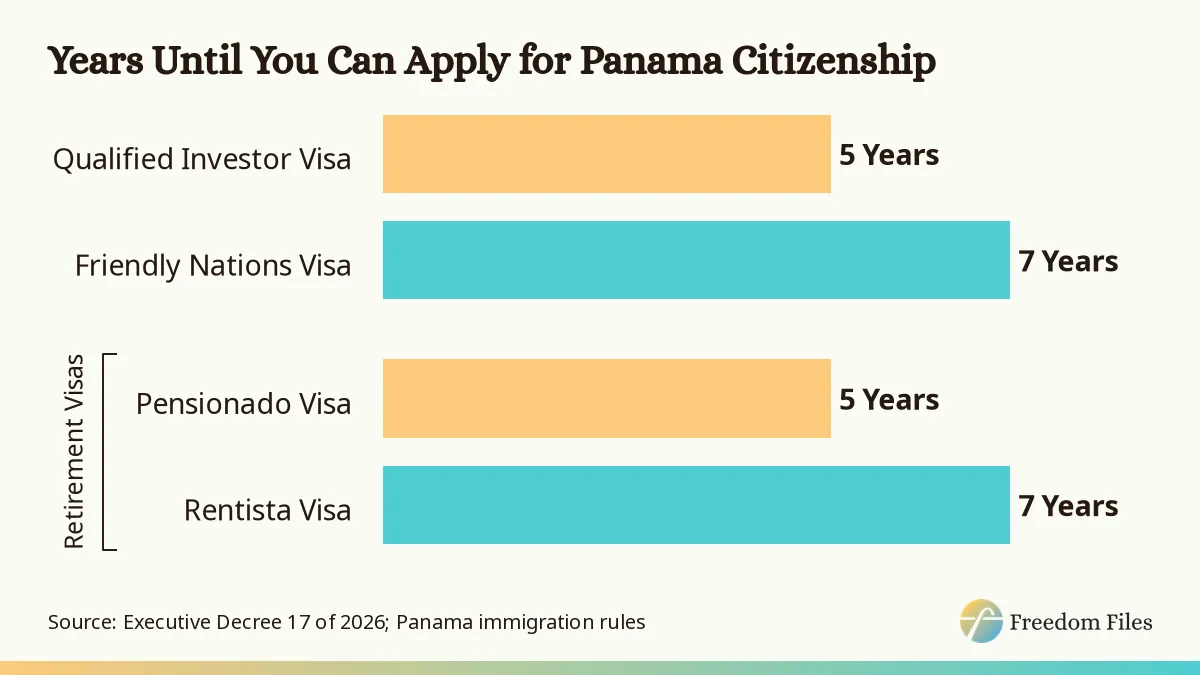
- Five Years to Citizenship: Qualified Investor Visa holders can apply for citizenship after five consecutive years of residency, two years sooner than Friendly Nations Visa holders.
- Record Approvals: Panama granted residency to 5,821 investors and retirees from January to October 2026, the most since its records began in 2010.
- Mid-March Deadline: If you signed a property contract in Panama before September 16, 2026, you have until about mid-March 2027 to file under the old $300,000 rule.
Approvals at a Record Pace
Panama is clearing residency files at a record pace, and that's the best news in this story for an investor. Panama's National Immigration Service (SNM) approved 5,821 permits on its investor and retiree routes from January to October 2026, past the full-year record of 5,776 set in 2024.
Most of that came after June. Approvals averaged 346 a month in the first half of the year and 936 a month from July to October, close to triple.
The obvious reading is that demand for Panama exploded in the summer of 2026. I, however, see an immigration service that cleared its desk: SNM credits the jump to how it processed approvals, and its tables count decisions on files, so they say little about new demand.
For you, the speed is the part that counts. A faster decision gets you from the wire transfer to a residency card in fewer months, and the golden visa grew fastest of the investment routes, with 420 approvals by October against 327 in all of 2025.
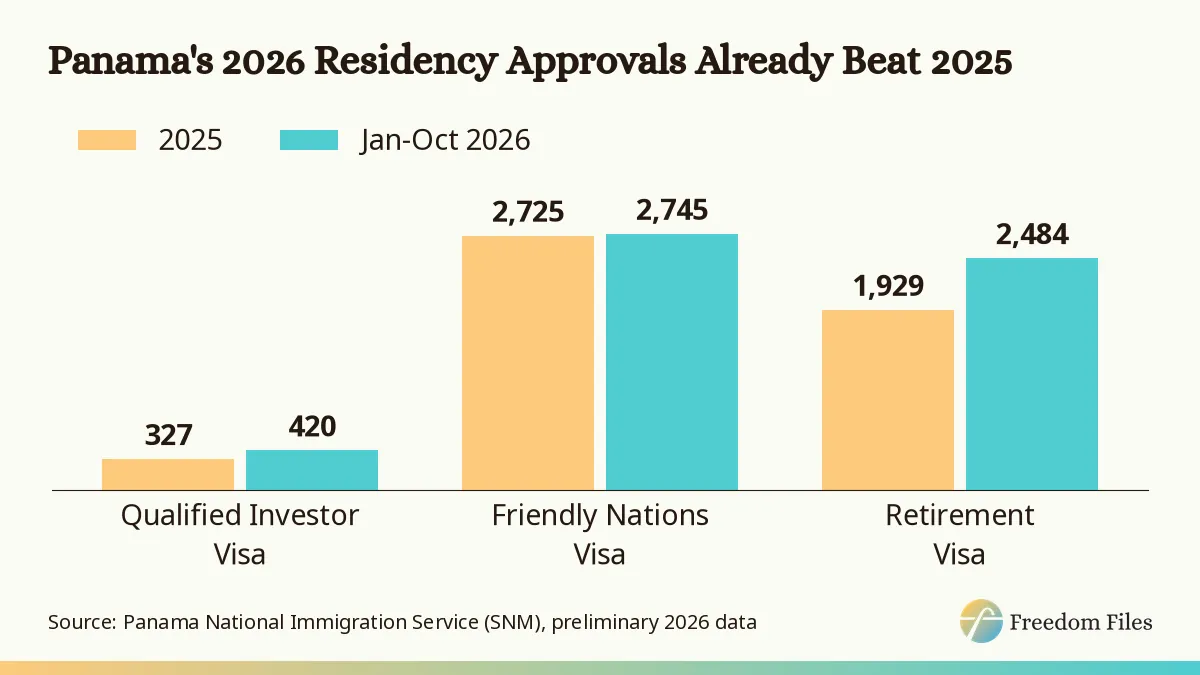
October alone brought 97 golden visa approvals, the program's best month in the 2026 tables. So if Panama is on your list, this is a good season to file.
The Qualified Investor Visa: Permanent from Day One
Panama is the most popular country in the Americas for our clients, and the Qualified Investor Visa is its fastest route to permanent residency. You become a permanent resident upon approval, about four months after you invest, with no temporary permit to renew or convert later.
The process asks little of your calendar. Our Panama team files your application for you, so you can start from home. Then you make one trip of about three days for your fingerprints, photo, and residency card.
After that, one entry every two years protects your residency. One investment also covers the family applying with you, including children up to 25 and dependent parents, with no added investment per person.
Panama Golden Visa Requirements after Decree 17
Panama's Decree 17 took effect in September 2026, replaced the 2020 rules, and gave property two prices. You qualify through one of five investments, made with your own money from abroad, and each one has to remain in place for five years. After that, you can sell the home or take back the securities or the money in the bank.
| Qualifying Investment | Minimum | Minimum Term |
|---|---|---|
| New home bought from its developer | $300,000 | Five years |
| Resale home | $500,000 | Five years |
| Registered Panamanian securities | $500,000 | Five years |
| Term account at a state bank (Banco Nacional or Caja de Ahorros) | $500,000 | Five years |
| Term account at a private bank | $750,000 | Five years |
Panama Learned from Europe's Golden Visas
The $200,000 gap between new and resale homes is the heart of the decree, and I think it's great policy. Panama learned from Europe, where golden visas that rewarded any home purchase took the blame for housing crises.
Portugal dropped property from its golden visa in 2023, and Spain closed its program in 2025. Golden visa buyers made up a relatively small share of home sales in both countries, but the optics of foreigners buying up homes hurt both programs.
Panama, however, points foreign money at new developments, which adds housing supply. Investors help the housing market there, which gives the program a better chance of lasting.
So I'd follow the incentive. A new unit bought from its developer gets you the lowest entry point and a modern building with a clean title.
Off-plan counts as well, through a bank trust or with full payment backed by a bank guarantee that pays out if the developer misses its deadlines. Residency on a pre-sale contract alone lasts up to three years, so the title has to register by then.
If you'd like to see the new buildings before you choose one, we're touring homes with one of Panama's most established developers on our Panama Plan B trip in March.
A Home Gives Your Citizenship Application Roots
Property does a second job on this route. Decree 17 opens citizenship to Qualified Investors and their dependents after five consecutive years of residency, and when you apply, Panama wants to see ties to the country.
A titled home in your name is about the clearest tie you can show. That's why I like the property route for most families: One purchase buys you permanent residency, a base in a dollar economy, a home you can rent out, and a stronger citizenship file.
If You Signed before September 16
Contracts and investments signed before Decree 17 took effect can use the old $300,000 rule for any home, resale included. File by about mid-March 2027, six months after the decree, or the new tiers apply.
Residents who qualified through Panama's older economic-solvency route (solvencia propia) also get 12 months to switch to the Qualified Investor Visa. That trade gets them direct permanent residency and the five-year citizenship clock.
The Friendly Nations Visa Suits Founders and Freelancers
It's also the way in for buyers with less capital, and it's open to citizens of about 50 countries, including the US and Canada.
Most of our clients qualify through self-employment, with no required investment. We set up your Panamanian company and file your work permit, and you employ yourself through the company.
The company needs substance, such as an office in Panama, and it has to do business year after year. Ideally, that means clients and income from abroad, which Panama's territorial tax leaves untaxed.
Treat it as a shell company and you'll pay for it. Starting in 2027, Panama's Law 526 taxes foreign passive income, such as dividends and interest, at 15% in companies without substance, and penalties can apply on top.
Done right, the company route is a plus for a founder: You come away with a Panamanian company and bank account, plus the legal right to work in Panama.
You can also qualify with property worth at least $200,000, and local bank financing can cover part of the price. A resale home qualifies here, which gives buyers priced out of the $500,000 resale tier a way in. A $200,000 three-year term account at a Panamanian bank works too.
To bring family, you also show income of at least $1,000 a month, plus $100 for each person applying with you.
The trade-off is time. You start with two years of provisional residency, a temporary permit, then convert to permanent residency on the same ties. You can apply for citizenship after five years of permanent residency, seven years in all.
Approval takes four to six months, with two trips to Panama: One for your bank account, fingerprints, and photo, and one for your residency card.
If you're weighing the company route, we'll talk about how Panama taxes both your personal income and your company's income on the Panama Plan B trip, and you can start your residency in a private meeting with our team while you're there.
The Retirement Visa Suits Pensioners
Panama's Retirement Visa suits you if you have Social Security or another pension paid for life. SNM approved 2,484 Pensionado permits from January to October 2026, already 29% more than in all of 2025.
On the Pensionado option, a lifetime pension of at least $1,000 a month makes you a permanent resident upon approval, with nothing to invest. The minimum drops to $750 a month if you own Panamanian property worth more than $100,000.
The Rentista option qualifies you on interest from a term account at a state bank, large enough to earn $850 a month. It starts with a temporary permit, so you can apply for citizenship after seven years, the same as on the Friendly Nations Visa.
Approval takes two to four months. Panama's retiree law also gives you discounts on flights and medical care. On the Pensionado option, you can apply for citizenship after five years of permanent residency.
Panama's Residency Routes Side by Side
Side by side, the choice comes down to how much capital you want to commit against how fast you want permanent residency and citizenship.
| Qualified Investor Visa | Friendly Nations Visa | Retirement Visa | |
|---|---|---|---|
| Minimum to Qualify | $300,000 new build | Your own company, or $200,000 | $1,000 a month pension |
| First Status | Permanent residency | Two-year provisional residency | Permanent residency (Pensionado), temporary permit (Rentista) |
| Time to Approval | About four months | Four to six months | Two to four months |
| Apply for Citizenship | After five years | After seven years | After five years (Pensionado), seven (Rentista) |
| Presence Required | One entry every two years | One entry every two years | One entry every two years |
Two Years Faster to Citizenship
New-build buyers barely notice Decree 17, but it shuts resale buyers under $500,000 out of the golden visa. If you had your eye on a $350,000 resale condo, it now qualifies you for the Friendly Nations Visa.
Take a couple who buys a $300,000 two-bedroom new build in Panama City from its developer. They're permanent residents about four months after they invest, and five years later they can apply for citizenship.
The same couple on the Friendly Nations property route needs $100,000 less, but they wait two years for permanent residency and two more years for citizenship. If citizenship is part of your plan, the extra $100,000 buys you two years on the clock, and it goes into a home you own and can sell after five years.
Panama is hard to judge from a screen, so we're taking a small group to Panama City in March to tour homes and learn how Panama taxes your personal income and your company's income.
If you plan to buy in Panama or start a company there, contact us for licensed support before you sign anything. This article is general commentary and contains no legal or tax advice.
FAQ
What Is the Panama Golden Visa?
It's the common name for Panama's Qualified Investor Visa. A qualifying investment, starting with a $300,000 new home from its developer, makes you a permanent resident upon approval.
What Are the Panama Golden Visa Requirements in 2027?
You need a qualifying investment made with your own traceable money from abroad, in place for five years. A new home from its developer qualifies at $300,000, resale homes and securities at $500,000, and bank term accounts at $500,000 or $750,000.
Can I Buy a Resale Home for Panama Residency?
Yes. For the golden visa, a resale home needs $500,000, but a resale home worth $200,000 or more qualifies you for the Friendly Nations Visa.
What Are the Friendly Nations Visa Requirements?
You need citizenship from one of about 50 listed countries, the US included, and a qualifying tie: Your own Panamanian company with substance, $200,000 in property, or a $200,000 three-year term account.
What Are Panama's Residency Requirements for US Citizens?
Americans qualify for all three main routes: The golden visa from a $300,000 new build, the Friendly Nations Visa, and the Retirement Visa with a lifetime pension of at least $1,000 a month.
Can I Get Panama Residency without Investing?
Yes. The Friendly Nations Visa's self-employment route has no minimum investment, and the Retirement Visa asks for a lifetime pension of at least $1,000 a month.
How Long Does It Take to Get Panama Citizenship?
Five years after a Qualified Investor Visa or a Pensionado approval, since both start as permanent residency. On the Friendly Nations Visa and the Rentista option, it's seven years, because a temporary permit comes first.
Do You Have to Live in Panama to Maintain Residency?
No. On all three routes, one entry every two years protects your residency. Citizenship is separate, so plan on more time in Panama if it's part of your goal.
Does Panama Tax Foreign Income?
No. Panama taxes only income earned in Panama, so a pension, dividends, or business income from abroad falls outside its tax, even once you become a tax resident after 183 days.
 Costa Rica
 Colombia

 Spain

 Portugal
 France