
 Spain
In this article
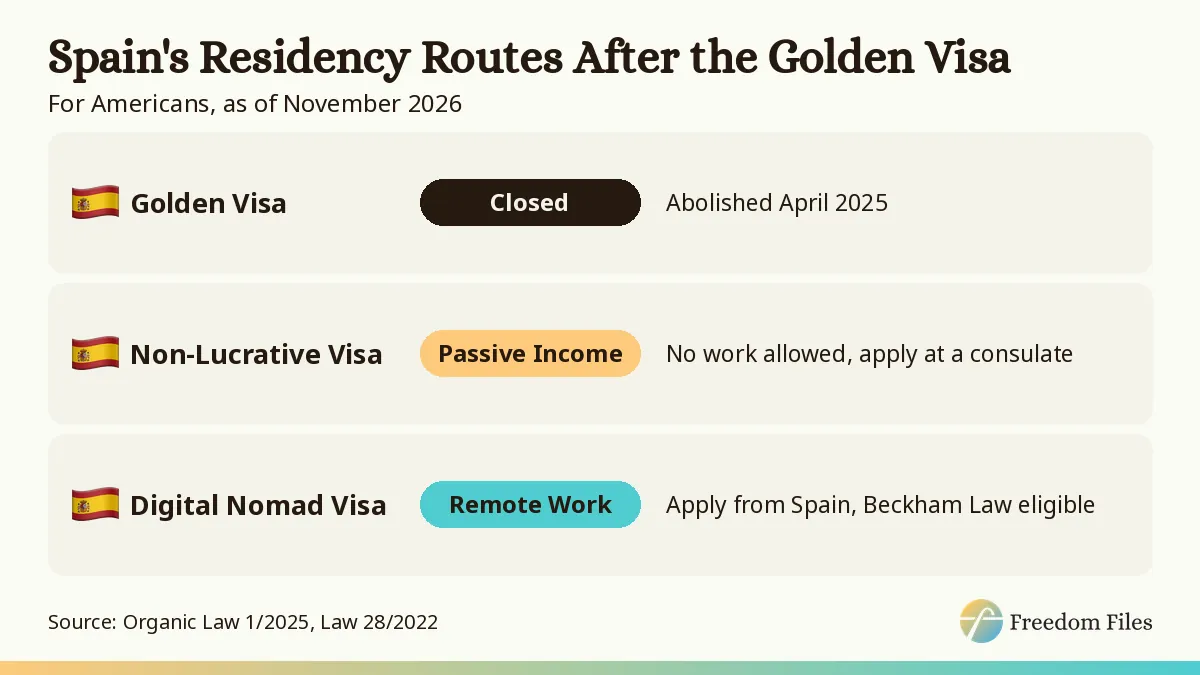
If you hoped a home in Spain would bring residency, that door closed in April 2025. To move to Spain today, you need one of two visas, and both put you on a 10-year road to citizenship.
My wife and I have spent what adds up to years in Spain, and our clients love its healthcare and its pace of life. I think that life is worth it, but Spain's taxes are punitive unless you move with a tax plan in place. Let me explain.
Two Visas Replace the Golden Visa
- Passive income: The Non-Lucrative Visa needs about €28,800 a year in income or savings, but you can't work, even remotely for a US employer.
- Remote work: The Digital Nomad Visa needs about €2,850 a month from employers or clients outside Spain.
- Citizenship: Most Americans wait 10 years, but anyone who has been a citizen of a Latin American country or the Philippines since birth qualifies after two.
- Taxes: Spain taxes residents' salaries at up to 47% in most regions and investment income at up to 30%, but the Beckham Law cuts foreign investment income to 0% for six years if you move for work.
Spain Gave Away Its Best Investor Route
For 12 years, €500,000 of Spanish property bought you residency. The government killed the program in 2025 to cool housing prices, though golden visa purchases made up less than 2% of property sales by its own figures. Rich foreign buyers made an easy scapegoat.
So if you want a tangible asset and European residency together, Greece and Cyprus now do what Spain used to do, as our guide to European golden visas through property shows.
The Non-Lucrative Visa Suits Passive Income
Non-lucrative is Spain's way of saying you won't earn a living there. You show 400% of Spain's public income index, about €28,800 a year in 2026, plus about €7,200 for each family member. Social Security, pensions, dividends, rent, and Individual Retirement Account (IRA) and 401(k) distributions all count, and savings work too.
The catch: Remote work for a US employer counts as work and can sink a renewal after you've moved. Spain also pairs this visa with no tax break, while Italy and Greece both offer a 7% flat tax to retirees, as our European special tax regimes breakdown shows.
Remote Workers Get the Better Visa
The Digital Nomad Visa is the stronger of the two, because it opens the Beckham Law and lets you apply from inside Spain. It needs about €2,850 a month in gross income, 200% of Spain's minimum wage, plus 75% of that wage for a spouse and 25% for each child. Remote employees qualify, and freelancers can earn up to 20% from Spanish clients.
Apply from inside Spain if you can. A consulate grants up to one year, but a tourist who applies in Spain gets up to three. The immigration office has 20 days to decide, and silence means approval.
Freelancers pay a hidden cost: They must register as self-employed and pay Spanish social security every month. US employees can skip it with a US certificate of coverage, but Social Security has gone back and forth on issuing those, so secure yours first.
Ten Years to Spanish Citizenship
Both visas lead to permanent residency at year five, if you spend most of those years in Spain: No more than six months out at a time, or 10 months in total. A summer at the lake plus Christmas with the kids can burn through that in a couple of years.
Citizenship opens at year 10, after an A2 Spanish exam and a test on Spain's constitution and culture. The prize is the right to live and bank across the European Union (EU). On paper, Spain asks you to renounce US citizenship, but it doesn't enforce that rule.
If a parent was born in Mexico, you may already be Mexican by descent, and that puts you on Spain's two-year clock.
Spain Taxes Residents Hard
Spend more than 183 days in Spain, or base your family there, and Spain taxes your worldwide income. Shakira learned this in Barcelona and settled for millions of euros.
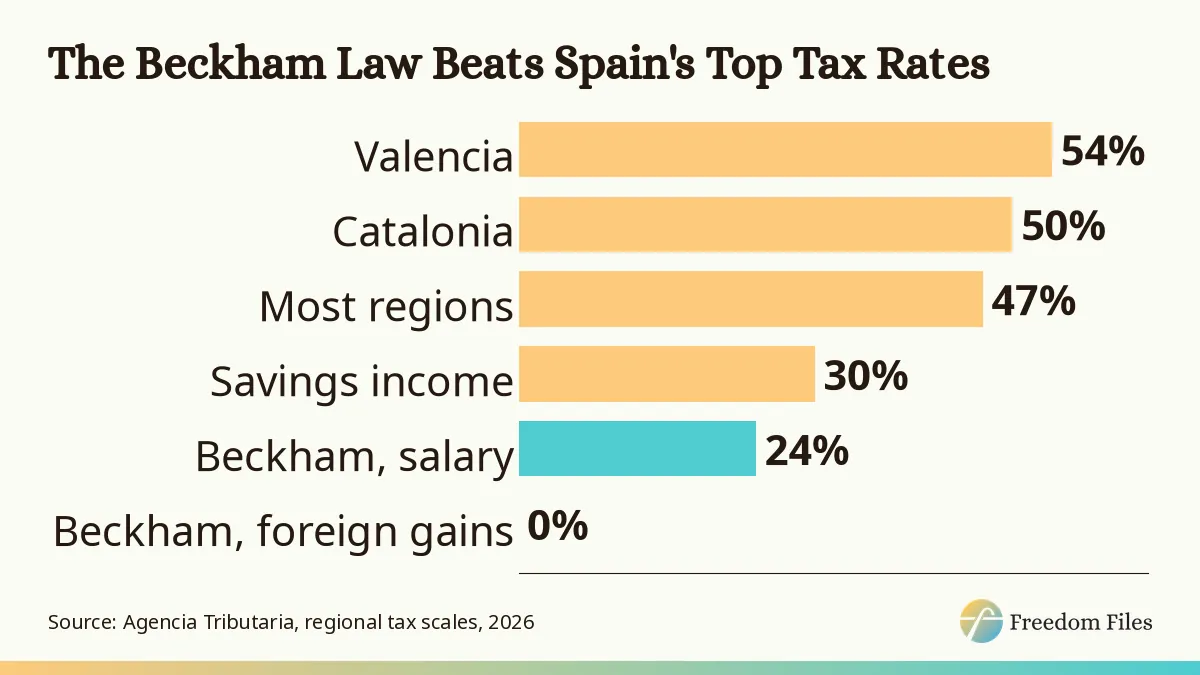
Top rates on salary and pensions reach 47% in most regions, about 50% in Catalonia, and close to 54% in Valencia. Most regions add a wealth tax on worldwide net assets, and the Modelo 720 report covers every foreign account above €50,000.
The Beckham Law Changes the Picture
The flat 24% on salary saves many Americans little. The prize is six years of 0% Spanish tax on foreign dividends, interest, and capital gains, with no wealth tax on foreign assets, so Spain adds nothing to your US bill on that income.
Remote employees qualify if they weren't Spanish tax residents in the past five years and elect within six months of starting work. Freelancers usually don't qualify, and the Non-Lucrative Visa never does. In year seven, full Spanish rates return all at once.
Madrid's Mbappé Law works without a job. New Madrid tax residents deduct 20% of what they invest in shares and bonds from Madrid's share of their income tax. Madrid and Andalucía also credit 100% of regional wealth tax, but the national solidarity tax of 1.7% to 3.5% hits net worth above €3 million in every region.
The US-Spain tax treaty means you pay the higher of the two bills on each dollar, never both. Spain leaves US government pensions alone until you become a Spanish citizen, but it taxes IRA and 401(k) distributions and Social Security, a reading of the treaty several respected firms dispute.
The Freedom Files works with local licensed teams in the US and Spain, and you reach them through us. Contact us for licensed support before you apply for either visa, since the Beckham Law election closes six months after you start work. This article is general commentary and contains no legal or tax advice.
FAQ
Does Spain Have a Golden Visa in 2026?
No. Spain abolished its Golden Visa in April 2025, so buying property no longer leads to residency. Greece and Cyprus offer property-based residency for Americans who want a tangible asset.
How Much Income Do You Need for Spain's Non-Lucrative Visa?
About €28,800 a year in 2026, plus about €7,200 for each family member. Consulates prefer a cushion above that minimum.
Can Americans Work Remotely on Spain's Non-Lucrative Visa?
No. Remote work for a US employer counts as work and can cost you your renewal. Remote workers need the Digital Nomad Visa.
How Long Does Spanish Citizenship Take for Americans?
Ten years of legal residence, plus about a year of processing. Americans who have been citizens of a Latin American country or the Philippines since birth, often through a parent born there, may qualify after two years.
Does the Beckham Law Apply to Retirees?
No. It covers people who move to Spain for work, such as remote employees on the Digital Nomad Visa. Retirees in Madrid can use the Mbappé Law's 20% investment deduction.
Video Transcript
Click to read the full transcript
Video Transcript
Click to read the full transcript
Spain killed its golden visa, so a home there is not going to buy you residency anymore. Only two visas are left, and I've spent what adds up to years in Spain. You'll learn how both visas work, who each fits, and the 10-year road to a Spanish passport. Then the taxes, over 50% in some regions of Spain, and the regime that charges 0% on your investment income from abroad. Let's get into it.
Most of you know the postcard, right? Late dinners in the plaza, the coastline, the tapas, the Tempranillo, the flamenco, what have you. But I want to talk about first why Spain in the first place.
Number one, the first practical reason to move to Spain is mobility. Your US passport gets you 90 days in Europe out of every 180. That's the Schengen shot clock. And it doesn't work if you want more than half the year somewhere in Europe. Once you're a Spanish resident, that count no longer applies to Spain, though. You can live there all year round and save your 90 days for Paris, Rome, or the Greek islands. Madrid and Barcelona fly direct to New York, Miami, Chicago, Dallas, and Los Angeles. And the high-speed train gets you from Madrid to Valencia in about 2 hours, and Barcelona or Sevilla in about 2 and 1/2.
Number two is healthcare. Spain's system ranks among the best in the world, and private coverage for a healthy couple in their 50s costs a few hundred a month. Many American families pay that much in a single week for a single person.
Number three, you won't be the first American on your block, most likely. Madrid, Barcelona, Valencia, Málaga, Alicante, all of these cities have big expat communities, English-speaking lawyers and doctors, and international schools if you're moving with your kids. That can be a huge plus, or a thorn in your side too if you want to be left alone. My advice to every client is if you plan to make Spain home, learn the language. Locals respect the effort, daily life gets easier, and it pays off at the citizenship stage because you have to take an exam. Have you lived inside an expat bubble abroad? I want to know in the comments if that's the kind of lifestyle you guys are looking for.
My wife and I have spent what adds up to years in Spain, as I mentioned before, because every time we're in Europe, we end up there. Madrid, Barcelona, Sevilla, Córdoba, Granada, Málaga, Marbella. We've loved every trip there. And Andalucía is probably the most beautiful part of the country. It's my personal favorite. I'll take some flak for this, but I love Spanish food. Paella with that mix of beef, ham, and seafood, and the rest of the cuisine. I'm a big fan. I know that's going to piss some people off, but I love it.
Now, Spain is not perfect. Our Expat Almanac on freedomfiles.co scores the top destinations for Americans across 10 different measures. Spain scores well, but Malta, Italy, and Greece all rank above it. Two things pull it down. Those are taxes and bureaucracy. The Spanish government can make the slowest American DMV look like a Ferrari pit crew. That's one reason people hire help throughout the process. And we'll talk about taxes later in this video, so you have some relief there.
Now remember, the Golden Visa is gone. From 2013 to 2025, Spain gave residency to anyone who bought €500,000 of Spanish property. That was the Golden Visa. And for over a decade, it was one of the most popular investor programs in Europe. Then Pedro Sánchez's government abolished it in 2025, blaming housing prices, despite its own figures showing Golden Visa purchases made up less than 2% of real estate sales in Spain. It was an easy scapegoat, though: rich foreigners buying property, of course. So, as of today, a Spanish property purchase gets you no residency card. You can still buy a home, of course, but you're not going to get residency because of it. If someone tells you otherwise, that's outdated information.
And Spain isn't alone. Portugal closed its property route in 2023. So if a tangible asset plus residency is your lane, Greece starts around €250,000, Cyprus at €300,000, and Malta's permanent residence program works through a property lease or purchase, plus a government contribution. Those countries do what Spain used to do, which is valuable if you want something you can own for an investment in Europe. For everyone else, residency in Spain comes down now to two visas: the non-lucrative visa if you live on passive income, and the digital nomad visa if you work remotely.
If you're weighing Spain against other countries, head on over to freedomfiles.co/consult. Take the Plan B Blueprint at the link. It's 10 quick questions, about 90 seconds, and you get a custom report and match on the residency and citizenship routes that fit your money, your timeline, your family, your goals. If you already know Spain is your pick, you can book a call with us on that same page.
Now, route one, the non-lucrative visa, for people who live on passive income or savings. As of November 2026, it needs about €34,000 a year in passive income or savings, plus €8,400 for each family member. So a couple should plan on about €42,400 a year, and a couple with one child about €50,800. Generally, we recommend more, but that's the bare minimum. Now, what counts? Social Security, pensions, regular IRA and 401(k) distributions, dividends, rental income, annuities, all passive income. So if your income is lumpy, savings works too. You show the full year's amount in the bank, and consulates like a cushion above the minimum, like I said. And also, if the money is spread across different accounts, we typically recommend marinating it in one account for a few months before you apply, because without months of statements showing the full amount, we could expect a rejection. Start about 6 months before you move and you'll have the time to do this.
Non-lucrative is the Spanish way of saying you won't earn a living in Spain. This is the route for people who fund their life from abroad. Many of our clients winding down a career pick it, but it fits a sabbatical too. It fits retirees, but it's not only for retirees. The big trade-off here is, again, that you cannot work. That includes remote work for a US employer and consulting for US clients. If active income shows up in your file, you can expect, again, a denied renewal after you've already moved to Spain. And since the digital nomad visa is the only Spanish visa you can apply for from within the country, switching to work later means a fresh application at the consulate.
Now the process. You file with the Freedom Files at the Spanish consulate that covers your US state. We assemble your apostilled FBI background check, a medical certificate, your proof of income, a notarized letter promising you won't work, and private health insurance from a Spanish insurer. Every consulate has its own preferences, as you may know from our videos, so presentation alone decides a lot. Plan on three to five months from the first document you gather to, finally, your residency card.
Now, once you're approved, you enter Spain. You register with your town hall, and you apply for your TIE, your foreign resident ID card, within your first month. The first permit lasts one year, and then you renew for 2 years, and again for two more. Each renewal checks that same income or savings that you qualified for in your first year, and it looks at your time in Spain as well. You have to be physically present.
This visa comes with no tax break, unfortunately. Italy's elective residency, on the other hand, pairs with a 7% flat tax in small southern towns, and Greece's FIP visa pairs with a 7% regime anywhere in the country. Both are valuable for passive income. Spain has nothing like that. And I'll point you to a full breakdown of those 7% regimes at the end of this video.
Now, residency route two is the digital nomad visa, for people who earn from remote work. If that's you, the non-lucrative visa will turn you down, and this one is built exactly for you. As of 2026, it needs about €2,500 a month in gross income from remote work. Add €916, sorry for the specificity, for your spouse. So a couple needs about €3,400 a month, plus about €300 for each child. Now, this is not an investment, remember. You just have to prove you have that income coming in.
Who qualifies? A remote employee of a company outside of Spain, or a freelancer whose clients are mostly outside of Spain. Freelancers can earn up to 20% from Spanish clients, but no more. Your employer needs at least one year in business, and you need at least 3 months with them, plus a university degree or three years of professional experience. So that's the qualifications.
But there are two ways to apply, and I mentioned this earlier. At your consulate, you get a visa of up to one year, and again, the Freedom Files can help you there. Or if you're already in Spain legally, say as a tourist, you apply from inside the country and get a permit of up to 3 years. Again, we can help you there too. By law, Spain's immigration office has 20 days to decide, and if it doesn't answer, your permit is automatically approved. After that, you renew for 2 years at a time, and at year five, you apply for permanent residency, same as on the non-lucrative visa schedule.
Now, the fine print. If you freelance, the US-Spain social security agreement puts you in Spain's system. So you must register as self-employed, an autónomo, and pay Spanish social security every month. Employees of a US company are a little different. With a US certificate of coverage, you can pay FICA in the US only and skip Spanish social security altogether. Social Security, gosh, this is hard to say, has gone back and forth on issuing those certificates to remote workers, and by the time you see this video, there may be news. So structure this work with our tax partners before you apply. And if you lose your employer or your clients, or your income drops below the minimum, your permit's going to be at risk. So make sure to keep that up.
The upside here is that as a remote employee on this visa, you can also elect Spain's Beckham Law special tax regime, the regime behind the 0% I teased at the top. We'll talk about that in the tax section later.
So here's your options. If you live on passive income and will not work while you're in Spain, the non-lucrative visa. If you work remotely for a company abroad, the digital nomad visa. If you wanted a property-backed residency, Greece, Cyprus, or Malta fit your situation better. And if taxes on passive income top your list, watch the tax section closely before you pick Spain at all, because we've got news on that.
Now, both of these visas are temporary residency, and both lead to the same place at year 5, which is long-term residency, or permanent residency. To qualify, you need 5 years of legal continuous residence. You can't spend more than 6 months out of Spain at a time, and no more than 10 months in total across those 5 years. That's tighter than most Americans expect, right? A summer at the lake house plus Christmas with the kids can burn through it in a couple of years. So commit to Spain only if you can renew on time and show the presence over that period.
If permanent residency, then citizenship, are the goal, then the citizenship clock: for an American, Spanish naturalization opens after 10 years of legal continuous residence. Portugal and Italy also make you wait 10. Greece takes seven, and France five. Spain is on the long end, but it has nowhere near Portugal's immigration backlog. It makes me laugh, honestly, because it's now averaging about 40 months from application to approval.
A Spanish passport gives you the right to live, to work, to study, to get healthcare, to bank, and invest across all 27 EU countries, plus visa-free travel to most of the planet, which is why we rank Spanish citizenship so highly. At year 10, you need a clean record, proof of integration into Spanish society, the A2 Spanish exam, and a 25-question test on Spain's constitution and culture. But after 10 years, I hope this is pretty easy. Then plan on about a year for the government to process your application.
You may read that Spain does not permit dual citizenship. On paper, Spain requires you to renounce your US citizenship. In practice, though, that prohibition is not really enforced. None of this is legal advice, of course, so confirm with Spanish legal counsel before you act. If you need help with that, we can offer it, of course.
Now, what about citizenship by descent? For most Americans, that path is closed. Spain's Democratic Memory Law let grandchildren of Spaniards apply directly for citizenship by descent, and that window shut in October of 2025. Today you need a parent who was born in Spain, and if you read somewhere that a Spanish grandparent works, it's outdated information.
Now, you may have heard some people get Spanish citizenship in just 2 years. That is correct. Spain cuts the wait to just 2 years for nationals of origin of Ibero-American countries, so most of Latin America, plus Andorra, the Philippines, Equatorial Guinea, and Portugal. People of Sephardic Jewish origin too. The key words here, and why I emphasized "of origin," are just that: you were a citizen of that country from birth, either because you were born there or because you inherited that citizenship by descent. So if you naturalized in Colombia after 5 years of marriage, Spain will not grant you citizenship after 2 years of residency when you move there. Maybe your wife, if she's Colombian, can claim citizenship in Spain after two years of residency, and you can claim it after one year of marriage to a citizen of Spain, but that's a whole other story. The same goes for a passport you buy through, let's say, Argentina's new citizenship by investment program, or El Salvador's citizenship by investment program. So can you buy your way into the fast track? No. But if your mother or father was born in Mexico, or anywhere else in Latin America, or the Philippines, you may already be a citizen of origin by descent. Mexican citizenship by descent is one of the most popular programs we handle, and it puts Spain on a 2-year clock. And we screen this for every Spain Freedom Consult we do.
All right. Taxes. Now, I'm not a tax adviser. I'm not a financial adviser. But we work with licensed tax advisors in the US and in Spain, and in more than 40 countries around the world.
Now, number one, the bad news: what you'd pay with no treaty and no special regime. Spain makes you a tax resident when you spend more than 183 days there in a calendar year, or when your main economic interests are there. Spain also presumes you're a resident when your spouse and minor children live there. Shakira found that out the hard way. She spent less than half the year in Spain, but prosecutors pointed to her home and her kids in Barcelona, and she settled for millions of euros. The same rule applies today, and both visas push you past that tax residency threshold. So if you move on either one, plan on tax residency, at least in your second year if you plan the first year correctly.
Once you're resident, Spain taxes your worldwide income. And as of 2026, salary, pensions, and retirement income climb to 47% in most regions, about 50% in Catalonia, where Barcelona is, and close to 54% in Valencia. When I said 52% in our last Spain video, a lot of you told me that was nonsense. Fair. That's the highest. That's the top rate on your highest dollars of income, and most people pay less on average. Investment income like dividends and capital gains pays 19 to 30%. Then there's wealth tax. Yes, Spain has a wealth tax, which most regions charge on your worldwide net assets, and a national solidarity tax in addition to that above €3 million of net worth, plus a report called the Modelo 720 on every foreign account and asset above €50,000. One word: punitive.
Number two, the Beckham Law special tax regime, named after the footballer who made it famous. Most people quote the flat 24% on your salary up to €600,000. For many Americans, 24% is no discount at all. The big draw is the other half of the equation. Your foreign dividends, your interest, and capital gains are taxed at 0% in Spain. You pay no Spanish wealth tax on your foreign assets, and you skip the Modelo 720 for 6 years. So it's not the longest special tax regime, but for 6 years, it can be pretty significant for an American. That means Spain adds nothing on top of your US bill on that investment income. So to qualify, you can't have been a Spanish tax resident in the five years before you move, and you elect within 6 months of starting work in Spain. So miss that date, and the option is gone. Remote employees of a foreign company qualify. Freelancers usually don't, and non-lucrative holders definitely do not, because the regime is for people who move for work. The con, however, is the exit, and I just mentioned this: in year seven, full Spanish rates arrive all at once, the wealth tax included.
Number three is something most people don't talk about, and that is the Mbappé Law, a newer regime that Madrid specifically built for investors. If you become a Madrid tax resident, only in Madrid, after 5 years outside of Spain, you deduct 20% of what you invest from Madrid's share of your income tax. Okay? Qualifying assets are shares and bonds, listed or private, and they don't have to be in Madrid. Real estate doesn't count, and neither does a company you control or manage. You have to remain a Madrid resident and leave the investments in place for six years. Just like the Beckham Law, it touches only the regional half of your bill, but this one doesn't need a job, so it works for a non-lucrative visa holder as well.
Number four, where you live, because Spain's regions set a big share of your bill. We typically point to Valencia and Catalonia as the most punitive. Madrid and Andalucía are at the other end of the spectrum, because both give a 100% credit on regional wealth tax. Currently, wealth tax in Catalonia starts on net worth above €500,000, and in Valencia the top rate is 3.5% a year. In Madrid or Andalucía, it's zero up to €3 million. Above €3 million, the national solidarity tax applies in every region, Madrid and Andalucía included, at 1.7% to 3.5%. Many of our clients are way above that line. And this is where the planning and global Plan B strategy really earns its keep, through our Private Client Engagement across residency, citizenship, banking, trusts, tax, asset protection, you name it.
Number five is the treaty: what Spain taxes and what it doesn't, if you're a US citizen. The US and Spain signed it back in 1990 and updated it again in 2019. You never pay full tax twice on the same dollar you're earning in the United States. So you pay the higher of the two bills. Say Spain charges 30% on a dollar and the US charges 22%. You pay Spain 30%, it credits against your US 22%, and the IRS gets nothing more. Your total is 30%.
Federal, military, and state government pensions: Spain doesn't tax them while you're not a Spanish citizen. Private pensions, IRA and 401(k) distributions: Spain does tax them. Roth IRA: Spain doesn't necessarily recognize it, so assume Spain taxes those withdrawals until counsel tells you otherwise in writing. And Social Security is the one people argue about. Spain's tax agency taxes it, with a credit for US tax, and several respected firms read the treaty the other way. On a $60,000-a-year benefit, that disagreement is worth several thousand a year, every year. So you have until your first Spanish return to really settle it and get a written position for it.
If Spain's your pick, our Spain country page is over at freedomfiles.co/spain, and the link is in the description. You can also go to freedomfiles.co/consult and get a free 60-minute consult with yours truly. And if Spain's bill on passive income has you looking around, watch my breakdown of all 15 special tax regimes in Europe next. It shows who qualifies, what you pay, and both 7% regimes built for retirement income in Italy and Greece. It's on your screen now. Thanks so much for watching, and talk to you soon.



 Portugal



 France

 Greece


 Italy