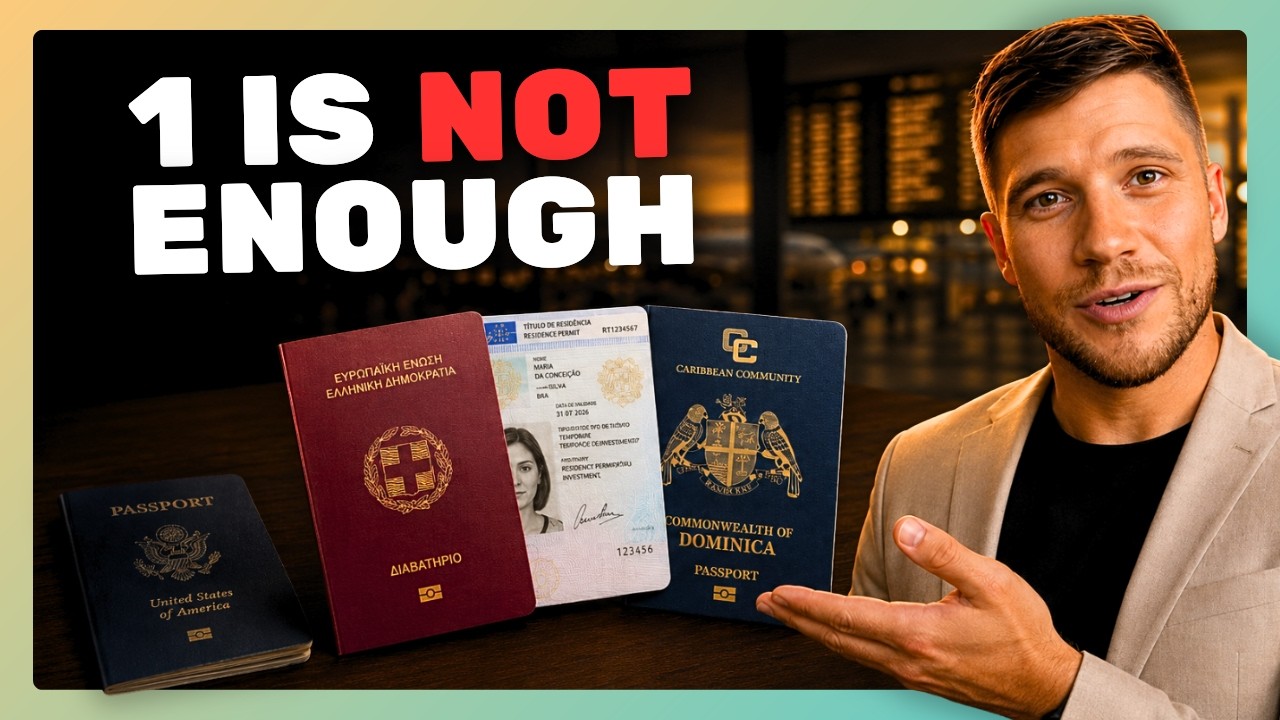
Almost everything you own answers to a single government: Your passport, your bank accounts, your health, your businesses, and the laws that govern all of it. You would never accept that much concentration in your investment portfolio, so why accept it in your life? That question is the whole of flag theory, and answering it well is how wealthy American families use residency and citizenship programs to reduce the largest single position they own.
Or watch the full breakdown here:
What Is Flag Theory? From Three Flags to Five
Flag theory is not new. The financial writer Harry Schultz laid out the first version in the 1960s and called it the three flags: One country for your citizenship, one for your residence, and one for your money. A later writer, W.G. Hill, expanded it to five:
- Citizenship: The passport that gets you across a border, and the government obligated to answer for you when something goes wrong
- Residency and tax home: Where you have the legal right to live and where you owe a tax bill, optimally zero
- Business base: Where the company that pays you is registered and taxed
- Asset haven: Where your capital, accounts, and property live
- Playground: Where you and your family spend your time and money
One note on the asset haven for US citizens and green card holders: An account outside the US is legal provided you're not hiding anything and you file your FBAR forms once foreign accounts pass $10,000 combined at any point in the year. The question this flag asks is simple: Should all of your capital answer to one banking system, one currency, and one set of capital controls?
Concentration Is the Risk, Not Any One Country
Most American families have all five flags planted in the same soil. This is not a prediction about America failing; it is an argument about concentration. If a friend held 90% of his net worth in one company's stock, you would tell him to trim it, not because the company is bad, but because no single position deserves that much of anyone's capital. One country sets your tax rules, controls the printing of your money, writes and adjudicates your laws, determines your travel access, and passes down your children's options. It is the single largest position you own. And the world is regionalizing: Trade blocs are pulling apart, payment rails are splitting, defense alignments are being redrawn, and insurers are repricing whole regions at a time.
The opposite mistake is just as real. A client came to us this month having fallen in love with Turkey: Citizenship through its investment program, all their capital deposited there, an apartment purchased, everything else sold, a company opened, a full relocation. Twelve months later they had rebuilt the same concentrated structure they were escaping, with a different flag on the building. Turkey's program is excellent, but if Turkey grants your second citizenship, it should not also become your bank, your tax home, your property market, and your children's schooling system. The point of five flags is that they land in five different places, and ideally across different blocs, not just different borders. A Caribbean passport plus a Panama bank account plus a Costa Rica house is three flags in one small corner of one hemisphere: One weather system, one broad set of political dependencies.
Residency vs. Tax Residency vs. Citizenship
Immigration status works like school: Tourist, temporary residency, permanent residency, citizenship, with each level granting privileges the last one didn't. A tourist is a guest, 90 or 180 days in most countries, no right to work, no healthcare access. Residency delivers a national ID, the right to be present 365 days a year, healthcare entry, a school seat, a local bank account, and a legal basis to work or own a business, but no passport, no vote, and no portability, and it can be revoked. Citizenship is the last rung: The travel document, sometimes supranational rights across a bloc, and a status that generally cannot be taken away.
The part that trips people up: Residency is an immigration status, while tax residency is a financial status. Most countries make you a tax resident at 183 days a year, but some attach it at zero, 60, or 90 days, and presence is only the most obvious trigger. A permanent home, your family's location, or the center of your economic interests can create tax residency by accident. For Americans, one tax home is always the United States because of citizenship-based taxation; a second one means two sets of rules, with double tax treaties deciding who taxes what. This is why your tax home and your playground should rarely be the same place. In our Expat Almanac, Spain ranks high on nearly everything except taxes: Hacienda claims tax residents at 183 days or on substantial ties alone, which is where Shakira got into trouble. An ideal playground is not always an ideal tax home.
Four Residency Programs, Four Different Designs
Mexico's economic solvency route: Proof of $4,400 a month in income or $73,000 in savings across 12 months, no investment required. A one-year temporary card, renewable to four, converts to permanent residency with citizenship after five total years, and retirees showing $7,500 a month or $300,000 in savings go directly to permanent residency. The wrinkle: Consulates read the qualifying financials differently from post to post.
Argentina's rentista visa: About $2,000 a month in passive income transferred to an Argentine account, and passive is the key word: Dividends, rent, royalties, interest, and pensions qualify; a salary does not. Citizenship opens after just 2 years of continuous legal residence, one of the shortest clocks on Earth, but 2025 decree changes expect you on the ground essentially year-round, a rule the Supreme Court has challenged President Milei on.
Portugal's golden visa: €500,000 into a regulated fund or a €250,000 cultural donation, with an average of 7 days a year of presence, permanent residency at year 5, and citizenship eligibility at year 10. The AIMA backlog stretches the first permit to 30 to 48 months, but this remains the only route in Europe to an EU passport without relocation.
Greece's FIP visa: Around €3,500 a month in income, approved in under four months. Renewal requires spending the majority of your time in Greece, which makes you a Greek tax resident, painless if you qualify for the 7% flat tax regime covered in our European special tax regimes guide.
The Five Paths to a Second Citizenship
1. Descent: Always start with your blood, because the cheapest citizenship on Earth is the one you may already be entitled to. Ireland recognizes a grandparent born on the island through the Foreign Births Register; Poland, Germany, Hungary, and Greece have descent routes with their own quirks. Italy is the cautionary tale: The 2025 Tajani decree capped claims at a parent or grandparent, wiping out great-grandparent eligibility valid since 1861. If you have a claim anywhere, make it before the rules change.
2. Birth: Argentina, Brazil, Mexico, Chile, Canada, and much of Latin America grant citizenship to anyone born on their soil, and several put the parents on an accelerated track behind the child. For a young family, that is a flag and a residency route in one delivery room.
3. Naturalization: Live somewhere long enough, learn the language, pass the test, swear the oath. Slow, but as governments demand a real, demonstrated connection from new citizens, it may be where this market ends up.
4. Merit: More than 130 countries grant discretionary citizenship for exceptional contribution, from Austria's decades of economic grants to the UAE's nominations for investors, doctors, scientists, and artists. No price list, no program: Your skills, notoriety, or job creation are the qualification. Our breakdown of citizenship by merit and the routes replacing CBI covers it in depth.
5. Investment: The most straightforward path. A Caribbean passport from a $200,000 donation in as few as 6 months; São Tomé and Príncipe broke the $100,000 barrier in 2025 at $95,000; Turkey pairs a $400,000 property purchase with a passport in 6 months. These offerings reprice fast, which is the argument for pairing citizenships with residencies instead of leaning on one option. Price the field with our cheapest citizenships by investment ranking.
About the Exclusive Citizenship Act
US Senator Bernie Moreno introduced the Exclusive Citizenship Act in December 2025, which would give dual citizens one year to renounce any other nationality or be treated as having given up their US citizenship. It is going nowhere fast. The Supreme Court settled the question in Afroyim v. Rusk (1967), ruling that Congress cannot strip citizenship from an American who hasn't voluntarily relinquished it, and Vance v. Terrazas (1980) tightened the standard. Add the constitutional problem to the political one, and neither party is likely to take it up. Watch it; don't panic about it.
Planting Your First Flag
The sequence is the strategy: Diversify the largest position you own the same way you would any portfolio, one flag at a time, in different places, across different blocs. If you want to know which residency or citizenship flag fits your family first, take the 90-second Plan B Blueprint for a custom report, then book a free Freedom Consult and we'll map the full five-flag structure with vetted counsel. Already know your program? Message us and we'll get you moving. And for residencies you can maintain from your couch, our guide to 9 golden visas without relocation is the natural next read.