


 Hungary
In this article
If you're weighing Hungary for a second base, a company, or an investment, this news should give you pause. Its parliament has passed a wealth tax of 1% a year on net wealth above one billion forints (about $3 million), rising to 1.5% above 99 billion forints (about $300 million).
This is disappointing news. Many investors thought Hungary was immune to the punitive wealth taxes of Western Europe, but we think the Hungary wealth tax will send wealthy Hungarians to the exits and turn away the founders who would have grown its economy.
It also follows Hungarian citizens abroad for a decade, a citizenship-based rule few people have noticed. Investors who wanted a base in the region have plenty of low-tax alternatives, Serbia and Montenegro among them. Let me explain.

A 1% Yearly Bill on Wealth Above $3M
The law hits founders and families with a paid-off home and a solid portfolio, well below the fortunes Budapest says it targets.
- The Rate: 1% a year on net wealth above one billion forints, about $3 million or €2.7 million, and 1.5% on the slice above 99 billion forints, about $300 million.
- The Base: Cash, securities, company stakes, real estate, vehicles worth over 10 million forints (about $30,000), and art and jewelry worth over three million forints (about $9,000) all count, and stakes owned by a spouse or close relatives are added together to value a family company.
- Worldwide Reach: Hungarian tax residents pay on assets at home and abroad, but foreigners who live elsewhere pay only on assets in Hungary.
- Citizens Abroad: Hungarian citizens count as residents until they've lived abroad for at least 10 years, so leaving the country doesn't end the bill.
- First Bill: The first assessment uses what you own on December 31, 2026, with payment due August 31, 2027, if the president signs the law in time.
Hungary Joins Europe's Wealth Tax Club
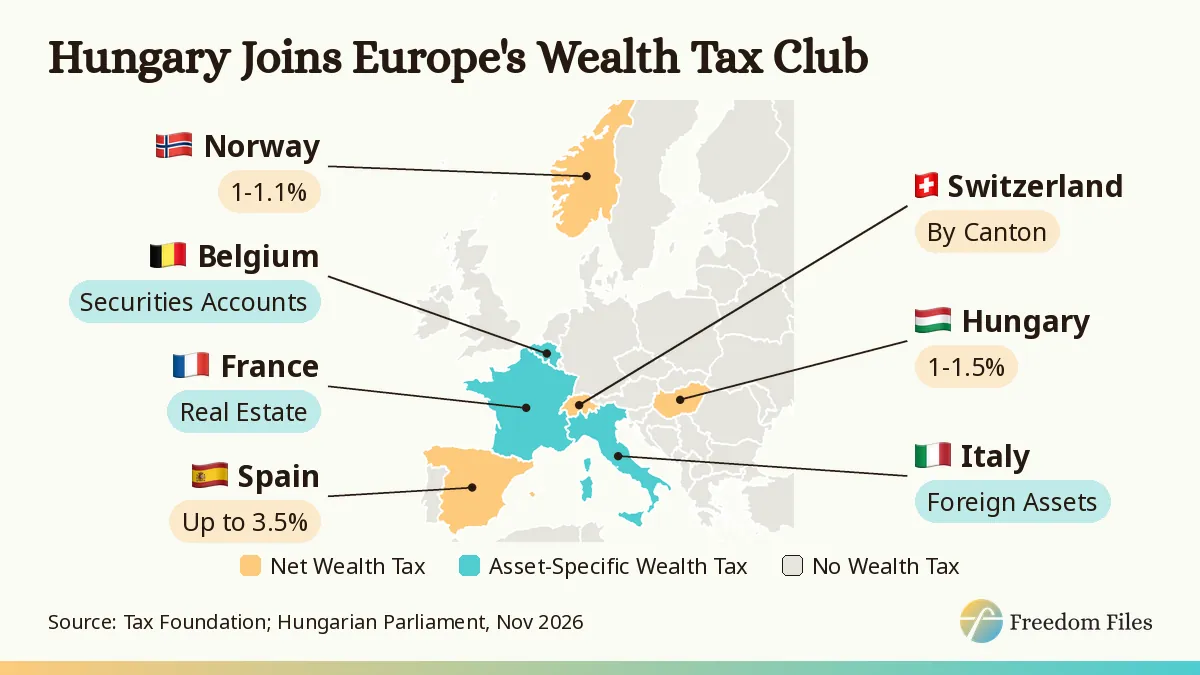
Hungary has now joined a small group of European countries that tax what you own each year, whether it earns anything or not.
Until now, Norway, Spain, and Switzerland were the only European countries with a tax on net wealth, while France and Italy tax selected assets and Belgium taxes large securities accounts. Hungary is the first in its region to join the net wealth club.
That's a sharp break from its neighbors. Most of Central and Eastern Europe taxes income at low, flat rates and leaves wealth alone.
Hungary's Wealthy Will Head for the Exits
The obvious reading is that a 1% levy on fortunes above $3 million raises easy money for families and pensioners, since the same package doubles family allowances and lifts the minimum pension for new retirees to 120,000 forints (about $365) a month. I, however, see a tax that drains the capital Hungary needs most.
Budapest calls its targets the ultra rich. In practice, the line falls at about $3 million, which describes a founder with a mid-sized company or a family with a paid-off home and a solid investment account.
So the bill arrives whether your assets earned anything or not. A founder whose company is worth $10 million on paper owes about $70,000 in cash each year, even in a year the company pays no dividend. Over a decade that adds up to roughly $695,000 before any growth.
After Norway raised its wealth tax in 2022, many of its wealthiest residents left the country, Tax Foundation research found. Hungary's 2027 budget counts on about 200 billion forints, roughly $610 million, from its version. I expect departures to shrink that figure.
Supporters say the richest pay little tax relative to their wealth, and I'm glad to see pensioners get a bigger check. But Hungary already collects a flat 15% income tax, and a levy on paper wealth forces owners to sell shares or borrow to pay it, which shrinks the companies that pay Hungarian wages.
Hungary Now Taxes Its Citizens Abroad
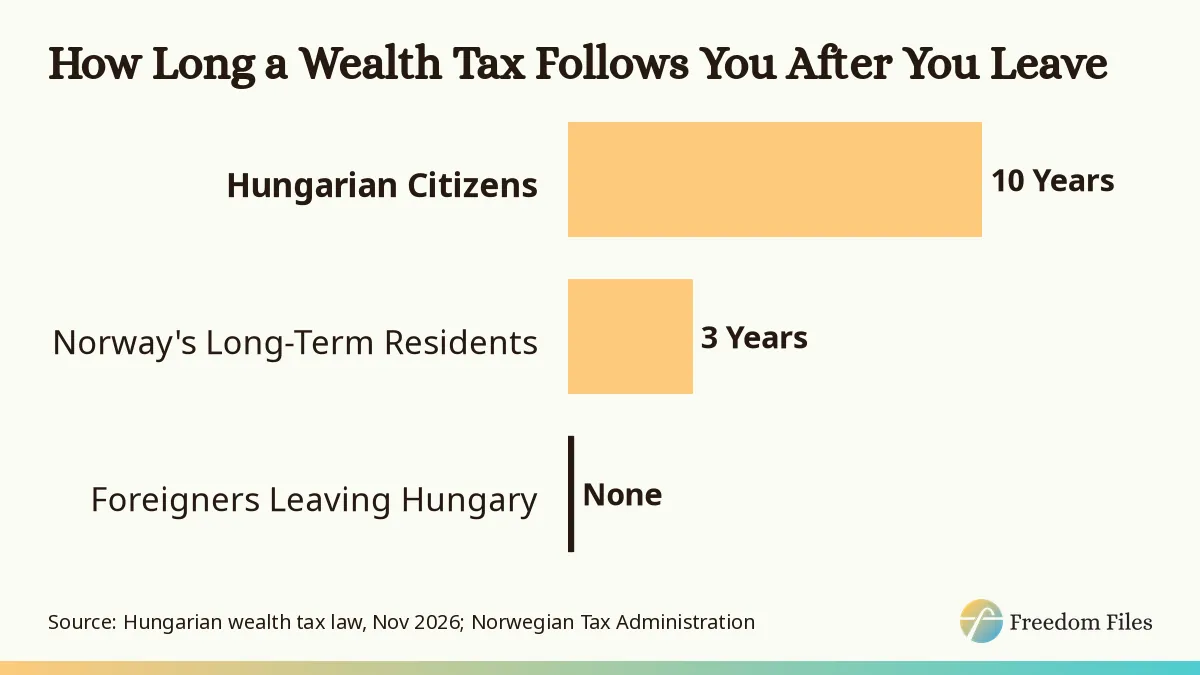
Hungary's lawmakers saw the exodus coming and tried to block it with citizenship-based taxation. Under the law, a Hungarian citizen counts as a resident for the wealth tax until they've lived abroad for at least 10 years, measured on the last day of the tax year.
Americans know this idea well. The US taxes its citizens on their income wherever they live, and very few countries copy it. Hungary has now applied a version of it to wealth, and dual citizens can be treated as residents even with no address in Hungary.
That tail is long for Europe. Norway taxes people who lived there for 10 years or more until the end of the third year after they settle abroad. Hungary's rule lasts more than three times longer, and it keys off your citizenship, so the years you lived in Hungary play no part in the clock.
On paper, the rule closes the exit, but in practice I think it will collect little, for two reasons.
First, Hungary can't see most of the money. Under the global system banks use to swap account data, a bank reports your accounts to the country where you're a tax resident. Your citizenship plays no part, so a Hungarian who moves to Vienna gets reported to Austria.
The US enforces its own citizenship-based taxes with the Foreign Account Tax Compliance Act (FATCA), which forces banks worldwide to report US citizens, and Hungary has nothing like it.
Second, tax treaties can override the rule. Where Hungary's treaty with your new home covers taxes on capital, the treaty can take precedence over Hungarian law, so where you move decides whether the 10-year clock bites at all.
So the rule's main effect falls on the people deciding whether to come. It tells a founder that Hungary wants a claim on the family's worldwide wealth for a decade after the family leaves.
Tax Residents Take the Hardest Hit
How much this costs you depends on where you live and which citizenship you have. Foreigners who invest in Hungary but live elsewhere pay only on Hungarian assets, which for most investors falls far below the cutoff of one billion forints (about $3 million).
Hungarian founders and families with company stakes take the hardest hit, along with any foreign investor who moves to Hungary and becomes a tax resident. Say you move to Budapest with $5 million in assets: As a tax resident you'd owe about $20,000 a year on your worldwide wealth, and the bill grows with your portfolio.
The timeline could slip. The president can send the law back to parliament or to the Constitutional Court, and either step would push the first payment to 2028.
Hungary's Golden Visa Gets Harder to Sell
The tax hits a residency program that was already struggling. Hungary's Guest Investor Program, its golden visa, offers residency, the legal right to live in a country without being a citizen, for €250,000 in an approved real estate fund or a €1 million donation to a higher-education foundation.
Interest has been thin from the start. By the end of September 2024, 109 people had applied and 11 had received the visa, and the government removed the direct property route a few months later.
Politics had already made many foreign investors cautious about Hungary. Now an entrepreneur who wants to move a company there, along with a spouse and children, faces a yearly charge on the value of everything the family owns.
Hungary's 9% corporate tax is the lowest in the European Union (EU). It should make the country a magnet for founders, but a founder who moves to Budapest to use it now pays 1% a year on the value of the company too.
The rule on citizens bites hardest for golden visa investors who plan to naturalize. Hungary's residency leads to citizenship after about eight years, and the day you become a Hungarian citizen, you also take on a 10-year tail on your worldwide wealth.
Eastern Europe Offers Low-Tax Options
Hungary often sets the tone in its region, and I expect a few neighbors to follow it. Most of the region, however, is moving the other way. That leaves investors with plenty of options.
Decades under communism left much of Central and Eastern Europe wary of taxes that punish success. So flat income taxes are common across the region, and Bulgaria and Romania both charge just 10% with no tax on net wealth.
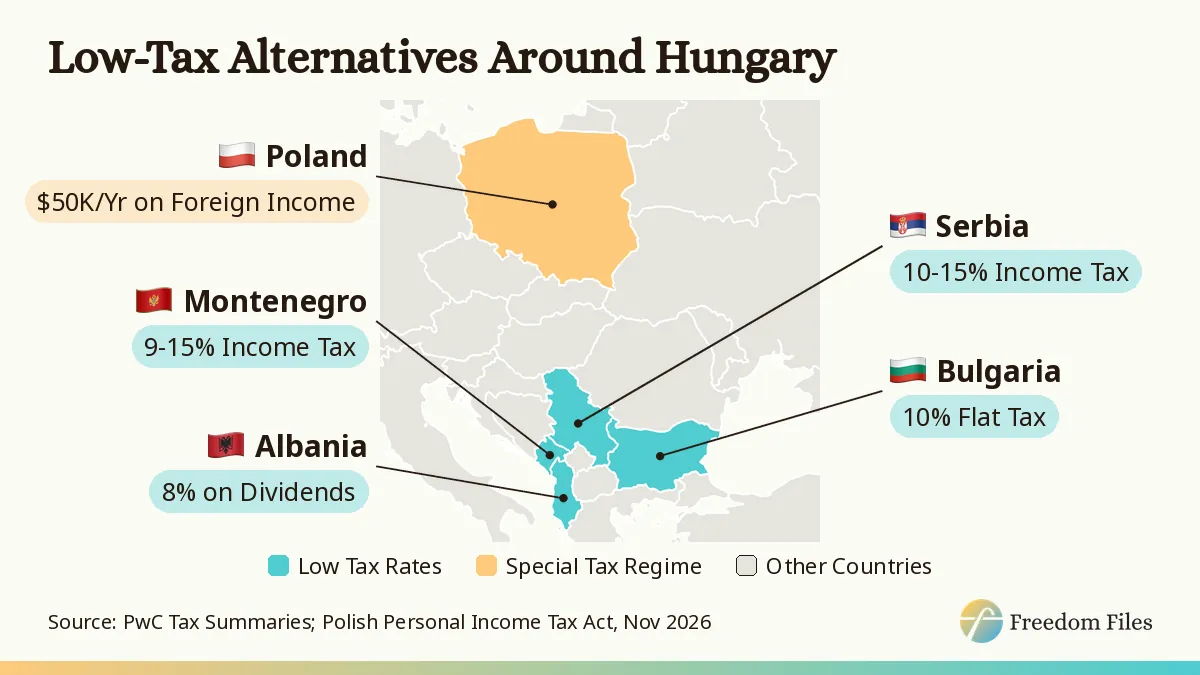
Serbia, Hungary's southern neighbor, has no wealth tax and taxes most personal income at 10% to 15%. It also grants residency to foreigners who buy a home there, at any price.
Serbia is outside the EU and trades with both East and West, which gives families tied to one bloc a hedge. For many of our clients, that diversification is the appeal.
Montenegro, on the Adriatic coast, has no wealth tax either and taxes income at 15% or less. It grants residency for €150,000 in property, and it's among the leading candidates to join the EU, which could turn that permit into residency in an EU member.
Albania taxes most dividends at just 8%, which suits investors who live off a company's profits.
Poland, one of the EU's largest economies, lets new residents pay a flat 200,000 Polish zloty a year (about $50,000) on their foreign income, however much they earn, for up to 10 years. You qualify if you weren't a Polish resident in at least five of the previous six years.
Greece, just south of the Balkans, also skips a net wealth tax and lets new residents pay a flat €100,000 a year on foreign income. So a family that liked Hungary's location has several low-tax bases within a few hours' drive.
If you're weighing Hungary, Serbia, Montenegro, or another base in Europe, contact us for licensed support before you move any assets.
This article is general commentary and contains no legal or tax advice.
FAQ
Does Hungary Have a Wealth Tax?
Yes. Hungary's parliament passed a wealth tax of 1% a year on net wealth above one billion forints (about $3 million), with the first assessment on wealth owned at the end of 2026, if the president signs it in time.
How Much Is Hungary's New Wealth Tax?
It's 1% a year on the part of your net wealth above one billion forints (about $3 million) and 1.5% on the part above 99 billion forints (about $300 million). Someone worth $10 million owes about $70,000 a year.
Who Pays Hungary's Wealth Tax?
Hungarian tax residents with net wealth above about $3 million pay on assets worldwide. Foreigners who live elsewhere pay only on assets in Hungary.
Does Hungary Tax Its Citizens Living Abroad?
Yes, for the wealth tax. A Hungarian citizen counts as a resident until they've lived abroad for at least 10 years, so a citizen who leaves can owe tax on worldwide wealth for a decade, unless a tax treaty says otherwise.
Do Hungary Golden Visa Holders Pay the Wealth Tax?
Only if they become Hungarian tax residents with net wealth above the cutoff. An investor who lives elsewhere pays only on Hungarian assets, but one who naturalizes takes on the 10-year rule for citizens.
When Is the First Hungarian Wealth Tax Payment Due?
August 31, 2027, based on what you own on December 31, 2026. If the president sends the law back or to the Constitutional Court, the first payment moves to 2028.
Which Countries in Europe Have a Wealth Tax?
Norway, Spain, Switzerland, and now Hungary tax individuals on their net wealth. France, Italy, and Belgium tax only selected assets, such as real estate, assets held abroad, or large securities accounts.
Which EU Countries Have No Wealth Tax?
Most of them, including Greece, Portugal, Cyprus, and Malta, have no tax on an individual's total net wealth. Hungary and Spain are now the two EU members that levy one.
Which Eastern European Countries Have Low Taxes?
Serbia, Montenegro, Bulgaria, and Romania all tax income at 15% or less and have no wealth tax. Serbia and Montenegro also grant residency through a property purchase.
Does Serbia Have a Wealth Tax?
No. Serbia has no net wealth tax and taxes most personal income at 10% to 15%, which makes it one of the most tax-friendly places in Europe for investors.
Is the Hungary Golden Visa Open in 2026?
Yes. The Guest Investor Program offers residency for €250,000 in an approved real estate fund or a €1 million donation, but the government removed the direct property route in 2025.

 Malta

 Panama
 Costa Rica



 Turkey

 Greece

 Italy


 Portugal

 United States