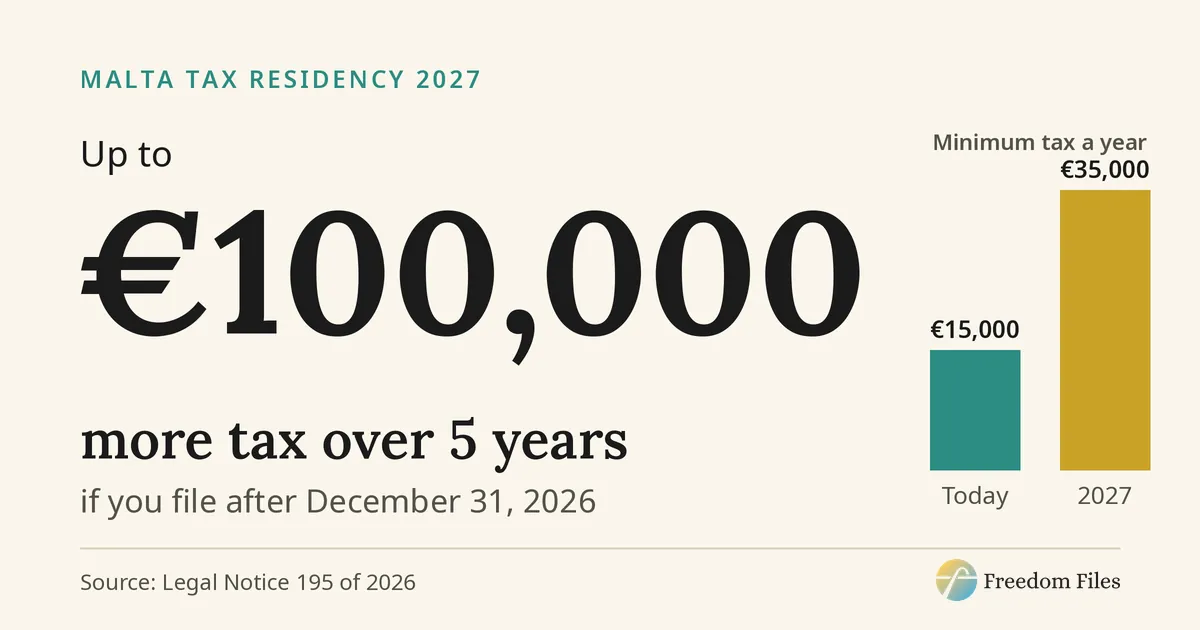
If a second tax home in Europe is on your list, Malta just showed you what waiting costs. A new applicant who files after December 31 pays up to €100,000 more in tax over the next 5 years than one who files before it.
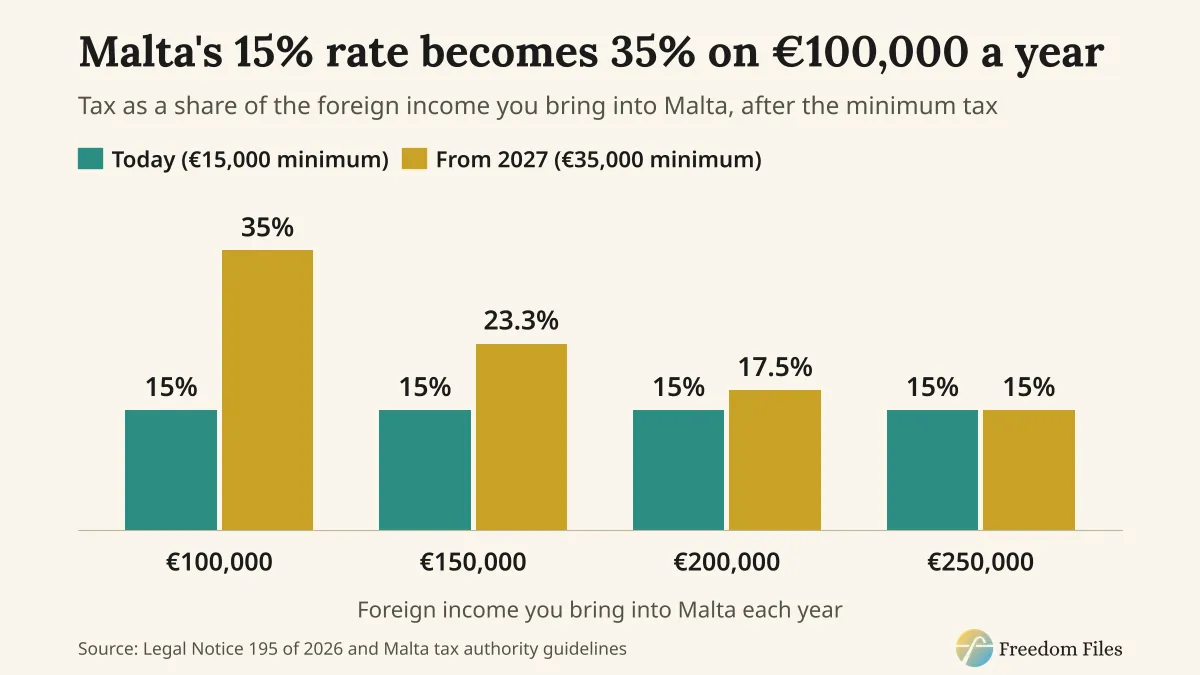
For Malta tax residency in 2027, the minimum annual tax for new foreign residents rises from €15,000 to €35,000 on January 1. The 15% rate on foreign income you bring into Malta is unchanged.
We see this as the pattern for anyone with assets to protect. Countries raise the price once enough people want in, and the good ones honor the old price for the people who came early. Italy did it, and now Malta has.
Portugal honored old prices on its tax regime, then spectacularly failed its golden visa investors. In May it doubled the naturalization timeline to 10 years and protected only people who had already filed for citizenship (details).
The Short Version
- File by December 31, 2026 and you pay today's €15,000 minimum until the end of 2031.
- File later and the minimum is €35,000, with a renewal every 5 years.
- Bring more than €233,333 a year into Malta and your tax bill is the same under both sets of rules.
- A €14,000 annual lease qualifies you as well as a €700,000 purchase, so lease.
What Changed in Malta's Tax Residency Rules for 2027
Malta published the rules as Legal Notice 195 of 2026 on July 14. Today's figures come from the tax authority's guidelines for the Global Residence Programme and the Malta Retirement Programme.
| Rule | Today | From January 1, 2027 |
|---|---|---|
| Tax rate on foreign income you bring in | 15% | 15% |
| Minimum tax each year | €15,000 | €35,000 |
| Minimum tax for retired pensioners | €7,500, plus €500 per dependant | €15,000 |
| Property purchase minimum | €275,000 (€220,000 in Gozo and the south) | €700,000 anywhere |
| Lease minimum per year | €9,600 (€8,750 in Gozo and the south) | €14,000 anywhere |
| How long the status lasts | No end date | 5 years, renewable |
Our Take on the New Rules
The Tax Increase Is Subtle
Malta left the 15% rate alone and raised the minimum underneath it. That's how a government raises a tax without touching the headline number.
The new €35,000 floor changes your bill only if you bring in less than €233,333 a year. Above that amount you pay the same 15% as today. Malta's minimum is also about a third of Greece's flat tax and less than an eighth of Italy's.
The Property Rule Is a Mistake
The purchase minimum jumps to €700,000 while the lease minimum goes to €14,000 a year. So a purchase now costs 50 years of rent, and every sensible applicant will lease for €1,167 a month and invest the €700,000 somewhere friendlier.
If the goal was more foreign money in Maltese property, this rule works against it. A seller in Gozo with a €300,000 townhouse loses every buyer who used to qualify at €220,000.
The 5-Year Term Is the Bigger Cost
Today the status has no end date. From 2027 it expires every 5 years, and the rules say nothing about what grandfathered residents pay after 2031.
That hands Malta a chance to reprice you at every renewal. Budget for €35,000 from 2032.
Early Movers Win When a Country Honors Its Word
Italy charged €100,000 a year in 2017 and charges €300,000 now, and each time the earlier arrivals paid their original amount (details). Malta has now put 5 years of the old price in writing.
Portugal shows both outcomes. It closed its NHR tax regime to newcomers in 2024 and honored it for people who had registered (details). Golden visa investors got no such protection on citizenship, so claim a favorable rule while it exists.
What to Do Before December 31
If Malta was on your shortlist, file this year. Over 5 years on the lease route, today's terms cost €123,000 in minimum tax and rent. The 2027 terms cost €245,000.
The tax authority has to receive your application by December 31. An approval that arrives in 2027 is fine, because the legal text protects applications received by the deadline.
Malta is a poor fit if you bring in around €100,000 a year. Your bill would be €35,000, or 35%, which matches Malta's top ordinary rate (details). For a retiree with a €60,000 pension, the bill goes from €9,000 to €15,000.
As an American, you file with the IRS wherever you live, and how much of Malta's minimum your US return credits depends on your income mix. Get in touch with us for licensed support on that question and on the application, before you sign a lease. This article is not legal or tax advice.
How Malta Compares with Italy, Greece and Cyprus
2 of these 4 countries raised their tax on new residents since 2024. Cyprus went the other way and Greece left its flat tax alone, which makes them the 2 to look at next.
| Country | Latest move | What you pay |
|---|---|---|
| Malta | Minimum tax raised to €35,000 from January 1, 2027 | 15% on foreign income you bring in (details) |
| Italy | Flat tax raised to €300,000 for arrivals from January 1, 2026 | €300,000 a year covers all foreign income (details) |
| Greece | Flat tax unchanged | €100,000 a year, plus a €500,000 investment in Greece (details) |
| Cyprus | 2026 reform added 10 optional years | No defence tax on dividends and interest for 17 years, extendable to 27 (details) |
Malta's 15% beats Greece's €100,000 until you bring in €666,667 a year. It beats Italy's €300,000 until €2 million.
Malta Tax Residency FAQ
Can Americans Get Tax Residency in Malta in 2027?
Yes. Americans apply for global resident status, which requires a €700,000 purchase or a €14,000 annual lease, plus private medical insurance.
Can I Apply for the Malta Global Residence Programme Before 2027?
Yes. An application the tax authority receives by December 31, 2026 gets today's terms until December 31, 2031.
Do I Have to Live in Malta for 183 Days a Year?
No. The rules set no minimum number of days in Malta, and your status ends if you spend more than 183 days in any other single jurisdiction in a calendar year.
Does Malta Tax Foreign Capital Gains?
No, for a resident domiciled outside Malta. Foreign capital gains are outside Maltese tax even when you bring the money in (details).