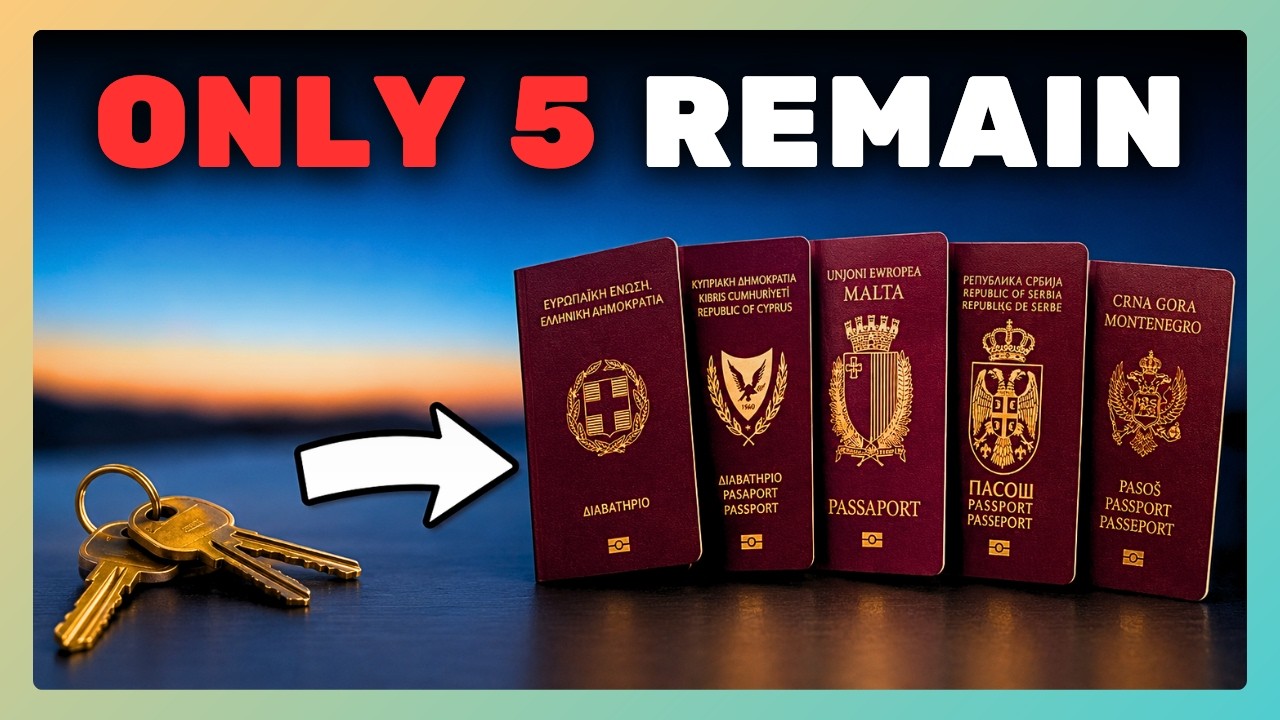
Europeans pay some of the highest tax rates on Earth, top rates of 55% in some countries. But foreigners like you get a different menu. In this video, you'll learn about all 15 special tax regimes in Europe: who qualifies, how, and which one fits your situation. The last one even charges 0% on your foreign income for 20 years, and the country will surprise you. Let's get into it.
By the way, don't feel like you have to take notes. We compiled everything in this video in a free guide at freedomfiles.co/guide/european-special-tax-regimes, which is linked below as well. That's probably easier.
First, why these exist. Europe's governments want you and your capital, and they can't cut rates for their own citizens, so they compete for newcomers instead. This is their recruitment strategy, and it's only smart to take advantage of what they offer. Where these 15 tax incentives differ is on rate, on term, and on how little they ask you to declare.
Two ground rules before the list. Almost every regime requires full tax residency, 183 days a year in most cases, except one unique deal we'll cover in a minute. A visa residency alone gets you none of this; you must relocate in most cases. And as we covered in a recent video on this channel, if you're a US citizen or you have a US green card, Uncle Sam taxes your worldwide income wherever you live. So everything in this video shapes your European bill only. For an accurate look at your unique situation, message us on the website. We sequence every plan with licensed US and local tax counsel before you commit to anything.
We've separated these programs into three groups. The first group is the flat rates for people earning an active salary.
Number one is Spain's Beckham Law, named after the British soccer great who relocated to Spain and for whom they designed this program. So you are the next Beckham. You qualify by relocating to Spain for work, and only the digital nomad visa in Spain allows you to qualify, since the non-lucrative visa prohibits local work. Spain charges a flat 24% on your professional income up to €600,000, and your foreign dividends, capital gains, interest, and rental income are fully exempt for 6 years. Remote work for a foreign employer qualifies, so a US salary while you live in Madrid, Barcelona, Valencia, or Andalucía gets taxed at 24% while your overseas portfolio income escapes Spanish tax outright. Additionally, you escape Spain's notorious wealth tax on foreign assets and Modelo 720, the foreign-asset filing Americans in Spain dread most. The con is the exit: it's only 6 years. Pass that 6-year mark by one day of residency and full Spanish worldwide taxation, up to 50% depending on where you live in the country, arrives at once, wealth tax included. If you earn a US salary and want residency in Spain, this is your lane, but plan your exit before you arrive.
Number two can stack on top of the Beckham Law, and that is Madrid's Mbappé Law. Guess who this one was named after? This law lets new residents deduct 20% of qualifying investments against the regional slice of their income tax, and Madrid already rebates 100% of its wealth tax. It only affects the Madrid portion of your bill, and it can interact with the Beckham Law, so counsel should model which combination wins for your income mix. Taken together, Madrid is mainland Spain's most tax-friendly region by far; I would say Andalucía is a close second.
Number three: Portugal's IFICI, the successor to the famous NHR that closed a few years ago. By the way, if you read or watch somewhere that the non-habitual resident regime is available, you're being lied to. It is not. And the IFICI is a far cry from the earlier version of the program; a lot of people call it NHR 2.0, but not so much. You qualify and pay a flat 20% tax on eligible Portuguese work income, while your foreign dividends, interest, rents, and capital gains are tax-exempt for 10 years. The gate is your profession: research, science, and engineering, IT and high-tech, certified startups, and companies deemed strategic to the Portuguese economy. Foreign pensions are the casualty here. Under NHR 1.0 they were heavily benefited; now they face standard progressive rates, a change that has pushed a lot of our clients toward Greece and southern Italy, which we'll cover later. If your work fits the list, Portugal may offer a good tax fit. If it doesn't, Portugal is not a tax-friendly jurisdiction in the slightest.
Quick context on why I care about this stuff so much. I left the US almost 10 years ago, and between regimes like these and where I planted my own flags, my own effective tax rate came down to nearly single digits, 100% legally, of course. If you want to know which jurisdictions and programs overseas fit your goals, take the Plan B Blueprint at freedomfiles.co/begin. Ten questions, 90 seconds, and you get a custom report on the routes that fit.
Back to number four: Malta's Highly Qualified Persons rules. We'll come back to Malta in a bit, as it has two attractive programs. This one is designed for those relocating to Malta with a licensed local employer in finance, gaming, or aviation on a salary above €98,000. The rate is a flat 15% on employment income up to €5 million, so it can be very attractive, and income above that €5 million is untaxed completely. This is a niche instrument for an executive taking a Maltese position. If that's not you, Malta has a second option coming later in this list that requires no employment at all.
Number five is Italy's Lavoratori Impatriati. If you move to Italy for work and commit to at least 5 years in the country, half of your professional income disappears from the tax base, and 60% disappears if you have a minor child at home, on income up to €600,000 a year. Remote work for a foreign employer counts, and effective rates land near 20 to 25% for most executives, which can turn Milan or Florence into a mid-tax city for half a decade. Leave before year five, though, and the relief is clawed back with interest. So the commitment is important here.
Now group two: the lump-sum regimes. One fixed payment regardless of how much you earn.
Number six is Switzerland's forfait fiscal. In an interesting quirk, Switzerland taxes qualifying foreigners on what they spend, not on what they earn. The canton agrees a deemed base in advance, usually about 7 times your annual rent, and about 750,000 to 1 million Swiss francs for non-EU applicants. If you spend a million francs against 10 million of income, your effective rate lands under 5% in Vaud, under 3% in Zug, with no global income or wealth reporting, indefinitely. There's no fixed term on this regime, unlike many of the programs we discuss today. Below roughly 10 million francs of net worth it's unavailable, and six of 26 cantons have abolished it completely, Zurich included, so canton choice is critical. Restrictive, but opportunistic for the right investor.
Number seven is Italy's lump-sum regime, and Italy has one more we'll get to later. This is the model a lot of countries have copied: pay a fixed €300,000 a year, up from €100,000 and then €200,000 a few years ago, and Italy exempts essentially all of your non-Italian income from local taxes for 15 years. No foreign-asset reporting, no wealth taxes on foreign portfolios, no gift or inheritance tax on assets outside Italy, and unlimited remittances into the country. Break-even against Italy's ordinary 43%-plus rates arrives near €700,000 of foreign income, and the true line falls lower for asset-heavy families once you price in the estate shield. Above seven or even eight figures, nothing in a G7 country competes, apart from Greece, which is next. Below that line, Italy has another option at number 11.
Number eight is Greece's non-dom regime for investors. First, you must put €500,000 into Greek property, businesses, or securities, either yourself or through a company you own. Greece then caps tax on all your foreign income at a flat €100,000 a year, a number that has not budged for 15 years, with no questions about how much you earn abroad and no obligation to declare it. Super strong. Family members join at €20,000 per adult per year. The arithmetic favors it only above roughly €1.4 million of annual foreign income, and there's no credit for tax already paid abroad, so treat Greece's lump-sum non-dom as a certainty play.
Number nine is a program rarely covered on YouTube or elsewhere: Poland's lump-sum regime for high-net-worth individuals, the cheapest in Europe. A fixed PLN 200,000 a year, about €47,000, covers all foreign income for up to 10 years, plus a required PLN 100,000 a year to designated causes, so the true cost is nearly €70,000. Few of our American clients shortlist Warsaw or Kraków against Milan or Athens, because lifestyle decides these moves more than spreadsheets do. But Poland scores high on a lot of metrics in our Expat Almanac, and the country may surprise you with its value.
By the way, if this kind of breakdown is useful, subscribe and drop a like. It tells us to create more content like this. We publish multiple videos like this every single week, so you won't miss out.
Now group three, and from here on out, every headline number is single-digit, or even zero in the case of the final regime.
Number 10 is Greece's 7% foreign-income regime. The marketing frames it as a pensioner scheme, which is misleading. What you need is pension-like income, and private schemes typically count, which brings your IRA and 401(k) withdrawals into scope. So most Americans over 59½ can qualify. Once in, the flat 7% covers foreign pensions and nearly all foreign passive income, dividends, interest, capital gains, annuities, for 15 years. Moreover, tax paid in the US credits against the 7% because of the US-Greece double tax treaty. Unlike the non-dom regime at number eight, the government requires no investment of any kind to qualify. There is a math risk: each spouse must qualify on their own income, so you don't simply pay a higher fee to include your wife or husband. For the typical American shortlist in Greece, this beats the non-dom regime.
Number 11 is very similar, and maybe the one you've heard about: the southern Italy 7% flat tax. Take a foreign pension to a town of under 30,000 residents in the Mezzogiorno, Italy's south (Puglia, Sicily, Calabria, and their neighbors), and Italy taxes every category of your foreign income at a flat 7% for 10 years, with no wealth taxes or foreign-asset monitoring. The binding constraint is lifestyle. You're choosing village Italy: gorgeous and slow, an hour from an airport on a good day. Clients who want northern Italy's speed and connectivity: this is not that. Clients who want a little grit, Puglia, Sicily, get one of Europe's lowest tax bills as a bonus. Clients who want the cosmopolitan lifestyle with tax benefits should look at Greece instead, where the 7% deal has no location requirement.
Quick aside: the free guide I mentioned at the top covers each of these regimes on its own page, who qualifies, what you get, and the fine print. The link is on your screen and below. Grab it and treat it as your notes for today.
Number 12 opens the remittance group. Ireland's non-dom basis taxes you only on your local Irish income, typically zero for our clients, and on foreign income you bring into the country. Leave your money offshore and it goes untaxed. No annual charge, no expiry, no waiting period, three things the UK's now-abolished non-dom program never offered. It's one of the most flexible systems in Europe on paper, and the least forgiving in practice: everything hinges on segregating your capital from income before you move to Ireland, and one mix-up can taint years of remittances. Sequencing is crucial here.
Number 13 is Malta's resident non-dom system, the second Maltese option I promised after number four. Same remittance logic as Ireland, with one feature no other regime has: foreign capital gains escape Maltese tax even when you bring the money into the country. There is a minimum tax of about €5,000 a year, and it only applies once foreign income passes €35,000. This can be a phenomenal deal. Which of these first 13 regimes is your lane so far? Any questions? Drop them in the comments. I read every single one.
Number 14 is Cyprus, and now we're at zero. The Cypriot non-dom regime zeroes tax on your foreign dividends and interest for 17 years. The country also levies no inheritance, wealth, or gift taxes, and no tax on gains from selling non-Cypriot assets or securities. The residency test is unique. Under the 60-day rule, two months of presence in Cyprus buys you full tax residency, not partial, full, provided that: one, you don't spend 183 days in any other jurisdiction; two, you maintain a permanent home on the island; and three, you have Cypriot employment or a directorship at a local company. That last one is the tricky one. Registration is proactive, not automatic, so miss the filings and none of it applies. Or spend 183 days there and qualify without those three boxes. For a portfolio-heavy American who wants an EU flag without an EU winter, Cyprus and its golden visa reach our shortlist.
And finally, number 15, the 0% I teased at the top, and it surprises almost everyone. This is brand new. Turkey, in force since June 2026 and backdated to January, now has a territorial tax system. Become a Turkish tax resident and the government will not charge any tax on your foreign income for 20 years. No annual fee, no lump sum owed, no obligation to report your foreign income or assets to Turkey. None of it. Now, you might say: come on, a 20-year promise from Ankara? Fair, and it's the right question. The implementation guidance is published, and the 20-year promise is worth what the next two decades of Turkish policy make of it. We treat it as a serious option for the mobile investor. Don't forget that Turkey also has a very popular citizenship by investment program, which we covered in the video on your screen. Check that out after this one.
So which regime is right for you? Of course, it depends; without speaking to you, I wouldn't know. But if you earn an active salary, Spain's Beckham Law, Italy's Impatriati, or Portugal's IFICI could be your lane. If your income is passive and mid-six figures, Greece's 7% or southern Italy's matching rate beat everything above them. If a large exit or a founder's dividend stream is incoming, Italy's lump sum buys certainty nothing else in the G7 sells. If you're worth millions, Italy's and Greece's lump-sum regimes and Malta's remittance-based program are worth a look. If dividends are the core of your portfolio, maybe Cyprus or Malta. And if maximum exemption down to zero tax abroad is the goal, Turkey, maybe even paired with citizenship as well.
We're jurisdiction agnostic over here, and roughly a third of the people who speak with us end up in a totally different direction than they expected. Why? Maybe they got bad advice elsewhere, or weren't aware of programs that fit their goals better. We always start with education. Whichever lane is yours, the free guide at the link on your screen has all of this info. And if you want to talk through your options, take the 90-second Plan B Blueprint quiz first and schedule some time with us as well.
And if Europe's tax deals got you thinking about the American side of the equation, if you're a US citizen or green card holder, my video on US citizenship-based taxation is on your screen now.