France taxes its residents at up to 45%, plus surcharges and 17.2% in social charges, yet an American living in Paris on a US portfolio and retirement accounts can owe France close to nothing. Portugal, sold for 15 years as a retiree's tax haven, can now take more than 40% of the same retiree's pension. The difference isn't the headline rate. It's the double tax treaty each country signed with the United States, and the domestic tax regimes layered on top of it.
This guide covers how a US tax treaty decides who taxes your salary, pension, Social Security, dividends, and capital gains once you're a tax resident in Europe, then walks through the five treaties Americans most often rely on (Portugal, Greece, Italy, Spain, and France) with the residency routes into each. It's our informational read of the conventions, not tax advice: Model your own income mix with licensed tax counsel before you move.
Or watch the full breakdown here:
Do Americans Pay Double Tax When They Live in Europe?
No. Most Americans assume a move to Europe means paying full tax to two governments. In practice, you pay the higher of the two bills on any given dollar, never the sum. Two tools make that work: The tax treaty, which decides which country gets first claim on each kind of income, and the US foreign tax credit, which cancels US tax you'd otherwise owe on income a foreign country has already taxed.
Every US citizen stays taxable by the IRS on worldwide income wherever they live (our guide to citizenship-based taxation covers the system in full). The treaty doesn't change that. What it changes is how the second country, the one you move to, treats you.
How a US Tax Treaty Works: The Saving Clause and Its Exceptions
A tax treaty does one job. When you're a tax resident of two countries, it decides which one taxes which kind of income: Salary, dividends, interest, private pensions, government pensions, Social Security, and capital gains. Sometimes only the country where you live taxes it, sometimes only the country where the income arises, and sometimes both, with a credit on one side to cancel the overlap.
Almost every US treaty also contains a saving clause, which preserves Washington's right to tax its own citizens as if the treaty didn't exist. On its face, that defeats the purpose of signing a treaty at all. The value lives in the exceptions each treaty writes to its own saving clause. When one of these five treaties is more generous than another, it's because it carved more out of its saving clause.
The Foreign Tax Credit and Form 1116
The foreign tax credit, claimed on Form 1116 with your US return, gives you a dollar of US tax relief for each dollar of income tax you pay abroad, generally up to the US tax on that same income. Say you become tax resident in a European country and owe it $70,000 of income tax where the US would have charged $50,000. The foreign payment cancels your US bill on that income, and the extra $20,000 of credit can roll forward for up to 10 years. If the European rate is lower, the credit covers most of your US bill and you send the IRS the difference.
The Re-Sourcing Rule
Here's the piece almost nobody explains. A foreign tax credit requires foreign income. If you live in Lisbon but your money comes from a US brokerage account and a US pension plan, that income is US-source, and on paper the credit shouldn't apply. Four of these five treaties fix that with a re-sourcing rule that deems your US income foreign, purely so the credit works. Greece's treaty has none, which is why it behaves so differently.
Who Counts as a Tax Resident: 183 Days Is Only the Start
Each country's own law usually makes you a tax resident after 183 days a year. When both countries claim you, the treaty's tie-breaker settles it, and it doesn't start with day count. It first looks at where you have a permanent home available to you; if you have one in both, it looks at where your personal and economic ties are closer (family, work, where you bank, where you manage your property), and only then at habitual abode. Don't plan your residence on a day count alone.
Portugal: The US-Portugal Tax Treaty After NHR
The US-Portugal convention dates to 1994 and hasn't been amended since. For 15 years it was barely relevant to new residents, because the Non-Habitual Resident regime exempted most foreign income. NHR is now closed to new applicants, so an American who spends more than 183 days a year in Portugal is taxed under a 30-year-old treaty.

- Private pensions, IRA, and 401(k): Article 20-1-A gives them to Portugal. IFICI, the narrower successor to NHR, doesn't shelter pension income.
- Social Security: Article 20-1-B lets the US tax it without excluding Portugal, so both countries tax it and Portugal relieves the overlap with a credit.
- Federal, military, and foreign-service pensions: Taxable by the US alone. Portugal can't touch them.
- US brokerage gains: Article 14 leaves securities gains with your country of residence, so Portugal taxes them at 28%.
Portuguese income tax reaches 48%, plus a solidarity surcharge of 2.5% above €80,000 and 5% above €250,000, so the effective rate on retirement income can pass 40%. The exception is IFICI: Founders, researchers, and some tech professionals who qualify are exempt on most foreign income, which is why our Portugal conversations now open with whether your work fits that list.
Residency comes three ways. The Portugal Golden Visa requires a €500,000 regulated fund investment or a €250,000 cultural donation, with only 7 days in Portugal in year one and 14 days in each two-year period after, so you can maintain it without ever becoming a tax resident. The D7 visa requires about €920 a month of passive income, and the D8 digital nomad visa about €3,000 a month of active income; both require you to live there. Since 2026, naturalization takes 10 years counted from the day your residence card is issued, and with AIMA's 30-to-45-month card backlog, the investment-to-passport timeline is roughly 13 to 15 years. Our Portugal 2026 guide covers the changes in detail.
Greece: The 1950 Treaty and the 7% Flat Tax
The US-Greece convention, signed in Athens in 1950, is the oldest US income tax treaty in force anywhere, and it's never been amended. It predates the IRA and the 401(k), and it has no capital gains article, no limitation on benefits, no arbitration, and no re-sourcing rule.
Article 14, paragraph 1, lets each country tax its own residents as though the convention didn't exist. That one sentence overrides most of the treaty's exemptions. Article 11 exempts private pensions where they arise, and 14-1 takes the exemption back for a Greek resident. The treaty points federal pensions to the US, but 14-1 can override that too. If you have a federal pension and Greece is on your list, get a written position from Greek tax counsel before you move.
Greece earns its place on the shortlist through two domestic regimes, both of which require Greek tax residency (183 days or more a year):
- The 7% flat tax for pensioners and passive-income earners: A flat 7% on all foreign income for 15 years, anywhere in the country. Each spouse must qualify independently. Tax you pay the IRS can credit against the Greek 7%, so the Greek bill on that income often comes close to nothing.
- The €100,000 non-dom lump sum: A fixed €100,000 a year covering all foreign income for 15 years, with a €500,000 investment in Greece. There's no credit for US tax, so the Greek and US bills stack.
The Greece Golden Visa starts at €250,000 for a commercial-to-residential conversion or listed-building restoration, €400,000 for standard residential property outside the prime zones, and €800,000 in Attica, Thessaloniki, Mykonos, Santorini, and the larger islands, processed in about 6 to 12 months with no presence requirement. If you're moving full time, the FIP visa requires about €3,500 a month of passive income and pairs naturally with the 7% regime. Greek citizenship is available after 7 years of tax residency. Our Greece residency guide covers every route.
Italy: The US-Italy Treaty Taxes Your Social Security in Rome
The US-Italy treaty was signed in 1999, waited a decade in the US Senate, and took effect in 2010. It does something few US treaties do. Article 18-1 gives your private pension, IRA, and 401(k) distributions to Italy as your country of residence, and Article 18-2 gives your US Social Security to Italy as well. Federal, military, and foreign-service pensions, by contrast, remain taxable only in the United States. Two payments that look identical in your bank account get opposite treatment under the same convention.

Ordinary Italian rates (IRPEF) range from 23% to 43%, plus regional and municipal surcharges near 4%, and a flat 26% on most dividends and capital gains. The treaty alone doesn't help most Americans; the domestic regimes do:
- The southern Italy 7% flat tax: 7% on all foreign income (pensions, dividends, gains, rent) for 10 years, if you move to a qualifying southern town of under 30,000 residents, up from 20,000 before 2026. Italy grants no credit for US tax under this regime, so withholding at source can tax the same income twice.
- The lump sum regime: A flat €300,000 a year in 2026 on all foreign income for up to 15 years, worth it only for very high incomes.
Roth accounts have no Italian equivalent and no treaty definition, so assume Italy taxes the distributions until counsel advises otherwise. For residency without relocating, the Italy investor visa requires €250,000 in an innovative startup or €500,000 in company shares, with the nulla osta often issued in about 30 days and the investment due only after the visa is granted. To move there, the elective residency visa requires at least €32,000 a year of passive income and makes you an Italian tax resident.
Spain: The Social Security Dispute and the Beckham Law
Spain's 1990 convention is the most modern of the five, updated by a protocol that took effect in 2019: Zero source tax on interest and royalties, 5% to 15% on dividends, and mandatory binding arbitration. Article 20-1-A gives private pensions, IRA, and 401(k) distributions to Spain. Article 21 exempts federal, military, and government-service pensions, with progression, so they raise the rate on your other income.
Two traps deserve attention. First, the government pension exemption generally protects you only while you're not a Spanish national; naturalize, and the taxing right on that pension can shift to Spain. Model that before starting the 10-year citizenship clock. Second, Article 20-1-B says US Social Security "may" be taxed in the US. Spain's tax agency reads that as non-exclusive and, backed by binding rulings from the Dirección General de Tributos, taxes the benefit in Spain with a credit for US tax. Many advisers read it the other way. On a sizable benefit, the disagreement is worth several thousand euros a year, every year.
Without a special regime, Spain taxes general income at up to 47% (higher in some regions), savings income at 19% to 30%, and adds a wealth tax and a solidarity levy above €3 million of net worth. The exception is the Beckham Law: On the Spain digital nomad visa (about €2,800 a month of foreign employment income), you're taxed as a non-resident for six years, a flat 24% on Spanish-source income up to €600,000 and nothing on foreign income. The non-lucrative visa gives no access to Beckham, so passive-income movers pay full Spanish rates. Spain suits two profiles: The remote worker billing US clients under Beckham, and the government retiree whose pension Madrid can't tax. Citizens of Latin American countries can naturalize after just 2 years of residency; everyone else waits 10.
France: The Most Generous US Tax Treaty in Europe
France has the heaviest headline bill of the five: Up to 45% on worldwide income, surcharges of 3% and 4% on high incomes, and social charges of up to 17.2% on investment income. Its treaty with the United States undoes most of it for Americans.
- Article 24, US portfolio income: France computes its tax on your US dividends, interest, and gains on listed US securities, then grants a credit equal to that same French tax. The two cancel, and the credit removes the social charges too.
- Article 18, retirement income: US pensions, IRA and 401(k) distributions, and US Social Security are taxable only in the United States. A qualified Roth distribution is untaxed on both sides, which is true in none of the other four countries.
- Government pensions: Federal, military, and foreign-service pensions are US-only here too.
No special regime, qualifying village, or 15-year countdown is required; the protection lives in the convention itself, and changing a treaty takes both governments plus US Senate approval. The fine print: The Article 24 credit must be claimed on the French return every year through a specific declaration (the mention expresse), and an accountant unfamiliar with American filers will miss it. It covers defined categories only, so gains on US real estate, most trust distributions, and business profits face full French rates. The IFI wealth tax applies to real estate above €1.3 million, with non-French property exempt for the first 5 years. And a 2026 Federal Circuit ruling held that foreign tax credits can't offset the 3.8% Net Investment Income Tax, so that slice of your US bill survives whatever France collects.
Two routes lead to French residency, both on a 5-year clock to citizenship eligibility, the shortest of the five. The Passeport Talent requires €300,000 invested in a French operating business, processes in a few months, and requires no presence (see our Passeport Talent guide). The long-stay visitor visa requires roughly €20,000 per applicant in savings and a commitment not to work in France. Naturalization then adds 12 to 24 months of processing, a B1 French exam, and a civics interview, so plan on 6 to 7 years from first card to passport. For an American living on a portfolio, retirement accounts, and Social Security who wants an EU passport in under a decade, France may be the strongest fit in Europe.
US Tax Treaties in Europe Compared
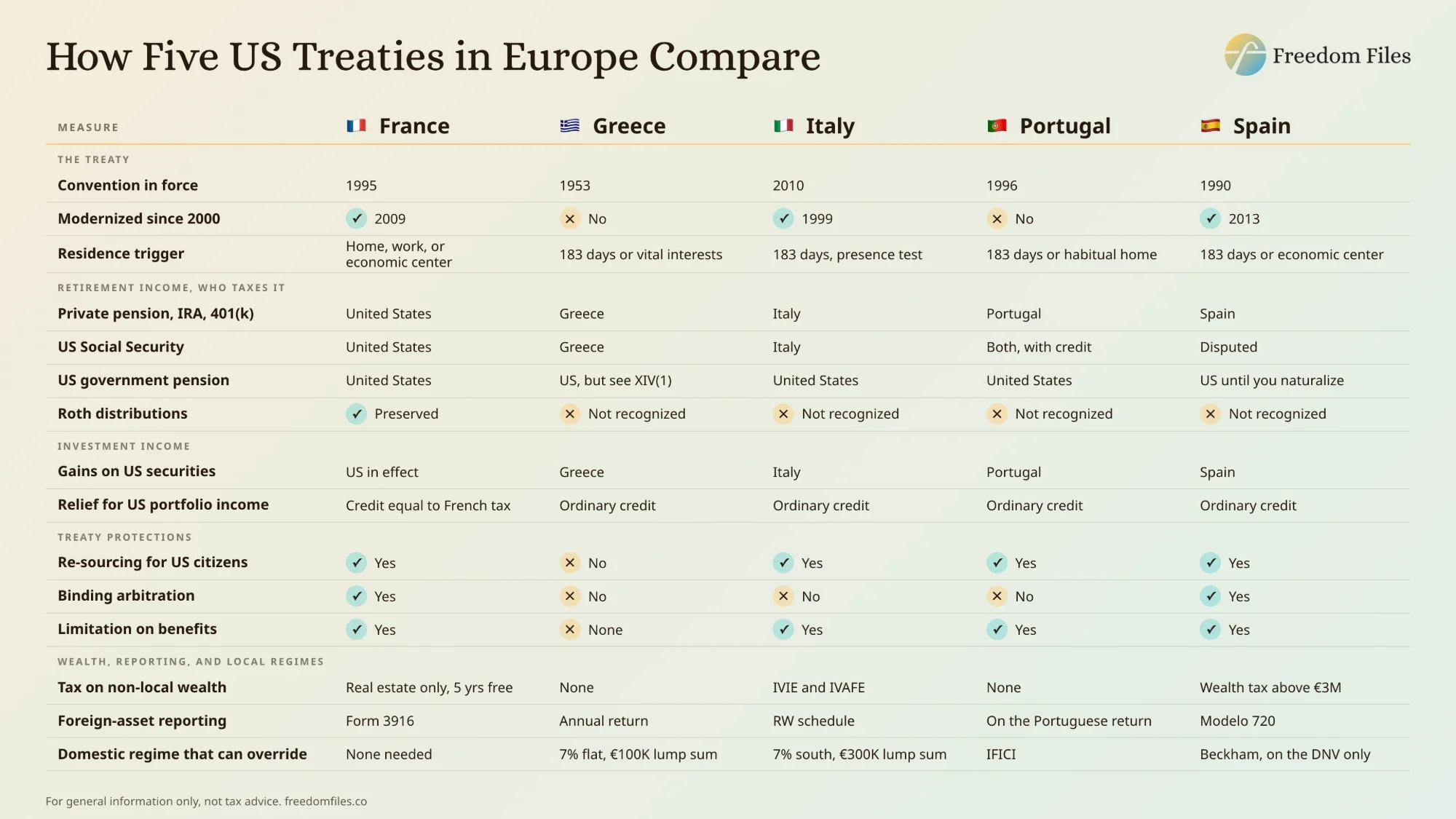
The chart below compares all five conventions on 15 measures, from the year each treaty took effect to who taxes your pension, Social Security, and Roth distributions, and which domestic regime can override the treaty result.
The US tax treaty comparison as a table
| Measure | France | Greece | Italy | Portugal | Spain |
|---|---|---|---|---|---|
| The treaty | |||||
| Convention in force | 1995 | 1953 | 2010 | 1996 | 1990 |
| Modernized since 2000 | Yes, 2009 | No | Yes, 1999 | No | Yes, 2013 |
| Residence trigger | Home, work, or economic center | 183 days or vital interests | 183 days, presence test | 183 days or habitual home | 183 days or economic center |
| Retirement income, who taxes it | |||||
| Private pension, IRA, 401(k) | United States | Greece | Italy | Portugal | Spain |
| US Social Security | United States | Greece | Italy | Both, with credit | Disputed |
| US government pension | United States | US, but see XIV(1) | United States | United States | US until you naturalize |
| Roth distributions | Preserved | Not recognized | Not recognized | Not recognized | Not recognized |
| Investment income | |||||
| Gains on US securities | US in effect | Greece | Italy | Portugal | Spain |
| Relief for US portfolio income | Credit equal to French tax | Ordinary credit | Ordinary credit | Ordinary credit | Ordinary credit |
| Treaty protections | |||||
| Re-sourcing for US citizens | Yes | No | Yes | Yes | Yes |
| Binding arbitration | Yes | No | No | No | Yes |
| Limitation on benefits | Yes | None | Yes | Yes | Yes |
| Wealth, reporting, and local regimes | |||||
| Tax on non-local wealth | Real estate only, 5 years free | None | IVIE and IVAFE | None | Wealth tax above €3M |
| Foreign-asset reporting | Form 3916 | Annual return | RW schedule | On the Portuguese return | Modelo 720 |
| Domestic regime that can override | None needed | 7% flat, €100K lump sum | 7% south, €300K lump sum | IFICI | Beckham, on the DNV only |
The pattern: The older the text, the thinner the protection, and Greece proves it. In four of the five, the treaty is only the floor, and your real rate comes from domestic law and regimes that a future government can change without notice. France is the one country where the protection lives inside the convention itself. For the rate side of the equation, our breakdown of all 15 European special tax regimes covers every regime mentioned here and more.
Which Country Fits Your Income Mix
- US portfolio, IRA distributions, and Social Security: France.
- Private pension and passive income, moving full time: Greece's 7% regime.
- Remote work billing US clients: Spain under the Beckham Law, for six years.
- Federal or military pension: Spain, Portugal, Italy, or France protect it; Greece may not.
- Residency with minimal time on the ground: The Portugal or Greece golden visas, Italy's investor visa, or France's Passeport Talent, none of which requires tax residency.
- Very high foreign income: Italy's €300,000 or Greece's €100,000 lump sum.
Change one input in your income mix and the best country changes with it. To compare all five side by side, download the free US tax treaties in Europe guide. To turn it into a shortlist, take the Plan B Blueprint for a custom outline of the residencies and citizenships that fit your goals, or book a free Freedom Consult. If you're building across borders, with multiple residencies, citizenships, banking, and the tax layer underneath, our Private Client Engagement coordinates all of it.
FAQ
Do US Citizens Pay Double Tax If They Live in Europe?
Generally no. The US taxes citizens on worldwide income wherever they live, but the foreign tax credit (Form 1116) cancels US tax on income a European country has already taxed, and each tax treaty decides which country gets first claim on each kind of income. In practice you pay roughly the higher of the two countries' bills on any given dollar, not the sum.
Which European Country Has the Best Tax Treaty for Americans?
France. Under Article 18 of the US-France treaty, US pensions, IRA and 401(k) distributions, and Social Security are taxable only in the United States, and Article 24 grants a credit that cancels French tax and social charges on US dividends, interest, and gains on listed US securities. Qualified Roth distributions stay untaxed in both countries.
Does Portugal Tax US Social Security?
Yes. Under Article 20-1-B of the US-Portugal treaty, both countries can tax US Social Security, and Portugal relieves the overlap with a credit. With the Non-Habitual Resident regime closed to new applicants, Portuguese rates of up to 48% plus a solidarity surcharge apply to most retirement income.
Does Spain Tax US Social Security?
It's disputed. Article 20-1-B of the US-Spain treaty says Social Security may be taxed in the United States. Spain's tax agency, backed by binding rulings from the Dirección General de Tributos, reads that as non-exclusive and taxes the benefit with a credit for US tax, while many advisers read it as US-only. Get a written position before you become a Spanish tax resident.
Does Italy Tax US Social Security?
Yes. Article 18-2 of the US-Italy treaty gives US Social Security to the country of residence, so an American tax resident in Italy pays Italian tax on it. Federal, military, and foreign-service pensions, by contrast, remain taxable only in the United States.
Can You Get Residency in Europe Without Becoming a Tax Resident?
Yes. The Portugal and Greece golden visas, Italy's investor visa, and France's Passeport Talent require little or no time in the country, so you can maintain the permit without spending the 183 days a year that usually triggers tax residency. Tax regimes like Greece's 7% flat tax, Italy's southern 7% regime, and Spain's Beckham Law all require full tax residency.