Colombia elected an outsider on June 21, 2026, and investors who had written the country off started circling within the week. The question is whether the celebration is out ahead of the substance. This piece walks through who Abelardo de la Espriella is in reality, what his platform means for capital, how the Colombian investor visa works in 2026, where the tax math lands, and whether the country belongs on your Plan B shortlist, all with the caveats that a hard read of Colombia deserves.
Or watch the deep dive here:
Who Is Abelardo de la Espriella?
On June 21, Colombia saw a presidential runoff few people expected twelve months earlier. Abelardo de la Espriella won 49.7% against leftist senator Iván Cepeda, who took 48.7%, a margin of roughly 250,000 votes on the highest turnout since 1994. He is sworn in on August 7.
He is a newcomer. He has never occupied public office. His profile was built as a high-profile criminal defense lawyer, a "devil's advocate" reputation from the controversial clients he took on, and as a businessman. Fitting for a piece about jurisdictional diversification: he owns Italian citizenship, took US citizenship in 2023, and maintains residences across several countries. The man Americans are now watching is himself a multi-passport portfolio owner.
His movement, Defensores de la Patria (Defenders of the Motherland), assembled quickly around a two-pillar message: security and the economy.
What His Platform Says in Plain Terms
Security, the Hardline Half
The security promises are blunt. Scrap the peace talks with armed groups like the ELN and FARC dissidents. Launch a 90-day US-backed air campaign against them. Build 10 so-called mega-prisons, explicitly modeled on Nayib Bukele's approach in El Salvador. Destroy the roughly 330,000 hectares of coca that drive Colombia's record cocaine production and account for about 4% of GDP. Use express asset forfeiture to seize cartel money.
The context is important. Armed groups grew by more than 23% under the last administration, and extortion and kidnapping climbed with them. Security was the number one issue at the ballot box.
The Economy, the Investor Pitch
The economic side is built for capital:
- Cut taxes and shrink government by as much as 40% in his own framing
- A "one-in, two-out" rule on regulation, two regulations deleted for each new one
- Reopen oil, gas, and mining, after the last government froze new natural-resource contracts
- A domestic home ownership plan built on 2% mortgages over 30 years
- A growth target of 7% a year, with South Korea and Singapore named as the models
De la Espriella is inheriting a difficult starting position. 2025 GDP growth came in at 2.6%, below expectations. The fiscal deficit hit 6.4% of GDP. Colombia lost gas self-sufficiency in late 2024 and is now importing close to 17% of its gas, while oil exploration investment fell 42% over three years. The pro-energy push is aimed squarely at that gap, which makes the reopening thesis interesting, and the 7% target a stretch.
One complication worth flagging: he is not a pure austerity hawk. He has said he will preserve the previous government's 23% minimum wage hike and several popular social programs. So the picture is a security hardliner and a market reformer who is also trying not to gut the safety net.
The Bukele and Milei Comparisons, Plainly
The template here borrows from two of the most-watched leaders in the Western Hemisphere.
Nayib Bukele in El Salvador took the murder capital of the world and turned it into one of the safest countries in the Americas through a security-first crackdown. The results are striking. So are the trade-offs. His state of emergency and mass incarceration have drawn heavy civil-liberties criticism internationally, alongside his roughly 90% approval at home. If the security template is what you are betting on, this is the model.
Javier Milei in Argentina has taken a libertarian chainsaw to the state, brought triple-digit inflation down hard, and delivered a sharp recession and a spike in poverty before any recovery could start. That is the market-reform template.
De la Espriella is not promising Milei's full chainsaw, and Colombia is not El Salvador. Colombia has stronger courts, an independent press, and a Congress the new president does not control. Those institutions will check him, which both limits how far he can push toward authoritarianism and limits how fast the reforms above can move. That is worth pricing in on both sides of the ledger.
The Thesis for Capital, and the Pushback
The shorthand: Latin America has historically offered low tax or safety, rarely both. The new wave is trying to deliver both at once. Colombia is the latest test of that idea. Promising, unproven.
The energy thesis is the cleanest example. If de la Espriella truly reopens oil and gas exploration, that sector is set to reprice, and it can reprice heavy. Real estate is another, yields in Medellín, Bogotá, and Cartagena have been rising against a peso that has already started to move on the political shift.
The counter-case is not hard to write either. A hard security campaign can turn volatile before it turns safe. The peso swings. Reforms can die in a Congress the president does not control. And the enthusiasm on the ground is uneven: Cepeda in fact won more departments than de la Espriella did, 18 to 14, with Bogotá and much of the outer regions voting the other way. Roughly half the country is uneasy about where this goes. Do not mistake the mood in Medellín's Antioquia department for a national consensus, because there isn't one.
Why Colombia Works as a Base Regardless of the Election
The reason capital is paying attention now is not just election night. It is the full stack, and most of it was already in place:
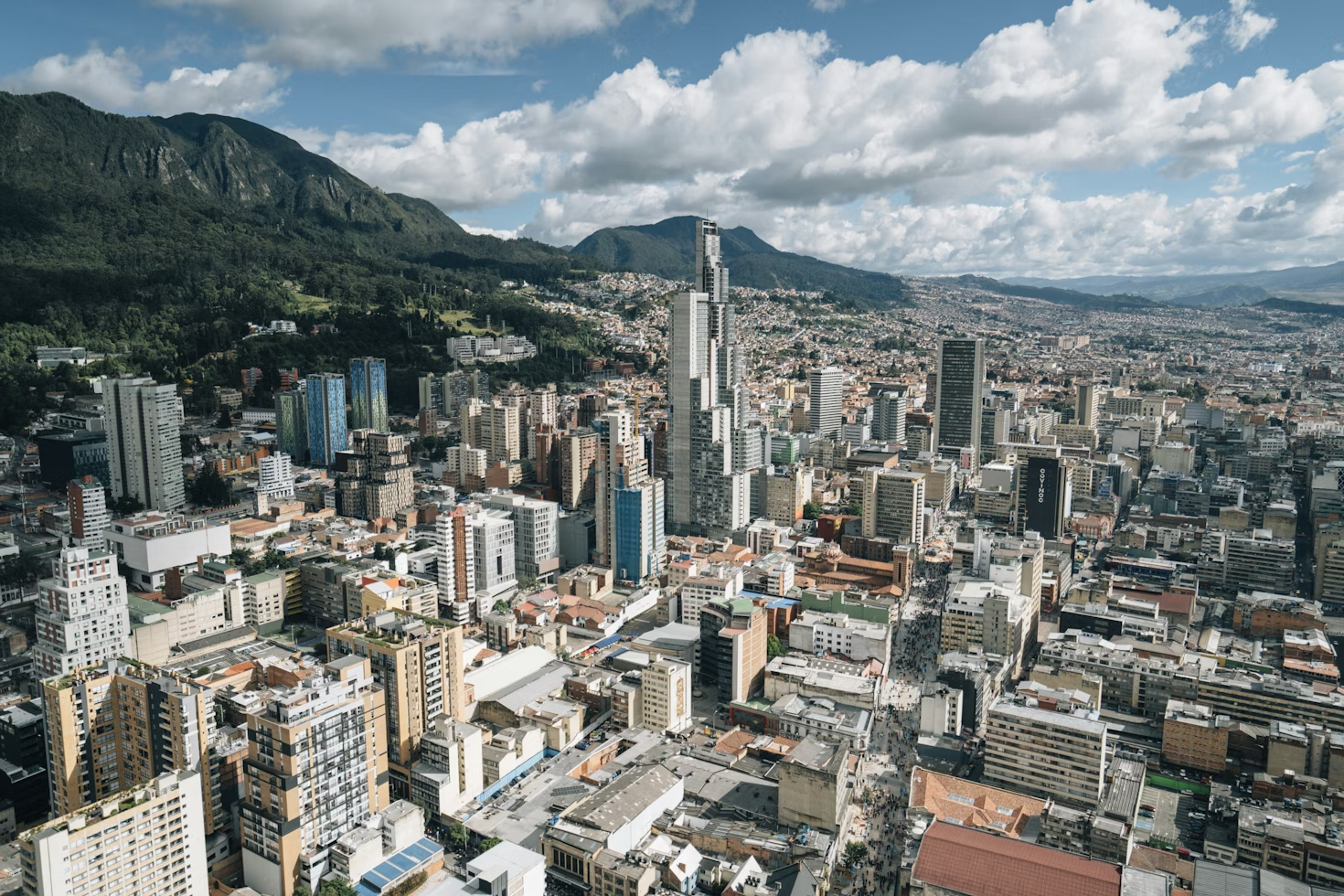
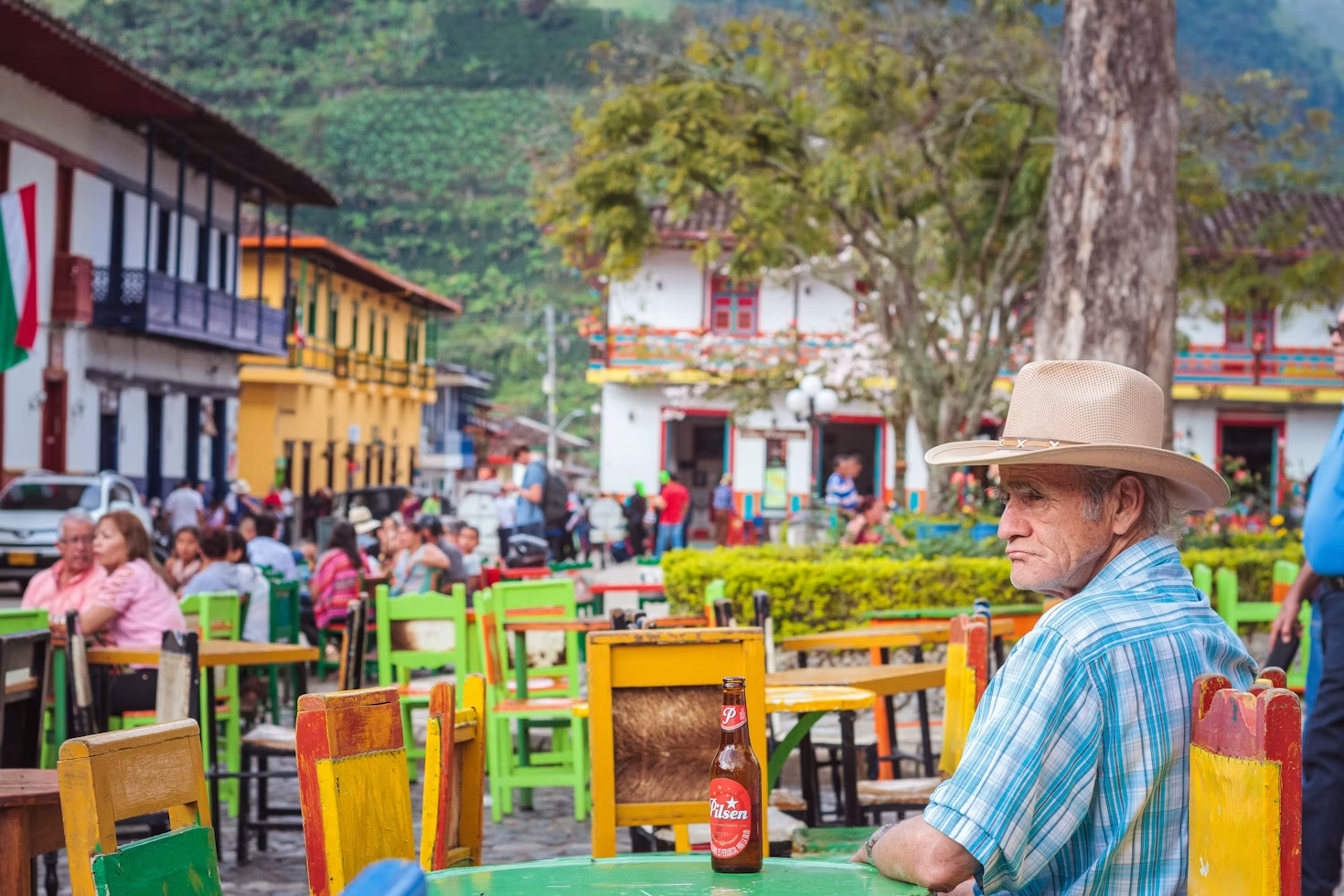
- Some of the most livable cities in the Americas, Medellín's eternal-spring climate, Bogotá's high-altitude cool, Cartagena's Caribbean coast
- US Eastern time-zone alignment, unbroken by daylight saving
- A three-hour flight from Miami; direct service to roughly 25 to 30 US cities from Bogotá and Medellín
- Private healthcare that ranks among the best in Latin America, at a fraction of US costs, plus a medical-tourism industry that has grown into a serious sector
- A growing economy with real depth, not a single-industry frontier bet
Add a pro-business government on top of those fundamentals at a moment when peso and asset prices have already started to move, and the case for moving earlier rather than later becomes coherent. It is not a guaranteed trade, but it is a trade with the structure of an early call rather than a late one.
How the Colombian Investor Visa Works in 2026
The route for most investors is the migrant visa in the investor category, the M-6, often just called the Investor Visa. Two ways to qualify:
Real estate route: Purchase Colombian property (buildings or land) worth at least 350 times the current Colombian monthly minimum wage. With the minimum wage's 23% jump in 2026, that puts the current threshold around US$165,000 to US$175,000. The title has to be in your name, and the underlying capital inflow has to be registered with Banco de la República (the central bank). The FDI registration step is where most self-guided applicants stall, it is not optional, and correcting it after the fact is expensive.
Business investment route: Put roughly US$50,000 to US$55,000 (100 times the minimum monthly wage) into a Colombian company you partly or wholly own. Sole proprietorships qualify. The structuring counts more than the number.
Both thresholds are pegged to the Colombian minimum wage, which is dollar-adjusted annually. Because the minimum wage climbed 23% for 2026, the dollar figure now lands meaningfully higher than a year ago. Budget above the minimum to give yourself renewal headroom, falling under the threshold at renewal, because of peso strength or a wage bump, is one of the most common ways applicants lose the visa.
What the visa gives you in practice. Approval delivers a temporary residency valid for up to three years, not permanent residency. Colombia scrapped its old "instant" golden-visa concept a few years ago, and the current investor visa is deliberately a slower path. Presence rules are light: your visa only lapses if you are outside Colombia for more than 180 consecutive days. In practice, entering Colombia once every six months preserves it, so you can retain your US base while building Colombian optionality.
For the full walkthrough of the visa and the country hub, see the Colombia Investor Visa page and the Colombia country brief.
The Road to a Colombian Passport, 10 Years, Plainly
Five years on the M-visa unlocks the R-visa (permanent residency). Another five years on the R-visa unlocks the citizenship petition. That is 10 years total to a Colombian passport, counted from the date your original M-visa was approved. Marriage to a Colombian citizen or a Colombian-born child shortcuts the clock to two years; short of that, this is the plain number.
The 2026 reform note worth flagging: Colombia's V-category (Digital Nomad Visa) is a temporary permit and does not count toward the naturalization clock. If a passport is the goal, the citizenship clock only starts on an M-visa. A lot of applicants confuse the two routes; the V-visa is a fine short-term base for a one-to-two-year trial stay, but not a first step toward citizenship.
The Tax Math, Two Things You Cannot Ignore
Colombia taxes residents on worldwide income once you cross 183 days of presence in any rolling 365-day period. That is not a calendar-year rule, it can span June to June, not just January to January. Cross the threshold and Colombian tax residency kicks in, and progressive resident rates top out at 39%.
As a US citizen, you owe US tax on worldwide income regardless of where you live. No second residency, no second passport, no jurisdictional structuring changes that basic fact, the US taxes its citizens, not its residents.
Colombia and the US do not have a comprehensive income tax treaty. Foreign tax credit mechanics on both sides typically soften the double-taxation exposure for most clients, but the softening happens through Form 1116 on the US side and Colombian counsel on the local side. This is not a jurisdiction to hit blind, US-licensed counsel and Colombian counsel need to be in the room before you trigger residency, not after.
Colombia Versus Its Regional Peers on Speed to a Passport
Colombia has some of the lowest financial bars and the lightest presence rules of its regional peers, but the longest road to a passport. That trade-off is worth naming clearly. If speed to a second citizenship is your top priority, three regional programs are materially faster:
- Argentina, naturalization after two years of legal residency; end-to-end typically three to four years including the court phase
- Brazil, naturalization after four years of legal residency; one-year fast-track for parents of a Brazilian-born child
- Dominican Republic, permanent residency from day one, then a two-year citizenship petition
If quality of life on a lighter financial and presence bar is the priority, Colombia is competitive with anyone. The 10-year clock is the price you pay for those advantages, not a flaw in the program.
The Verdict, Bullish, Eyes Open
The read from where we stand is bullish, with the caveats above preserved intact. The fundamentals were already in place before de la Espriella was elected. The politics just turned meaningfully friendlier for capital. Asset prices have started to move but have not caught up to the underlying story yet. The people moving now are early, if the thesis plays out.
The counter-case is not hard to write. Reform can die in a Congress the president does not control. Security campaigns often turn volatile before they turn safe. The peso swings hard on political noise. The 10-year passport clock is a long relationship to make with a country before you know how the next two elections resolve. All of those are real.
The right way to place Colombia in a plan is for the trajectory and the fundamentals, livable cities, US time zones, a light presence rule, a low investment bar relative to European alternatives, with the election read as a bonus that could accelerate the trade, not the entire trade. The bet is on Colombia the country, with a friendlier political tailwind priced in as upside.
Where to Go from Here
If Colombia is already the answer for your situation and the question is process, a fifteen-minute chat is the fastest way to walk through the investor visa in detail. If you are yet choosing between Colombia and a peer, the Panamanian Qualified Investor Visa, say, or a European route on a longer horizon, the Freedom Consult is the better fit; we work backward from your goals and tell you whether Colombia is the right call.
Book a call when you are ready.