Colombia has just elected an outsider they call El Tigre and investors who once wrote this country off are circling. Is it time to buy in? It depends on what the celebration videos are leaving out. By the end of this video, you'll know whether Colombia belongs in your Plan B portfolio or if it doesn't. So, who is El Tigre?
On June 21st, Colombia had a runoff almost nobody predicted a year ago. Abelardo de la Espriella won with 49.7% against the leftist senator Iván Cepeda, who got 48.7%. So that's a margin of only 250,000 votes on the highest turnout the country has seen since 1994. Abelardo is sworn in on August 7th. But who is he? The man is a newcomer. He has never occupied public office. He built his name and his fortune as a high-profile criminal defense lawyer, one some Colombians nicknamed the devil's advocate for the controversial clients he has taken on. He's also a businessman and fittingly for this video, an Italian citizen and a US citizen since 2023 with homes in many countries around the world. The man Americans are now watching is himself a multi-citizenship passport portfolio guy. Twelve months ago, he was not even a contender. Like I said, de la Espriella came from almost nowhere, writing a security message and a movement he named Defenders of the Motherland or Defensores de la Patria.
So what does he want to do once he is in control of the government? His platform leans on two main pillars, those being security and the economy. On security, the promises are pretty blunt. He wants to scrap the peace talks with armed groups like ELN and FARC. He wants to launch a 90-day US-backed air campaign against them. Build 10 so-called mega-prisons, à la Bukele in El Salvador, which we'll come back to in a second, dismantle the roughly 330,000 hectares of coca that have driven record cocaine production and 4% of the Colombian economy, and finally use express asset forfeiture to go after the money of those cartels. There is a problem behind those numbers, though. Armed groups grew by more than 23% under the last socialist government and extortion and kidnapping climbed with them. So security was the number one issue for his voters.
Now on the economy, the pitch is built for investors, people like you. Cut taxes and shrink the size of the government by as much as 40% in his own framing. And again, we'll come back to a very similar program and system that Javier Milei has in place down in Argentina. One in, two out on regulation, meaning two regulations deleted for every new one that the government creates. Reopen oil, gas, and mining after the last government froze new natural resource contracts. A home ownership plan for locals with 2% mortgages over 30 years. A growth target of 7% a year with South Korea and Singapore named as the model. Make of that as you wish.
Now, Abelardo inherits a tough hand. Candidly, growth in 2025 came in at just 2.6%, below expectations. The fiscal deficit hit 6.4% of GDP, and Colombia has lost its gas self-sufficiency at the end of 2024 and began importing close to 17% of its gas, while oil exploration investment fell 42% in three years. His pro-energy push is aimed at that big issue, and that makes the opportunity even greater. And the 7% target a stretch at the same time. One more thing that complicates this whole framing. He is not a pure austerity hawk. He has said he will maintain the previous government's 23% minimum wage hike and several popular social programs. So this is a security hardliner and a market reformer who is also trying not to gut the safety net here in Colombia.
Now if this feels familiar, it should. De la Espriella is borrowing from two of the most watched leaders in the Western Hemisphere. The first is President Nayib Bukele in El Salvador. Bukele took the murder capital of the world and turned it into one of the safest countries in the Americas through a security-first crackdown. The results are striking, yes, but so have been the trade-offs. His state of emergency and mass incarceration have drawn heavy civil liberties criticism across the world, not just in El Salvador. But he's also extremely popular, having received about 90% of the vote, I believe, in his last election.
The second is President Javier Milei in Argentina. Milei has taken a libertarian chainsaw to the state and brought triple-digit inflation down hard with a sharp recession and a spike in poverty before any recovery. Now that's the model on markets.
Now Abelardo is not promising Milei's full chainsaw and Colombia is not El Salvador. Colombia has stronger courts and independent press and a Congress that Abelardo does not control. Those institutions will check him. That limits how far he can push toward authoritarianism if you're concerned about that. And it also limits how fast he can push those reforms we just talked about.
So for your capital, the thesis is rather simple. Latin America used to offer low tax or safety. Rarely both. The new wave is trying to deliver both at once. Colombia is the latest test of that idea. Promising yet unproven.
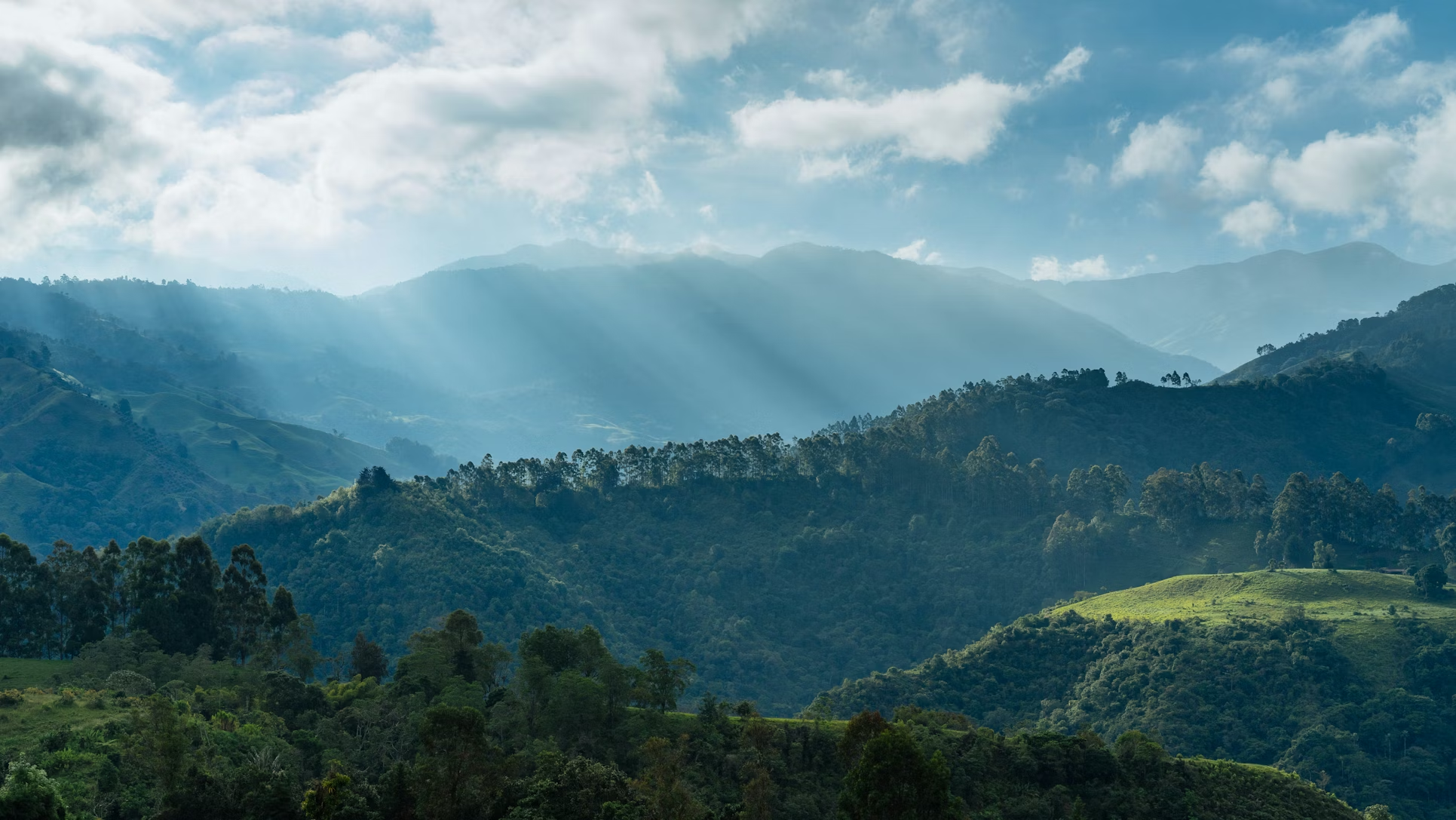
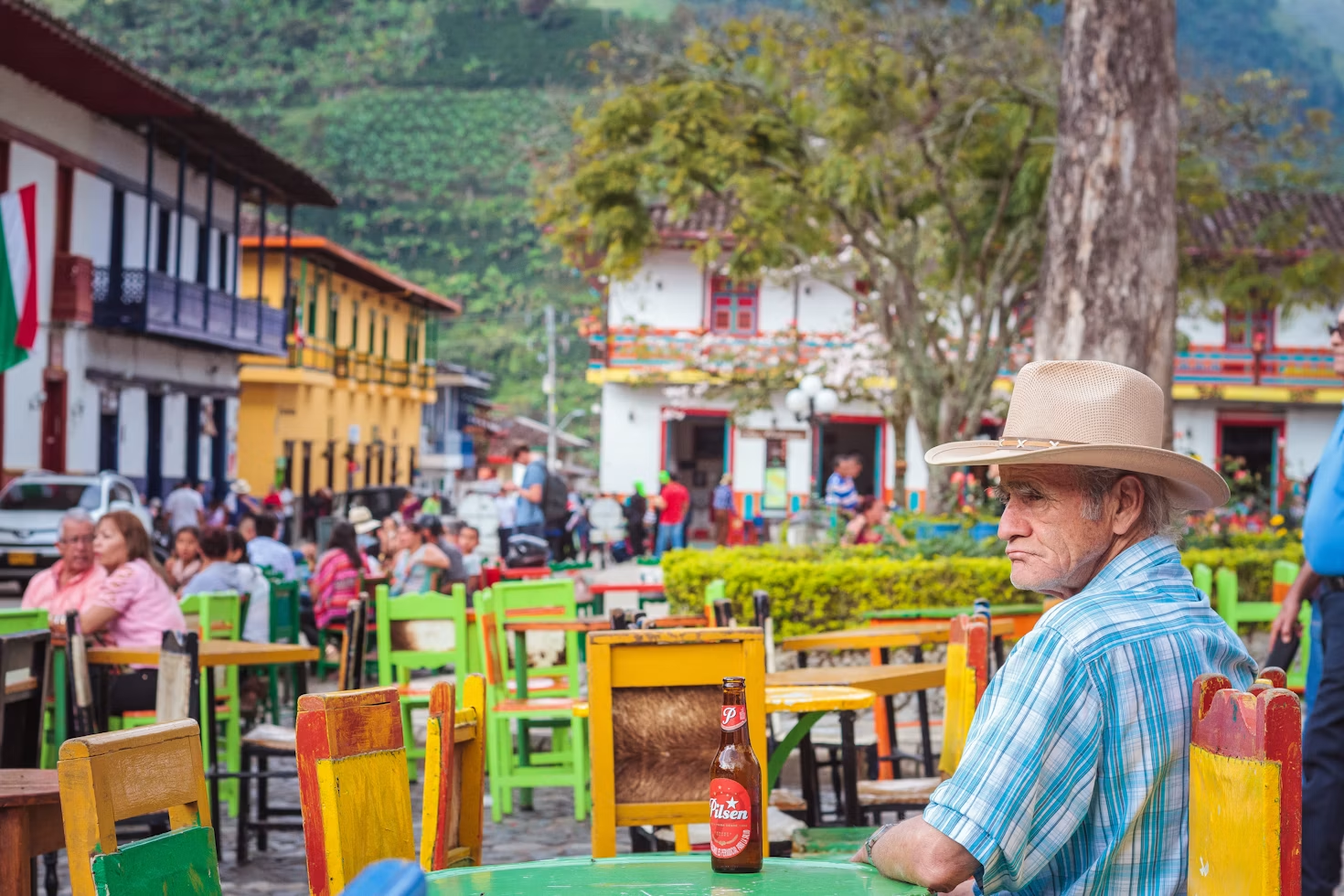
Look, I love Colombia, but I am not going to sell you a fantasy. I have been based in Medellín for years. I invested here in 2023. I speak the language. My family is here. Antioquia, the region around Medellín, the department is what it's called here, is conservative, entrepreneurial, business first country. And by my read walking around this city and interacting with people all the time, something like 75% of people I talk to are thrilled about this election. But warts and all that is Antioquia. It is a department. It is not the country. Cepeda in fact won more departments than Abelardo did. 18 to 14 to be exact. And as is tradition, Bogotá and much of the outer regions went the other way. Roughly half of Colombia is uneasy about where this goes. Now, don't mistake the energy in Medellín for a national consensus because that's not the case. There isn't really one.
Now, if you are weighing Colombia against other countries and you don't yet know where you fit, that is what we designed the Freedom Consult for. We are jurisdiction agnostic and we work backward from your goals and we will tell you if Colombia is the right call or the wrong call for you and your situation.
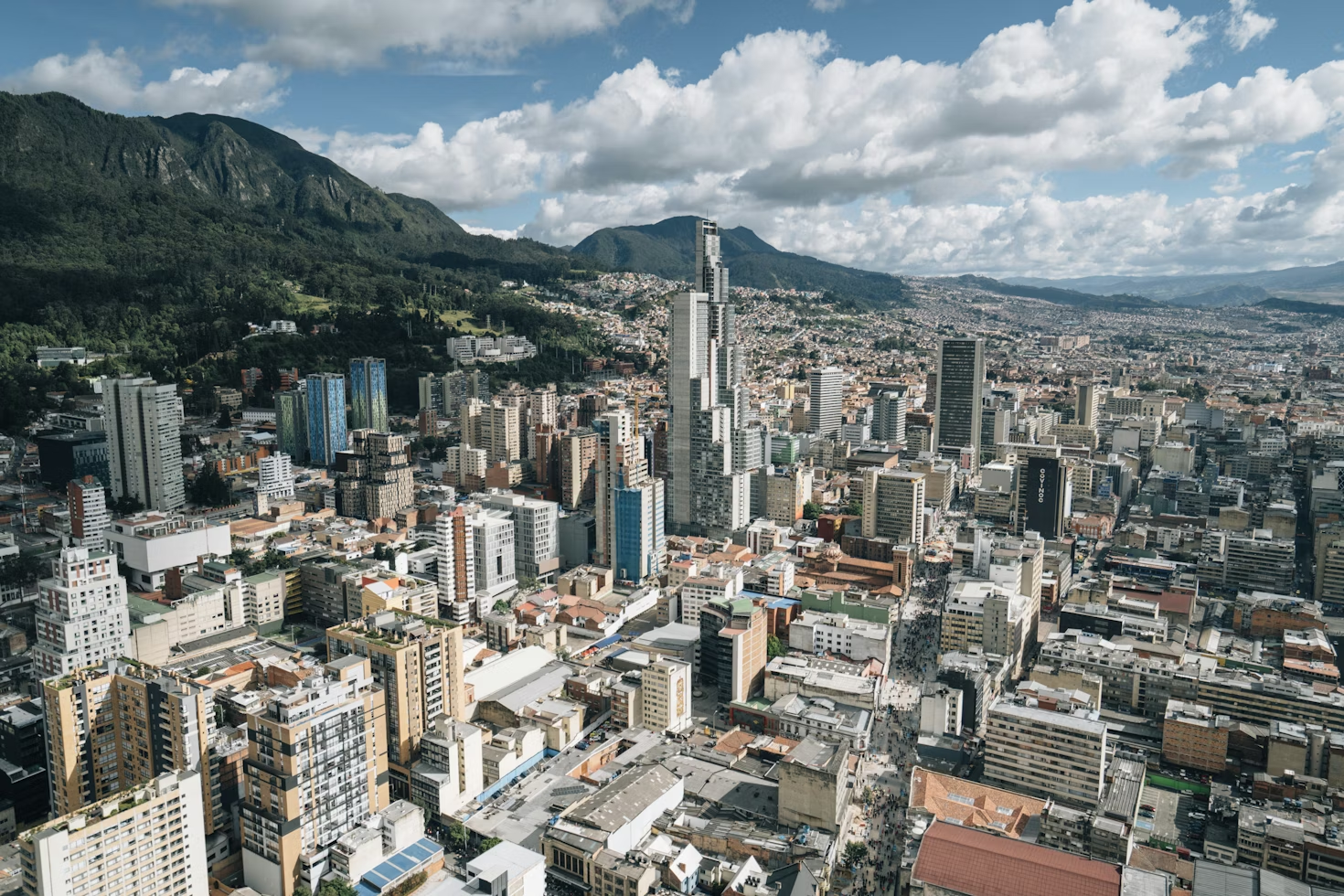
So the reason capital is really paying attention now to Colombia is not just this election night. It's the full stack. You already had the fundamentals. Some of the most livable cities in the Americas in Medellín and Bogotá, US time zone alignment, private healthcare, and a booming medical tourism industry that ranks among the best in Latin America. A growing economy with depth. Now add a pro-business government on top at a moment when the peso and local asset prices have already started to move and reflect it. If the thesis plays out, the people moving now are early.
Energy is the cleanest example here. If Abelardo reopens exploration, that sector is going to reprice and it's going to reprice heavy. Real estate is another. Don't believe the marketing that this is a sure thing. Of course, a hard security campaign can turn volatile before it turns safe. The peso swings. Reform can die in a Congress that again, Abelardo does not control. We always report the cons as loudly as the upside in this case.
The route for most investors is the migrant visa in Colombia, the investor category. Now, there are two ways to qualify. One of them being real estate by which you must purchase property and that includes land worth at least 350 times the monthly minimum wage which in 2026 is about $165 to $175,000 and that has to be titled in your own name. It has to be registered with the central bank. It's kind of a tricky process and that's why we help. The other route is a business investment. Put roughly $50,000 to $55,000 US, which is 100 times the Colombian minimum monthly wage into a Colombian company that you partly or wholly own, you can qualify.
The investment bar is pegged to the minimum wage, which I just explained, and that jumped 23% in 2026. So, dollar figures shift with the peso, and you should budget above that minimum in order to renew your visa when it comes up for renewal in one, two, or three years. This is a mistake that a lot of people make here. This is not instant permanent residency. Colombia scrapped its old instant golden visa a few years ago. What you get on approval is temporary residency, which is again valid up to three years. Additionally, presence rules are light. Your visa only lapses if you're outside of Colombia for more than 180 consecutive days. In practice, entering once every six months maintains it, so you can leave your base in the United States or wherever you are. Five years on the investor visa to qualify for the permanent residency R-visa, then five more years before you can apply for citizenship in Colombia. So that's 10 years total to a Colombian passport. Now that can drop to five years if you marry a Colombian, but I know that's a niche situation.
So on tax, two things you cannot ignore here. Colombia taxes residents on worldwide income once you cross 183 days in the country in any 365-day period, not a calendar year. So that could be June to June instead of just January to January. And as a US citizen, of course, you are taxed on your worldwide income no matter which passports you own. No second residency changes that fact. Now, tax treaties and foreign tax credit mechanics can soften the double-taxation blow in most cases, but you need cross-border tax professionals for your own numbers and situation. And know this comparison: Colombia has some of the lowest financial bars and the lightest presence rules of its regional peers, but the longest road to a passport. So if speed to a second citizenship is your priority, Brazil, Argentina, the Dominican Republic can grant citizenship far faster than Colombia can.
The reason it works for working Americans is access and lifestyle. Colombia is on a lot of the same time zones as the United States. It's a three-hour flight from Miami, both Bogotá and Medellín with direct service to about 25, 30 US cities. Your business and your family back home do not skip a beat if you're spending just a few months a year here in Colombia.
Now, if you already know Colombia is your play and you want to start or you have direct questions about the investor visa, for example, you can book a free 15-minute chat with us and we'd be happy to spell out the process. But if you're deciding between Colombia and somewhere else or the Colombian investor visa and the Panamanian qualified investor visa, for example, the Freedom Consult is a better fit so we can give you the full picture.
So, is it time to invest? My read is bullish, but my eyes are open. The fundamentals were already in place before Abelardo was elected. The politics just turned, I think, a little bit more friendly. The assets have not caught up yet. I am long Colombia and I have been for years, warts and all. And if you go in, go in for the trajectory and the fundamentals.
I want to know where you land though. Would you put capital into Colombia right now or would you wait for the dust to settle? Drop your answer in the comments below. I read every single reply. I'm curious.