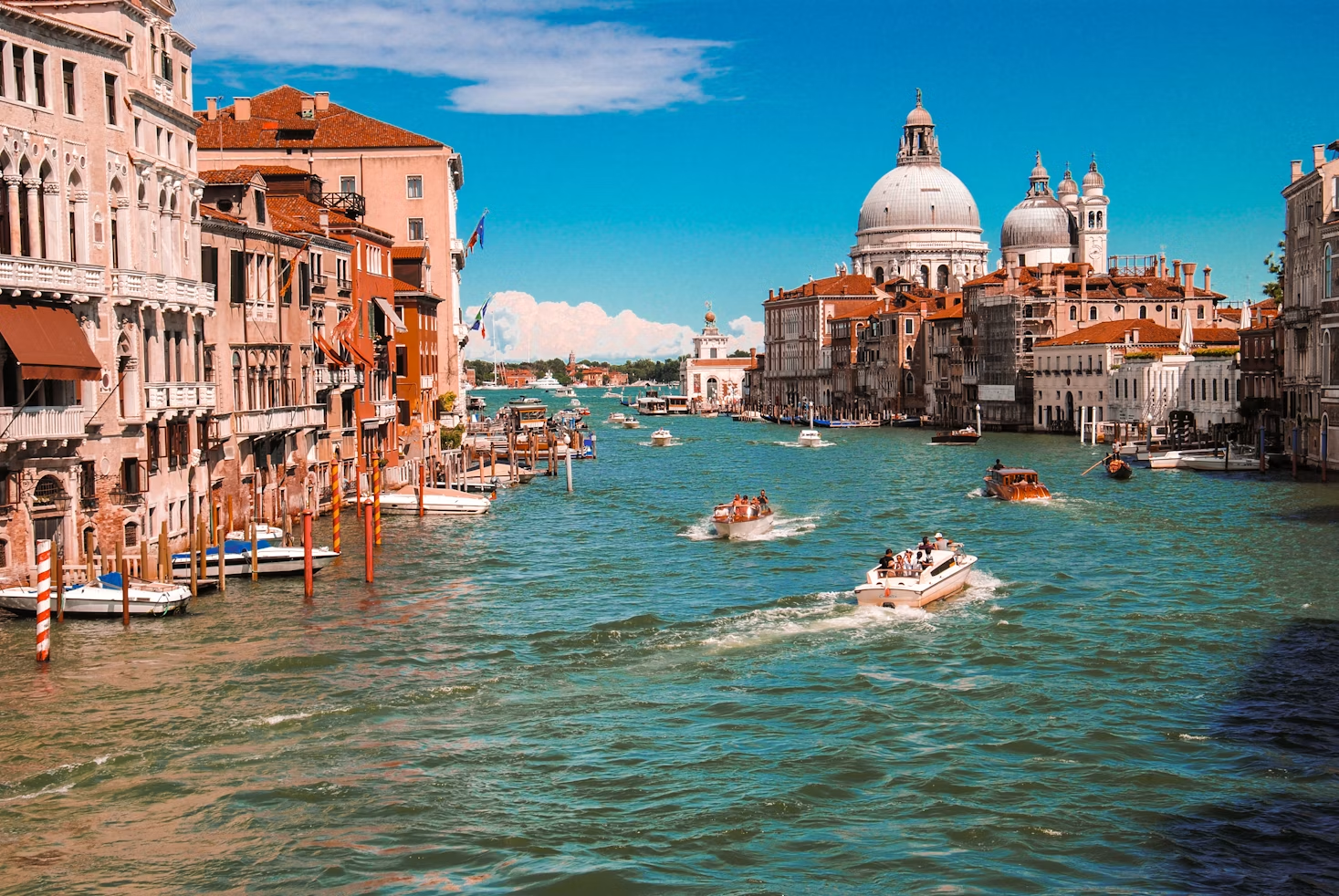
Most Americans think they have to wait until 67 to retire. But there's a little known path to retire in Italy now, not in five or 10 years, complete with natural beauty, lower prices and taxes, ancient history, the world's best food, and good healthcare. If you're craving more freedom and meaning in your next chapter, this could be the video that you look back on as the turning point. By the end, you'll know exactly why Italy is an incredible expat destination and how to make it your new home, as well as my personal opinion of what the right path for you is. Let's get into it. So, first off, why are our US expat clients increasingly choosing Italy as their retirement destination? The answer might truly surprise you. Retiring in the US is getting more expensive and more uncertain. Housing costs, health care bills, inflation, and taxes are forcing Americans to delay retirement or settle for less. This probably isn't news to you, right? Meanwhile, Italy offers not just a lower cost of living in taxes, but a higher quality of life. In many southern Italian towns, you can rent a two-bedroom apartment for under $800 a month and qualify for the 10-year 7% retirement income special tax regime. Or if you're a really high earnner, you can pay a flat €200,000 in tax every year in Italy without as much as a detailed tax return. For those particularly interested in healthcare costs, you'll pay around $1,000 a year for a high-end international private plan in Italy. Would you believe Italy's capital is cheaper than, let's say, Minneapolis of all places? Let's compare an average urban cost of living metric in the US, Minneapolis, with Rome, one of the most expensive cities in Italy, for a second. Check out this data. Meals, fresh produce, public transport, all dramatically cheaper in Italy than in the US. Cost of living in Rome is 17% lower, rent is 15% lower, and food prices are 18 to 30% lower. And if cost and tax isn't a big deal to you, how about the central location of Italy and Europe? get anywhere via rail or air in 2 to three hours. To the Alps for a a weekend ski trip, to the beach for a relaxing trip, to another historic European city for just a cultural romp. And that's not to mention all the natural wonders that Italy itself has. All this to say, Italy isn't just a nice place to visit. It can be a serious retirement upgrade for so many Americans. lower cost of living, potentially lower taxes thanks to those special tax regimes I mentioned, excellent food, blue zone culture where you'll live longer and healthier, walkable cities, more history than Americans can even appreciate and comprehend, and a couple legal affordable paths to get there that we'll cover in a second. So whether you're living off dividends or deploying capital, Italy has a visa that can work for you and a lifestyle obviously that in my opinion and that of 15,658 expats in Italy makes it worth it. Now let's discuss the Italian visa that most American retirees will qualify for. It's called the elective residence visa, and it doesn't require a job, a massive investment, or even a long list of qualifications. There's a catch, and if you misunderstand one piece of this process, it can fall apart really quickly. The predominant rule of eligibility for this elective residence visa, you need to prove that you earn at least €31,000 per year per applicant in stable recurring passive income. Things like pensions, dividends, retirement income, or rental income. But here's where most Americans mess it up. Remote work and more generally employment income does not count. This visa is not for freelancing on an Italian beach. In fact, it specifically forbids active work if you're approved and relocate to the country. If your income is not 100% passive, your visa will be denied or revoked later when you try to renew it. Of course, this visa application doesn't just require proof of income. You'll also need proof of accommodation for 12 months, international health insurance, a clean criminal record, and a few other bol requirements. Some consulates are also stricter than others. For example, Miami might reject an application that New York would accept just because the documentation isn't clear enough. But if you know how to present your criteria and case properly, which the Freedom Files does, is the easiest path to live in Italy full-time. You don't even need to buy property. You can rent. You don't even need to stay year round either, as long as you're a resident on paper and spend at least 6 months per year here. If you have about $35,000 per year per applicant in passive income, you can live legally in Italy with a renewable long-term visa and build toward permanent residency in 5 years. So, if you have passive income, this visa could be your fast track to laita. But what if you have capital to deploy and want more flexibility in Italy? That's where this second immigration path changes the game. Italy also offers an investor visa that's ideal for Americans with capital, but no fixed passive income stream. Unlike the elective residence visa, this residence program doesn't require income, just an approved investment. And the best part, one, you don't even have to invest until after your visa application is approved, which is rare. And two, the minimum stay requirement in Italy is zero. So no need for tax residency and taxes in general. The investor visa has four investment tiers, but most expats use one of the bottom two, the most affordable two. €250,000 in a certified Italian startup or business investment, or €500,000 into an investment fund in Italy. Both options offer a sizable return on your capital, but obviously nothing is guaranteed. And yes, the Freedom Files team in Italy can help you with your visa application and investment. These thresholds are significantly cheaper than comparable EU investor visas, as in Portugal, which requires 500,000 in nearly all cases, or Malta. Spain, by the way, has no path to residency or citizenship through investment. So, with this Italian investor visa, you get a 2-year residency permit, renewable for another three, and it leads to permanent residency in 5 years and citizenship intent. And as I alluded to earlier, investors are not required to live in Italy fulltime on the investor visa. Just visit occasionally and maintain the investment or sell your stuff in the US and relocate entirely if you so desire. But don't get cute. Trying to pause your investment midstream or swap out companies midcycle canvoid your permit entirely. And yes, this does take patience. The application includes a noosta, which is like a temporary residence card, police checks, and multiple government bodies, but it's far more navigable than it sounds, especially with guidance from our team. In fact, the investor visa application requires only about 2 or 3 months for approval. Compared to Portugal's Golden Visa, this is a walk in the park. An investor client of ours just got his residency card in Portugal 41 months after his investment. That level of bureaucracy is nuts. For Americans with capital, this Italian investor visa is one of the fastest ways to get European residency with minimal red tape and no physical presence rules. So, let's summarize. You and I both know that Italy is an incredible retirement destination for Americans. The quality of life you can unlock with the Italian residence visa or the investor visa is beyond most Americans comprehension. blue zone climate, Mediterranean cuisine, historic and walkable cities. As far as visas go though, this is what I recommend after helping many US retirees move to Italy. The elective residency is great for those without significant investment capital, of course, but because it requires 6 months of presence per year to renew. It works for those willing to live in a small southern Italy town and access that 7% special tax regime or those who don't even consider cost of living and taxes a big deal. On the other hand, the investor visa is great for those seeking flexibility. No investment required until you're approved in two to three months. No physical presence required, meaning you can gallivant the rest of Europe or the the world, while you maintain residency and avoid Italian taxes entirely. Italy offers one of the best retirement options for American expats in 2025. This is our pride and joy and what we do day in and day out, helping you live a healthier, happier, richer, freer life overseas. If you're considering moving to Italy, contact us on the website. And if Italy isn't your speed or you want to explore more options elsewhere in Europe, watch the video on your screen next. This is all about the Portugal D7, D8, and Golden Visas and why they may be a good fit for you. See you later.