

Oct 8, 20265 min read
Greece Wants 10% of Your Crypto Gains While Italy Takes 33%
Greece plans a 10% crypto tax, under a third of Italy's 33%. We think it beats most of Europe, and a 7% regime for new residents can beat it.
- Tax
- Europe
Most Americans abroad overpay the IRS by $22,000 a year and have no idea. A legal tool called the FEIE can shield your first $130,000 of income, and I'll walk you through claiming it without tripping the fine print.
Click to read the full transcript
Most Americans are overpaying the IRS by $22,000 a year and don't even know it. That money could buy topshelf healthc care in Portugal or a full year of early retirement in Vietnam. A secret yet legal hack called the FEIE exempts from taxes your first $130,000 of income per person per year. But if you miss even one small detail, you lose that sweet, sweet tax-free gift. So, let's walk through exactly how the FEIE works and how you can use it to build a freer, wealthier life abroad. Let's start with the basics. What is the FEIE and why should you care? The foreign earned income exclusion or the FEIE lets you exclude up to $130,000 in foreign earned income from your US federal tax return. If both you and your spouse qualify, that's over $260,000 of annual income tax-free. I'll talk about what that foreign earned income means in just a second. Yes, this is federal tax. We're talking about the big one. For many Americans living abroad, this exemption can reduce your tax bill to almost zero, especially if you have residents in a zero or low state income tax state. That's money you can put toward travel, a better health care plan, a beachfront property in Costa Rica, or just not working as long. So, what would you do with an extra $20,000 this year? Drop a comment down below. I'm curious. Now, here's what the FEIE is not. It does not apply to investment income, retirement income, or pensions. It doesn't mean you avoid all taxes, and it's not automatic. You have to qualify and file, but once you do, it's a major key to keeping more of what you earn, which is the ultimate goal, right? So, who qualifies for the FEIE? There are three boxes you need to check to legally exclude this income from your return. You must earn income from working abroad. This means you're self-employed and living overseas or working for a foreign employer or running a US company remotely as long as the work is done abroad. And remember, this is for earned income, not retirement distributions or investment gains. Two, this is where you work and live most of the time. If you're working remotely from Portugal or Thailand and not maintaining a base in the US, that becomes your tax home. And then three, you must pass one of the following two IRS tests. Number one, the physical presence test. You must be physically present outside the US for 330 full days in any 365day period. That's not a calendar year. So, you can't just bounce back and forth every couple weeks. Here's the beauty. You don't have to be in just one country. You can slow travel. You can nomad your way across continents or live in multiple countries. But if you do spend your time in just one country abroad, the next test is for you. Number two, the bonafide residence test. This one's generally trickier. You have to establish residency in a foreign country, show you've been there for a full calendar year, and prove your ties to that place with a lease, visa, bills, even join the local gym help. This is ideal for people who want to live abroad in a single place. Think early retirees, slows, or digital nomads who've picked their base. So, the big question is, how much can you actually save? In addition to the foreign earned income exclusion, you can add in these other benefits of living abroad. The foreign housing exclusion, which is like the sister of the FEIE, and lets you deduct part of your rent or housing costs overseas. In expensive cities, that can be another $50,000 or more. I'll do a separate video on this soon. Let me know if you want to hear about it. Double tax treaties with 60 to 70 countries around the world that prevent double taxation of your income. And finally, tax residency in a country that does not tax foreign income like Panama, Paraguay, or Malaysia. If you earn $125,000 a year as an employee while living abroad, have residence in a zero state income tax US state and qualify or the FEIE, you could owe the IRS nothing. Suddenly, you're earning more, keeping more, and living better than you ever could have back home. This is the thrill of living outside of America's borders. By the way, if you want to find the residency or citizenship program and destination that fit your situation and goals, take the Plan B Blueprint at freedomfiles.co/begin. Okay, let's summarize this quickly. To qualify for FEIE, you must earn income while abroad, have a tax base outside of the United States, and pass either the physical presence test or the bonafideed residence test. Don't forget that the US subjects its citizens to what's called citizenshipbased taxation, which means that even if you live abroad 365 days a year, forever, you still have to file a US tax return annually. If that sounds like a headache, you're right. That's why we always recommend working with an international tax pro before moving abroad. So, who is this FEIE perfect for? Typically, it's remote employees, freelancers and consultants, business owners living abroad, part-time contractors with location freedom. And with the rights setup, retirees can take advantage of FEIE in that last category. Just note that if you're self-employed, you still owe Social Security and Medicare. I'm in that boat, too. I get it. If you're making above that exclusion cap, more than $130,000 per year, you can still benefit. You'll pay tax only on what's left after the exemption. And with the right structure, you may still owe very little. Okay, here are the top FEIE mistakes I've seen US expats make. Maintaining residency and high tax states like California or New York that don't even recognize the FEIE regardless. Forgetting to file altogether. Yes, you still have to file. Using the FEIE when the foreign tax credit would have saved you more, we'll talk about this in a second. And finally, spending too many days in the US if qualifying or trying to qualify for the physical presence test. This is a really sad story. An American from Tennessee, which is a zero state income tax state, came to us last week after he lost $25,000 in tax savings because he returned to the US for his friend's birthday party and didn't account for his total days spent in the country. You need to track your travel days like your retirement depends on it because it very well may. This is a question we get often. Should you use the FEIE or the foreign tax credit, which is a credit for all the tax you pay in a foreign country? You cannot use both for the same income. It's either or. So, here's a quick rule of thumb for those who become tax residents in another country abroad. If you live in a lower no tax country overseas, we recommend using the FEIE. If you live, god forbid, in a high tax country like Canada, France, or Germany, the foreign tax credit is probably better. Most people spend their best years working for money they'll never get to fully enjoy. This is where working with experts like the Freedom Files pays off. We help you structure your life and income so you keep more of what you rightfully earned and live better. If you're earning income abroad, this FEIE could literally save you tens of thousands of dollars every single year. That's money you keep compounding years you gain back and freedom you feel now, not someday. Want help figuring it out? Book a freedom consult and let's map out your lower or even zero tax life overseas. Or take the Plan B Blueprint at freedomfiles.co/begin to find the residency or citizenship program and destination that fit your situation and goals. If you're ready to stop overpaying and start living, hit subscribe. You're just getting started.
More long-form and short-form coverage on the same topics, swipe sideways for the full strip.
Greece plans a 10% crypto tax, under a third of Italy's 33%. We think it beats most of Europe, and a 7% regime for new residents can beat it.

Americans who move to Europe don't pay full tax twice. A double tax treaty and the foreign tax credit decide who taxes your pension, Social Security, and portfolio. Here's how the US treaties with Portugal, Greece, Italy, Spain, and France work, why France is the most generous, and the residency routes into each.
 31 min
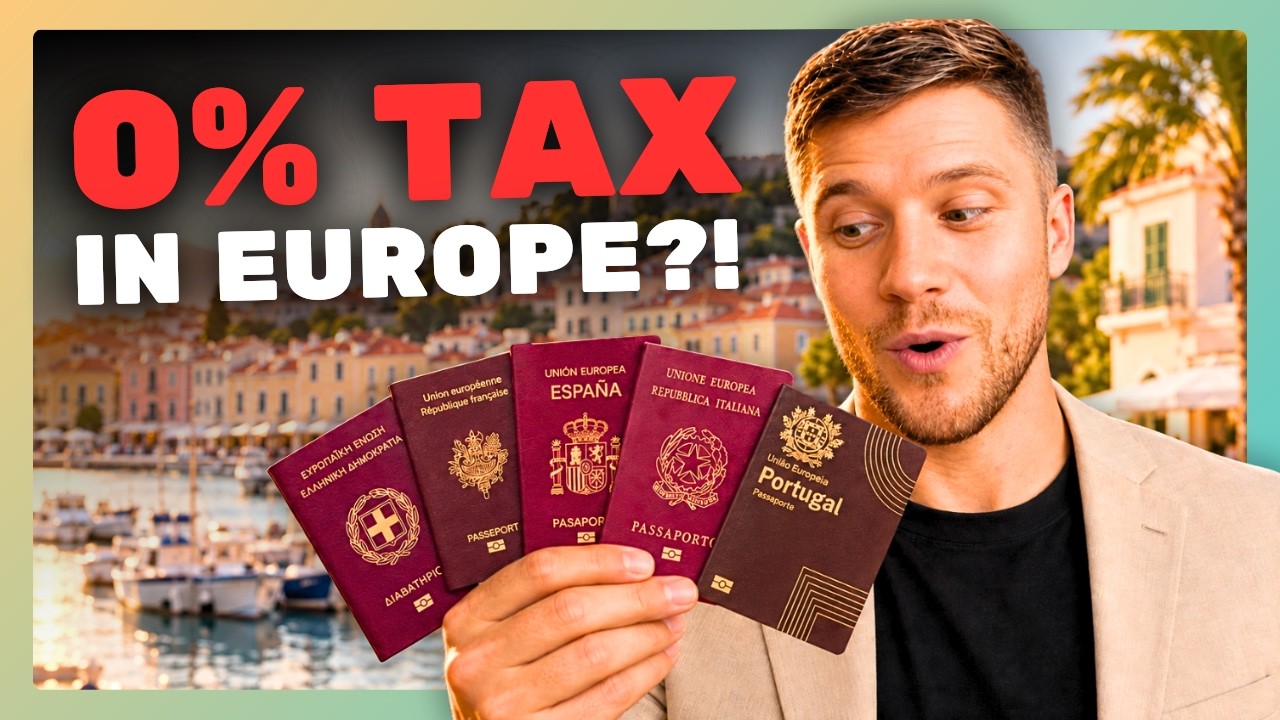
Europe doesn't have to be the tax trap most Americans think it is. As a US citizen living in most European countries, you avoid double taxation thanks to a bilateral tax treaty between that country and the United States. In this video, James from the Freedom Files covers how tax treaties and the foreign tax credit save you money, how 5 popular destinations treat your pension, IRA, 401(k), Social Security, and investment income when you move there, and how to get residency in Portugal, Greece, Italy, Spain, and France.

Greece plans to raise its transfer tax on non-EU home buyers from 3% to 15% in July 2027. We think it punishes investors and adds no housing.

File for Malta tax residency by December 31 or pay up to €100,000 more in tax. Our take on the new rules and who should move now.

Non-Americans can drop their total tax rate to 0% by establishing tax residency in the right jurisdiction; US citizens simply avoid a second tax bill on top of the IRS. Here are all 19 tax-friendly countries across 4 systems, from the UAE and the zero-tax island citizenships to Panama's territorial system, Turkey's new 20-year exemption, and the Irish and Maltese non-dom regimes, plus the residency or citizenship route into each.
 35 min
If you're not a US citizen and don't have a green card, you can drop your tax bill to zero by establishing tax residency in a zero-tax jurisdiction; if you're a US person, these countries simply won't add a second tax bill to your US one. This breakdown covers 19 tax-friendly countries worldwide across 4 systems, zero income tax (UAE, St Kitts and Nevis, Antigua and Barbuda, Vanuatu, Nauru), territorial tax (Costa Rica, Georgia, Paraguay, Grenada, Panama), tax holidays from 3 to 20 years (Chile, Uruguay, Cyprus, Turkey), and conditional non-dom systems (Dominica, St Lucia, the Dominican Republic, Ireland, Malta), plus how to get residency or citizenship in each and reduce your total tax bill to as close to zero as possible.

With Portugal's property route closed since 2023 and Spain's golden visa gone entirely, only 5 European residency programs remain where buying real estate earns the permit: Cyprus at €300,000, Serbia with no minimum at all, Montenegro at €150,000 ahead of possible EU accession, Greece from €250,000, and Malta's permanent residence program. Here is what each costs, what the fine print says, and the tax regimes that reward relocating.

Move money from a domestic bank account to an international one and walk away with legal residency in 6 countries, and direct citizenship in 2 more. From Ecuador's $48,000 certificate of deposit to Turkey's $500,000 citizenship deposit, here is how residency by bank deposit works in Panama, the Dominican Republic, Ecuador, Latvia, the UAE, Thailand, Egypt, and Turkey, and the currency fine print that decides which fits you.

Greece offers 3 residency routes in 2026: A Golden Visa from €250,000 with zero days of required presence, the FIP visa for financially independent retirees on €3,500 a month, and a Digital Nomad Visa, with EU citizenship at year 7 on the Golden Visa and year 12 on the FIP. Here is how each works, who qualifies, and the 3 special tax regimes, including the 7% flat tax on foreign pensions, that make Greece surprisingly tax friendly.
Freedom Files newsletter
Short emails on the policy moves, program updates, and the math underneath.
The 15-minute conversation is the fastest way to find out whether anything in this video really fits your family.
Most people spend 100+ hours researching residency and citizenship options before they realize they were looking at the wrong programs. We compress that into 10 questions, 90 seconds, and a single report.
“You come across as very genuine, authentic, and easy to deal with. Most experiences I've had with others are like, 'Send me money and I'll tell you what to do.'”