
If you own crypto and you've thought about a home base in Europe, Greece moved up your shortlist this week. A draft bill puts a flat 10% tax on crypto gains, under a third of what Italy charges.
We'd prefer zero, and a new tax earns no applause from us. But Athens cut its own number from 15% to 10% before the bill reached parliament, and that's a government competing for your capital. Greece's crypto tax plan for 2026 also connects to 2 new-resident regimes that can undercut it.
Greece Plans to Tax Less of Your Crypto than Its Neighbors Do
- Flat 10%: Your gain gets taxed at 10% when you sell crypto for cash, down from the 15% officials floated in June.
- €500 exempt: The first €500 of gains each year is tax-free, which helps a hobbyist and does little for a six-figure seller.
- Swaps untaxed: Trading one coin for another creates no taxable gain, so you can rebalance a portfolio without a bill.
- Yield at 10%: Income from staking and lending gets taxed as interest at the same 10%.
- Clean-up window: You get 12 months after the law is published to declare older gains, with no penalty or interest if you pay within 60 days.
Greece Is Pricing Itself to Win Mobile Capital
The obvious reading is bad news: A country with no crypto tax law is writing one. I read it the other way. Greek law had no line for crypto, so an owner had to guess at the bill, and a guess is a poor base for a 15-year plan.
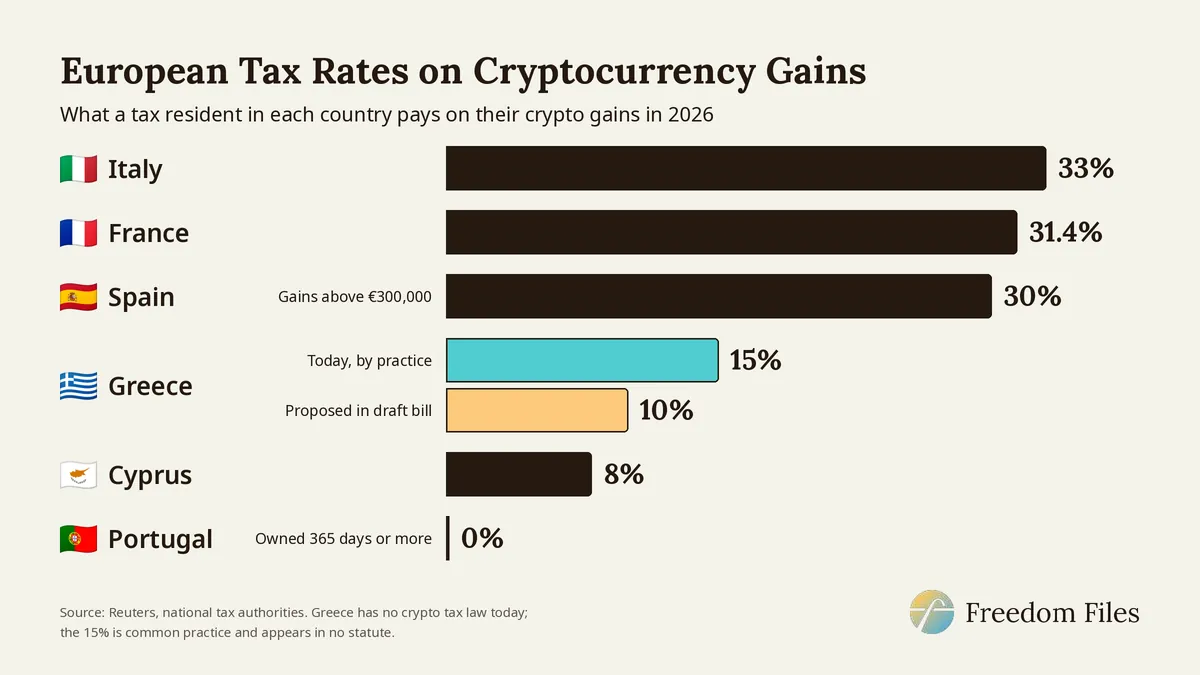
Now you get a number, and the number is low. Italy raised its crypto rate from 26% to 33% in January, the same month France pushed its flat tax on investment gains to 31.4%.
Greek officials told Reuters it's very difficult to size their own crypto market, since most Greek investors use platforms abroad. So a high rate would have collected little and scared off the newcomers Greece courts with its tax regimes. A low rate gets people to declare.
You could say a new tax is a new tax, and you'd be right to watch where the rate goes next. So far it has gone down, from the ministry's first number of 15% to a published 10%.
Greece does lose one contest. Portugal charges 0% on coins you've owned for 365 days or more, so a patient investor does better in Lisbon. For an active trader, Greece beats Portugal's 28% by 18 points.
I watch moves like this closely because my own effective tax rate came down to near single digits, 100% legal, by choosing jurisdictions that compete for people like you.
Greece's 2 Regimes for New Residents Can Beat the 10%
Greece already offers new residents 2 special tax regimes, and both last 15 years. Either one requires that you were outside the Greek tax system for 7 of the last 8 years.
The 7% regime is the one most Americans should look at first. It charges a flat 7% on foreign pensions and foreign passive income, including dividends, interest, capital gains and annuities, with no investment required. You qualify with pension-like income from abroad, and IRA and 401(k) withdrawals count.
The catch is family. Your spouse qualifies on their own income or gets nothing.
Then there's the non-dom regime for investors. One flat €100,000 payment a year covers all your foreign income, in exchange for a large investment in Greek assets. The math favors it only above roughly €1.4 million of foreign income a year.
For Americans the 2 bills stack: You pay Athens €100,000 and the IRS in full, with no credit in either direction.
Both regimes demand full Greek tax residency, which for most people means 183 days a year in the country. A Golden Visa alone gives you none of it.
The reports on the draft give no rule on whether a gain on a foreign exchange counts as foreign income. If it does, the 7% regime undercuts the new 10% for anyone who qualifies.
On a €100,000 Gain, Greece Takes €9,950 and Italy Takes €33,000
If you buy and never sell, this bill costs you nothing, and swaps between coins are free too. The people who feel it are sellers. Cash out a €100,000 gain as a Greek resident and you'd owe €9,950 after the €500 exemption.
The same sale costs €33,000 in Italy, a difference of €23,050.
As an American, you owe the IRS on that gain wherever you live, so Greece's 10% is a second layer. A US foreign tax credit absorbs it only when the gain is sourced the right way, and the 1950 US-Greece tax treaty has no capital gains article to settle the point.
The bill is a draft for now. Consultation closes on October 22 and parliament is due to receive the text in the first week of November, so the rate and the fine print can change.
If you own crypto and you're weighing Greek residency, contact us for licensed support before you sell or move. This article is general commentary and contains no legal or tax advice.
Italy and France Went the Other Way
Southern Europe has split into countries that raise the rate on crypto and countries that compete on it.
| Country | Latest move | Our read |
|---|---|---|
| Greece | Draft 10% flat tax, first €500 exempt (details) | Cheapest in this table for an active trader |
| Portugal | 28% on sales within 365 days, 0% after (details) | Best for buy-and-wait investors |
| Spain | Top rate on gains raised to 30% above €300,000 (details) | A big exit gets punished |
| Italy | Rate raised from 26% to 33% in January 2026 (details) | The most expensive place here to sell |
| France | Flat tax lifted from 30% to 31.4% in January 2026 (details) | Creeping up through social charges |
FAQ
Is Crypto Taxed in Greece in 2026?
Greece has no dedicated crypto tax law today. A draft bill sets a 10% tax on gains, and parliament is due to receive it in November.
What Is the Crypto Capital Gains Tax Rate in Greece?
10% under the draft bill, with the first €500 of gains each year exempt. Officials floated 15% in June, so the number already came down once.
Are Crypto-to-Crypto Swaps Taxed in Greece?
No. Under the draft, exchanging one coin for another creates no taxable gain. The tax applies when you sell for cash.
Do Americans Pay US Tax on Crypto If They Live in Greece?
Yes. The US taxes its citizens on worldwide gains wherever they live. Greek tax comes as a second layer, and a foreign tax credit covers it only in some cases.
Does a Greece Golden Visa Give You the 7% Tax Regime?
No. The 7% regime requires full Greek tax residency and pension-like foreign income. A Golden Visa is a residence permit and changes nothing on your tax bill.