Balaji Srinivasan spent 20 years building a portfolio worth half a billion dollars in America. Then in 2023, he traded his US passport for a Singaporean one. And last week, the Wall Street Journal came after him for it. I'll walk you through his story, the lessons to be learned here, and how this applies to your expat experience or future. Let's get into it.
Balaji grew up on Long Island, the son of two Indian immigrant physicians. He went to Stanford and earned a bachelor's, a master's, and a PhD in electrical engineering, plus a second master's in chemical engineering. Smart cookie all around. In 2007, he co-founded Counsyl, a genetic screening company, with his brother. It won a Wall Street Journal innovation award in 2010 (ironic), landed him on MIT's under-35 list in 2013, and sold to Myriad Genetics for $375 million in 2018. From there, he became a general partner at Andreessen Horowitz, probably the most successful venture capital firm of all time, then chief technology officer at Coinbase. By any measure, he lived out the American dream to a T.
Now, this is interesting. One of his other companies was called Teleport, which helped people figure out which city they should move to, just like us. He built a business around relocation years before he relocated himself. And in 2013, at Y Combinator's startup school, he gave a talk called "Silicon Valley's Ultimate Exit," built on the economist Albert Hirschman's framework of voice versus exit. Voice means you argue for change inside the system; it's what a lot of people do in the United States. Exit means you simply vote with your feet: leave and build elsewhere. Balaji argued that technologists should stop arguing and start leaving. So the sequence went like this: build the wealth, then build the optionality that protects it. He was 10 years ahead of most of the investors and entrepreneurs doing this now.
The reasons he gives for leaving the United States are neat. He describes Singapore as a country where Tamil, his mother tongue, is a national language, where he can worship at a Hindu temple without anyone denouncing his religion, and where people of Indian descent can become full citizens. He calls it voting with his feet for a life, culture, and meritocracy he wanted his sons raised inside. I celebrate that, really. I celebrate anyone who finds happiness, freedom, wealth, and health anywhere in the world, let alone in the country they were born in.
But think about the odds for a second. There are 193 to 195 UN-recognized countries in the world. You were probably assigned one of them at birth by an accident of geography and timing. The lucky ones get more than one. And nobody did any analysis first on where your health, money, family, and freedom would compound best. The chance that the country you were handed at birth is also the country where you'd be the healthiest, happiest, wealthiest, freest version of yourself for all of your life is close to zero. That's just arithmetic.
You already understand this logic in your portfolio. You wouldn't put 100% of your net worth into a single stock and call it prudent. You'd call that risky and overconcentrated, and you'd fix it. Your citizenship is the biggest concentrated position you may ever have, because you're essentially saying you're 100% okay with your nation's culture, direction, laws, monetary policy, climate, politics, quality of life, and tax policy.
And the payoff of moving is not only financial. It can be, but having helped hundreds of people do it, it rarely is. You learn a language and it rewires how you think. You watch a different economy work on rules you were never taught. You meet people from foreign lands who assume things about the world you never thought to question. I left the US almost 10 years ago and have benefited astronomically from the experience: the fascinating people I've met, the things I've seen, the cultures I've been exposed to, the languages I've learned, the investments I've stupidly turned down. Through it all, I've yet to meet one person who did this and came out worse for it.
By the way, if you're weighing where to plant your first flags abroad, go to freedomfiles.co/begin, answer 10 questions in 90 seconds, and you'll get a report on the residency and citizenship programs that fit your goals best.
All right, back to Balaji and his decision to drop American citizenship for Singaporean, which is a big one. The Singaporean passport is probably the strongest travel document on Earth if you rank it solely by visa-free access, opening around 190 destinations. That part is as good as it gets. Everything underneath it, though, is narrower than most people assume.
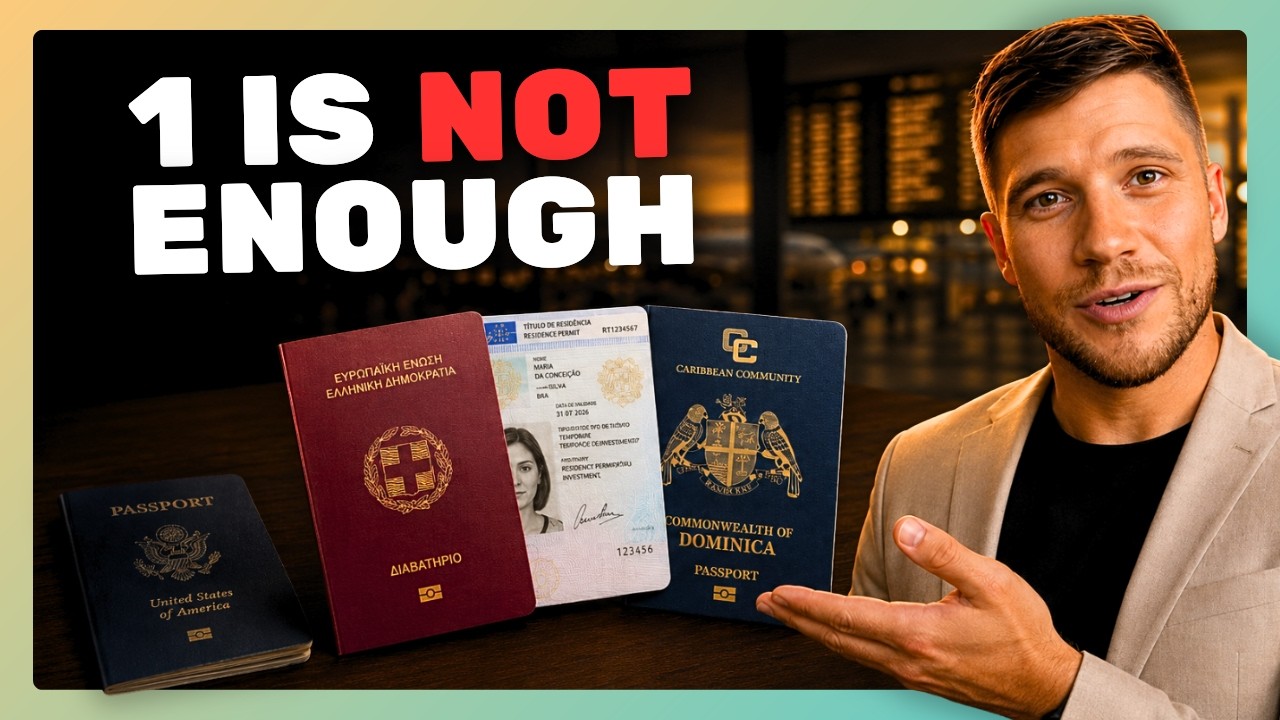
Start with settlement. A powerful passport lets you visit almost anywhere. It doesn't let you live almost anywhere. Singaporean citizenship gives you the right to settle in Singapore, one city-state of 280 square miles. Granted, one economic and financial giant of a city-state, but a city-state nonetheless. Compare that with an EU passport, where one document gives you the right to live, work, study, and get healthcare in more than 27 countries if you include the EEA. Or a citizenship in the Mercosur bloc in South America, which allows you to immediately claim residency in nine other countries on that continent. On mobility, Singapore wins. On the right to plant yourself somewhere, it's one of the most restrictive strong passports in the world.
Then there's conscription. National service is compulsory for male Singaporean citizens and second-generation permanent residents: registration at 16 and a half, enlistment at 18, two years full-time in the armed forces, police, or civil defense, then reservist obligations that continue to age 40, or 50 for officers. Balaji has said his sons will serve, so at least he knew about this going in and thinks it's a good idea for his family.
Finally, Singapore does not permit dual citizenship. You cannot add Singaporean citizenship to whatever you have now. When you claim Singaporean citizenship, which is not easy to do, you surrender your other citizenships to receive it. And getting out later is not simple either, because the government can reject a male citizen's renunciation if he has used citizenship privileges and has national service obligations outstanding. Very subjective, right?
If you want to be all-in on one country, and that country is one of the best-governed on Earth, Singapore is a decent trade, as long as you know the limitations going in. But if what you want is a portfolio of citizenships, this is the wrong instrument, and no amount of visa-free travel changes that fact. I'm curious: knowing these downsides, would you pick Singaporean citizenship if you had the choice? Comment down below.
Now to the half of the equation you may be considering. Because Singapore bars dual citizenship, Balaji had to give up his American citizenship to naturalize, and according to federal records, he did that in 2023. There are significant consequences of doing this.
The tangible costs first. If your net worth is $2 million or more on the date you expatriate, or your average annual income tax over the prior 5 years is above $211,000 (that's the 2026 number), or you fail to certify 5 years of tax compliance, the IRS treats you as a covered expatriate. That triggers a deemed sale of everything you own worldwide at fair market value the day before you leave. The first $910,000 of net gain is excluded; everything above that is taxed at capital gains rates, whether or not you sold a single share. Founders with illiquid equity can get crushed here, because the tax is due in cash on paper wealth they don't have.
But the intangible cost may be even bigger depending on your situation. This decision does not reverse. If you ever want to be American again, you start at square one, in the same line as any other foreign national, with no credit for having been born there, having spent decades as a citizen, or having family in the country. Visiting gets harder too: you need a visa or a travel authorization, and a valid visa is permission to arrive, not permission to enter, since the border officer makes the final call. There's also the Reed Amendment, which allows the government to bar a former citizen permanently if it determines the renunciation was tax-motivated. It was enforced against exactly two people between 2002 and 2015, so I'm not going to tell you it's likely, but it exists and it's written into the statute.
Now, someone will say: so what? Balaji lives in Singapore and he's happy. He made a deliberate trade with full information, and he seems at peace with it. That's awesome. My point is simply that this is the one decision in the sequence that has no undo button. You must plan it out and consider it deeply. We help people do this, and we always recommend taking it very slowly.
So where does the Wall Street Journal come into play? Last week, a reporter named Stu Woo, who moved from San Francisco to Singapore himself, sent Balaji a summary of a story he was about to publish. Woo told Balaji he has no plans to return to America and agreed that millions of Americans had made the same difficult decision as both of them. But Woo said that didn't belong in the story, because everyone already knows it. The replies under Balaji's post called him an opportunist and a carpetbagger for walking away from the US where he was born, raised, educated, and made his money, and said his US citizenship was an obligation rather than a convenience.
Here's some American history for you. Article 13 of the Universal Declaration of Human Rights says everyone has the right to leave any country. The United States helped write that. In 1974, Congress passed the Jackson-Vanik Amendment, sanctioning the Soviet Union for blocking its people from leaving. America once treated the exit door as the test of whether a government deserved to be trusted. A government confident in itself lets you leave and come back. It doesn't need to make an example of the guy who walked out. Whether Balaji made the right call is a fair question. Whether he had the right to make it is not.
Now, what can you learn from Balaji's story? First: sequence beats speed. Balaji built the assets inside the American system for two decades before he built the exit. Optionality is what you buy to protect the wealth you already have. Buying insurance doesn't make sense if the house it protects is empty.
Second: not every passport is additive. Singapore gave Balaji the best travel document in the world, but it also took his ability to have any other. Most people evaluate a second citizenship on what it grants, but some passports are subtractive, as we learned in this case. Read the fine print before spending years of your life or thousands of dollars on another nationality.
Third: this story's pushback is information. When a globally recognized news outlet asks a private citizen why he left his birth country, and that same reporter left too, you're looking at a very strange story. The vibes are changing. As work and money become more digital, and extreme politics become the norm, entrepreneurs and investors learn that optionality is their greatest asset, and governments learn that these individuals have options. Residency and citizenship abroad will only become more popular. These are already high-demand tools for the wealthy in the Middle East, Nigeria, and China, but the markets in Canada, Australia, the UK, and even Western Europe are now catching fire. The ratchet is turning in our favor.
Now, if you'd like to learn where you can get started on a second residency, but you're not quite ready to move across the globe, watch my breakdown of the top nine golden visas that do not require relocation. You can stay on your couch. That's the video on your screen now. Talk to you soon, and thanks for watching.