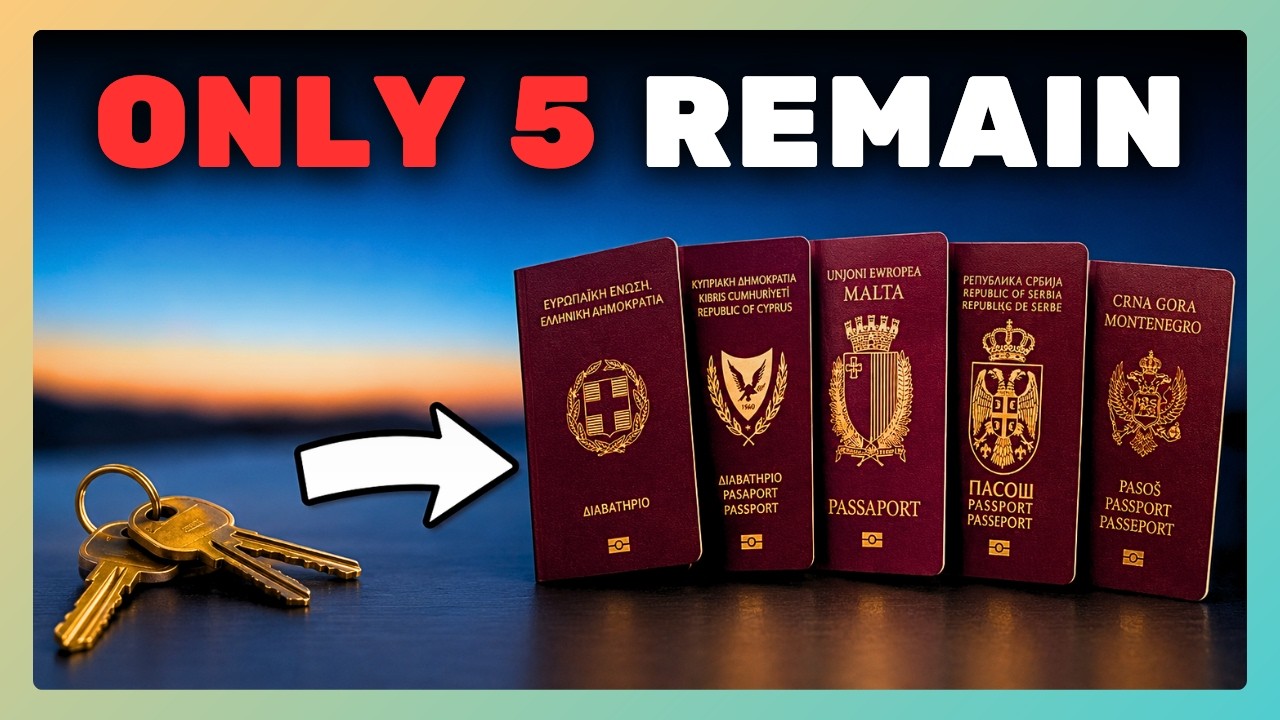
There are seven ways an American can get a second passport, four of which are free, yet most people can think of only one or two. In this video, I'm going to walk you through every single one, how you can get citizenship, and whether it fits your situation. And number seven is the route that I think will replace citizenship by investment in the future. Let's get into it.
I'm James. I left the United States almost a decade ago. I've lived in more than 15 countries. I've invested in my own little residency and citizenship portfolio. And now I help people achieve freedom and optionality just like me. The Freedom Files is my life's work and my passion, and I think that shines through. Now, a quick reframe before we start. Most videos on this topic rank by price, right? But I'm going the other way. I'm ranking these by their ease of access: First the ones that you may get for free, then working toward the ones you may have to pay for or earn from scratch. And by the way, if you watch this channel regularly, you already know I'm going to give you the cons on every single one of these just as much as the pros.
So, number one is citizenship by descent. The cost is documents, and the timeline is roughly 1 to 3 years depending on the country and the consulate backlog. This is the one most Americans never check, yet it's likely the easiest, fastest, and cheapest way to get a second passport. Here's the thing. You were taught citizenship comes from where you were born. That's called the right of soil, or jus soli. But most of Europe grants citizenship by blood, or jus sanguinis. If your parent or grandparent was born in Ireland, Italy, Poland, Greece, Hungary, or a handful of other European countries, you may already be a citizen on paper. You just need to prove that bloodline. Plenty of Latin American countries also offer citizenship by descent. One of our clients' most popular programs is Mexican citizenship by descent, which opens you to a fast-track naturalization process in Spain in just 2 years compared to the standard 10-year track. Huge difference, especially when you account for Spanish taxes over that 8-year period that you don't have to spend there.
So, how does this work? Let's take Ireland, for example. One parent or grandparent born on the island of Ireland, and you go on the Foreign Births Register, a small government fee for an adult, and then you're waiting on Dublin, which as of 2026 has about a year-long queue. Bonus here: In my opinion, Ireland offers the world's strongest citizenship, as it doesn't only grant EU residency rights in 30 countries, but also access to the UK through the Common Travel Area, and the UK left the EU a decade ago.
And on that note about the European Union, this is why we always explore citizenship by descent with our clients first. Claim citizenship in Italy, Slovakia, Lithuania, Poland, Spain, or Hungary, and once you're through the bureaucratic process and the passport is in your hand, you have the right to live, work, study, bank, invest, and get healthcare in more than 30 countries across the European Union. That value cannot be overstated. It's like having 30 passports in your back pocket, and you got them for just filing fees. Compare that to traditional naturalization routes in most European countries and you're looking at a decade of time savings and a boatload in tax savings, right? Because a lot of these countries are high-tax countries. There's no residency or language proficiency typically required, although some countries differ, like Hungary, where you do need to speak Hungarian.
Now, let's crush a myth quickly. If you read somewhere that descent from a great-great-grandparent works in Italy, that's outdated info. In March 2025, Italy capped descent at a parent or grandparent under Law 74, and the constitutional court upheld that cap in April of 2026. So the Italian route that half the internet is describing closed 18 months ago for anyone who hadn't filed. The con here with citizenship by descent is patience and paper. The hard part is tracing the genealogical line and documenting every link: Birth certificates, marriage records, naturalization records, sometimes a ship manifest or two. But this is what the Freedom Files does, so if you want to get started, reach out. Otherwise, if your ancestor naturalized in the US before the next generation was born, the chain breaks and you're unfortunately done when it comes to citizenship by descent. If you have a foreign-born grandparent or parent, this is the first thing you should check before you spend a dollar or hours of research on anything else. Now, if you don't have any citizenship by descent claims, welcome to my boat. I've unfortunately got nothing in the family tree that helps me, so everything in my portfolio came through routes three and four, which we'll discuss later.
All right. Number two is citizenship by birth, and this is the one that's free for your kids and, in a few countries, cheap and fast for you. So don't skip over this if you've already had your kids or don't plan on having any. You already know how this works because you're American or you're Canadian. A child born on US soil is a US citizen, full stop, and the Supreme Court reaffirmed that in 2026 despite the administration's challenges. The same rule exists across almost the whole Western Hemisphere. Fewer than 40 countries in the world now hand out citizenship automatically to anyone born on their soil, and almost all of them are in the Americas: Mexico, Brazil, Argentina, Chile, Panama, and so on. And doing this, by the way, is 100% legal and in these countries not frowned upon in the slightest. Europe, by contrast, has essentially no birthright citizenship at all.
I have a lot of friends who've done this in Mexico and Chile and Brazil. What surprises people is that Chile has the strongest passport in all of Latin America, with visa-free access to the United States, the only Latin American country with that privilege. But birth citizenship is closing in Chile under President Kast, the newly elected president: You must have residency there before your child is born to be granted citizenship. Plenty of countries offer this today, though. So what does that mean for you? If you're planning a family or your kids are young, where they're born is a citizenship decision. Have a child in Mexico and that child is Mexican from day one. Have a child in Brazil, same deal. And in a few of these countries, the child then pulls the parents in behind them. Let me explain.
In Brazil, the parent of a Brazilian child qualifies for residency immediately and can then apply for citizenship after just one year of residency instead of the standard four. In Mexico, the parent of a Mexican child gets permanent residency, and citizenship opens after just 2 years instead of five without a citizen child. So one birth in the right hospital can produce three or four passports in a family within 2 years. Talk about a head start. Now, you might say, "Come on, birth tourism. How is this legal?" That's the part to watch, because governments notice volume, right? Although in most of these countries, the rule is baked into the constitution and fundamental rights. Argentina tightened in 2025 with a decree that resets your residence clock if you leave the country. Portugal moved its rule in 2026, so a parent now needs 5 years of legal residence at the time of birth, up from one, for the child to be Portuguese. And the White House signed an executive order aimed directly at birth tourism into the United States after the Supreme Court struck the broader birthright executive order down. So this route is very much alive, but it's also on the radar. The con is obvious: This doesn't help you if your kids are already grown or you're not having any more. If that's you, though, number three might work.
Number three is citizenship by marriage. The cost is again basically filing fees, and the timeline can be as short as 1 year. I'm married abroad, and although this wasn't my primary goal, of course, I'm in line for citizenship in a few years in my wife's birth country. And vice versa, she'd be eligible for US citizenship if we were to move stateside for a few years. So, how does it work? If you're legally married to a citizen of a country that shortens naturalization for spouses, and most countries do, you can typically get residency right away and citizenship on a reduced clock.
Brazil requires just one year of residence for citizenship if you're married to a Brazilian citizen. Spain is one year of legal residence if married to a Spanish citizen. Italy is 2 years living in Italy or 3 years living abroad, plus a B1 language test. Portugal needs 3 years of marriage with no residency requirement at all, which is a very interesting one if you don't want to move. Mexican citizenship through marriage requires just 2 years of presence in the country. And Argentina waives the residence clock for spouses entirely. But two warnings before you apply. One, this is not a loophole. You'll have to prove the relationship with shared leases, shared bank accounts, social media photos, and in some countries an interview. And two, the clock in most of these countries only starts when your residency card is issued, not on your wedding day, of course. And the residency card itself can take a few months in Latin America and even longer in Europe. Thanks, bureaucracy. If you're already in a cross-border marriage, you are closer to a second passport than almost anyone watching this, and you probably haven't looked at the paperwork. If you're single, well, I'm not going to tell you who to date. Let's move to the routes that don't depend on your family at all.
And by the way, if you're weighing a bunch of these residencies or citizenship programs, or don't know where to start at all, it's okay. This world can get very confusing very fast. Go to freedomfiles.co/begin and answer 10 quick questions. Then you'll get a custom report on the routes that fit your goals.
Okay. Number four is citizenship by naturalization, the typical way an immigrant in the US or Canada becomes a citizen. You don't need an ancestor or a spouse or a check for this one, just presence and time on the ground. And it's free in the sense that the government fees are a simple rounding error. The real price is obviously time, and whether that time comes with taxes. The clock varies a lot, and Latin America definitely beats Europe here. And remember that this is qualification for citizenship, not a passport in hand. Bureaucracy and processing times once you qualify and apply vary drastically from country to country. The Dominican Republic is just six months if you invest in the country through the investor visa program. Argentina is just 2 years of residency. Uruguay is 3 years if you're married or five if single. Paraguay is 3 years of permanent residency. Brazil is four. Mexico is five. Now compare Europe. Portugal moved from 5 to 10 in 2026, and with the AIMA immigration authority backlog, the effective number for most families comes in closer to 13 or 15 years. Greece is seven. Spain is 10 for Americans. By the way, I'll show you how to cut that decade down by 80% in the next route.
So every Latin American clock on that list is significantly shorter than the majority of Europe, and significantly cheaper too, because the tax policies in Latin America are far friendlier on average while you're qualifying for citizenship. But admittedly, their citizenships are not as strong as those of European Union member countries, depending on your goals. Having said that, Argentina, Mexico, Brazil, and Chile will surprise you with their strong passports.
Now, an extra tidbit of info here. A residency permit and a naturalization clock are two very different things. In Portugal, the Golden Visa investor residency requires you to spend on average 7 days a year in the country for 10 years to qualify for citizenship. Even when you apply, you must prove that you have some ties to the country, right? A lease, a gym membership, a cell phone bill, some ties to the country. In Argentina, again, the 2025 decree means a single departure from the country, whether it's for a funeral or a business trip, can reset your 2-year count to citizenship, so you're committed to being there. The Panamanian government has said itself that on the Qualified Investor golden visa, you have to spend one day in the country every 2 years to qualify for citizenship after 5 years total. But most experts like us recommend you learn Spanish, create ties to the country, and make sure you can prove you live there, at least in the last 2 years of residency before you apply. Naturalization is typically subjective. You have to make the best case for it.
And in some countries, even if you must spend significant time there, as in the case of Argentina, it doesn't have to be a tax trap. We covered 19 countries where you don't pay tax on your foreign income in the video at the bottom of your screen right now. Paraguay has territorial tax: Foreign income untaxed. Uruguay gives new tax residents a tax holiday on their foreign income for 11 years: Foreign income untaxed. Cyprus has a non-dom tax system for 17 years: Foreign income untaxed. So the time you're spending is not dead time. You're planting a flag, and the flag comes with a tax structure, ideally a favorable one. The con is the con: You're living there. If your business, your kids' school, and your aging parents are in the US, a 5-year clock in Chile can be tough. Be very clear with yourself on that before you start on any of these routes. If you have more time than capital, or you're planning to spend a few years abroad anyway, this is a great option. And if you already have a second passport from routes 1, 2, or 3, the next route turns this clock into something much shorter.
Number five is preferred nationality tracks. This is another that most Americans have never even heard of. Certain countries give a fast track to citizens of certain other countries, and if your second passport happens to be one of them, your third passport can come in as few as 2 years. The big one is Spain, as it offers one of the most powerful passports in the world. Spain's civil code gives natural-born nationals of Ibero-American countries, that's Mexico, Colombia, Argentina, Brazil, Chile, Peru, the Dominican Republic, and the rest of Latin America, plus the Philippines, Portugal, and Andorra, Spanish citizenship after just 2 years of legal residence instead of 10. If you're American or Canadian or anything else, the timeline is 10 years. They're also exempt from the Spanish language exam upon citizenship qualification, and they don't have to give up their existing nationality. For an American applying as an American, it's 10 years and a technical rule that you're supposed to give up any original nationalities. For the same person applying as a Colombian, it's 2 years. That's an 80% reduction in time, right?
So let's walk it through, because this can get confusing very fast. You get Mexican citizenship through marriage or a child born in Mexico. Then you move to Spain. You'd think, based on what I just said, that you'd qualify for powerful Spanish citizenship in just 2 years. But because you were not born a Mexican citizen, it's a 10-year timeline for you. If you had Mexican citizenship from birth, or you qualified for Mexican citizenship by descent from birth, you can qualify in just two years. Three flags at the end of it. There are other versions of this. Portuguese citizenship comes faster, in 7 years instead of 10, to citizens of Portuguese-speaking countries like Brazil or São Tomé and Príncipe. The con is that this route is typically two routes deep for our clients: You need the first passport before the second one does anything for you. If you already have or are building toward a Latin American passport, this is the highest-leverage move on this list. Nothing else gets an American an EU passport in just 2 years of presence.
And a quick aside here: If you're extracting value from this video, we should sign an agreement that makes you subscribe. Just kidding. But seriously, if you don't subscribe, you'll miss out on future program updates and investment opportunities. So hit that button and the notification bell.
Now, number six is citizenship by investment, and this is the one everybody thinks of first. You write a check, and you get a passport in 3 to 18 months depending on the country. And that's it. First, the prices as of 2026. Dominica: A $200,000 donation. Antigua and Barbuda: A $230,000 donation. Grenada: A $235,000 donation. St Lucia: A $240,000 donation. St Kitts and Nevis: A $250,000 donation. Turkey, spanning the Middle East and Europe: $400,000 in real estate. Egypt: A $250,000 donation. Then the budget options, Nauru and São Tomé and Príncipe, at about $90,000. Pacific island nation Vanuatu, which is one of our most popular programs right now because it takes just 3 to 4 months, requires a donation of $130,000. Argentina, Botswana, and others are talking about launching similar programs. The former is just a few months away from launching. In fact, when you watch this video, that program might exist already.
What's important here is where the market is heading. With more programs like these coming online, the United States and the European Union are clamping down on them, especially if revenue raised by the programs accounts for a significant share of that country's GDP. In the Caribbean, for example, some of these programs account for upwards of 25% of the country's total revenue. So as a result of the enhanced scrutiny, these programs have doubled their prices and layered on additional due diligence under pressure from the European Union. And while they have visa-free access to Europe right now, they may not in 2028. The goalposts move constantly. So, in summary, here's the caveat: A citizenship you buy from a country with which you have no other ties is subject to changing terms. The passport you buy in 2026 may look different in 2030, but you could also say that about any other route as well. With that said, this is the fastest route here to alternative citizenship. No language, residency period, or time on the ground required. We created a video on all the cheapest passports you can buy in 2026, including a few under $100,000, and went into excruciating detail on each of those programs. Check that one out after this video, linked at the end.
Now, number seven is citizenship by merit, and this is the one I teased at the top that I think may replace citizenship by investment in the long term. When the European Court of Justice struck down Malta's citizenship by investment program in 2025, Malta closed that route but opened another. Malta grants citizenship by naturalization to people who render exceptional services or make an exceptional contribution to Malta or to humanity: Scientists, athletes, artists, entrepreneurs, philanthropists, job creators, investors, you name it. But this is not a program. There's no fixed price list, quota, or residency period. It's case by case and subject to a ministerial decision after an evaluation board. Provided you have a clean, desirable profile as it relates to Malta's economic vision for the future, you're looking at a contribution of a bit north of a million.
More than 130 countries have written into their constitution or their nationality law the power to grant citizenship to exceptional individuals. Sometimes that means a donation. Sometimes it means an investment in the country via real estate or business. Sometimes it means hiring a significant number of people and contributing to the local economy. And sometimes it means just donating your skills as an Olympic athlete, a Nobel laureate, or a surgeon with a specialty the country lacks. Austria has done this for decades, typically for people investing 8 figures in the Austrian economy. Tom Hanks got Greek citizenship this way. Peter Thiel got Kiwi citizenship this way. And as the EU tries to squeeze the transactional citizenship by investment programs out of existence, every country that wants investor capital is going to lean on this same mechanism, in my opinion. Now, the con: Discretionary means discretionary. There's no checklist that guarantees an outcome, and your profile has to be legitimate. So you build toward this route with a track record, a foundation, and a partner that knows the bureaucracy like the back of its hand, like the Freedom Files, and then you move forward. If you're a founder, an investor, or a family office with a track record, you can contact us and we'll find the right fit for you.
So, which one is yours? Candidly, I can't tell you from this side of the screen. A European grandparent, a Colombian spouse, a baby on the way, a business that can move, a businessman with a track record. Each of those points to a different option, and that's without even knowing your goals. We're jurisdiction-agnostic over here, and we just want the perfect fit for you, your family, and your assets. So here's how we work with people. If you want one residency or citizenship in one country, we can help you with that, of course. We work in more than 40 jurisdictions and have a massive partner network to help with other things. If you're after a full global Plan B strategy, though, including multiple residencies or citizenships in multiple jurisdictions, a bank account here, a trust or a foundation there, and tax optimization along the way, we offer long-term Private Client engagements where we quarterback the whole strategy and knock these things out one by one across borders in the right sequence, which is very important. Either way, get a free 60-minute one-on-one with yours truly. You'll walk away with a recommendation personalized to your situation and goals. The link is down below.
Now, if you want to do a bit more research and you want deeper expertise on naturalization and citizenship by merit, I broke down how to get a second citizenship without buying a passport in the video on the screen now. Talk to you soon, and thanks again for watching.

 35 min