

Freedom FilesFreedom Files
🇺🇾 Uruguay

Uruguay Residency

The Switzerland of South America. $1,500/month in stable foreign-source income clears it, the ten-year tax holiday on foreign income is the structural prize, and a Uruguayan passport is reachable in three years for married applicants or five for individuals.

Financial req
$1,500/mo income
Processing
8 to 12 months
Naturalization
3 years (married) / 5 (single)
Presence required
183+ days / year
Download the briefing

The basics of the Residency

What it is

Uruguay's residency program grants permanent residency on initial grant to applicants who demonstrate stable foreign-source passive income of at least $1,500 per month, supported by six-to-twelve months of bank statements and source documentation. The application is submitted through the Dirección Nacional de Migración and typically processes in eight to twelve months. Once granted, the residency is permanent (no renewal required), and the path to Uruguayan citizenship runs three years for married applicants and five years for single applicants, contingent on demonstrated 'effective residency,' a Spanish-language assessment, and a basic Uruguayan-civics exam. The 2024-2026 tax-regime updates extended the new-resident foreign-source-income tax holiday from six to ten years.

Who it’s for

  • US retirees with Social Security plus pensions or annuities clearing $1,500/month
  • Remote workers, contractors, and founders with foreign-source income looking for a Latin American base with rule of law
  • Couples and families seeking a three-year (married) or five-year (single) Uruguayan-passport pathway
  • Patrons wanting a ten-year tax holiday on foreign-source income, with EU-grade quality of life at Latin American cost
  • Clients drawn to Uruguay's stability, beach belt, and same-time-zone-as-US-East-Coast convenience

Why it’s beneficial

Uruguay is structurally the most efficient passive-income residency in Latin America. The $1,500/month income bar is among the lowest on the continent for a country at Uruguay's quality-of-life and rule-of-law standard. The ten-year foreign-source-income tax holiday (extended in 2024-2026 from a prior six-year window) means most US earnings stay outside the Uruguayan tax net during the early residency years. The three-year-married, five-year-single naturalization clock is among the fastest in the world for a country with Uruguay's passport strength (visa-free to Schengen, the UK, Japan, and most of Latin America). The trade-offs: 183+ days/year residency, a Spanish-language assessment at naturalization, and a higher cost of living than regional peers like Paraguay or Argentina.

Key benefits

The outcomes the Residency actually delivers, beyond the headline numbers. The six that matter most to our clients.

  1. Ten-year tax holiday on foreign income

    Uruguay's new-resident tax regime, extended in 2024-2026 from six to ten years, exempts foreign-source income from Uruguayan tax for the first ten years of residency. After the holiday, foreign-source dividends and interest are taxed at a flat 12%, with foreign-tax-credit elections available. Foreign-source capital gains remain exempt indefinitely.
  2. Three-year (married) or five-year clock to citizenship

    Naturalization at three years of legal residency for married applicants and five years for single applicants. Among the fastest naturalization clocks in the world for a country with Uruguay's passport strength and rule-of-law standard.

  3. Top-tier quality of life in Latin America

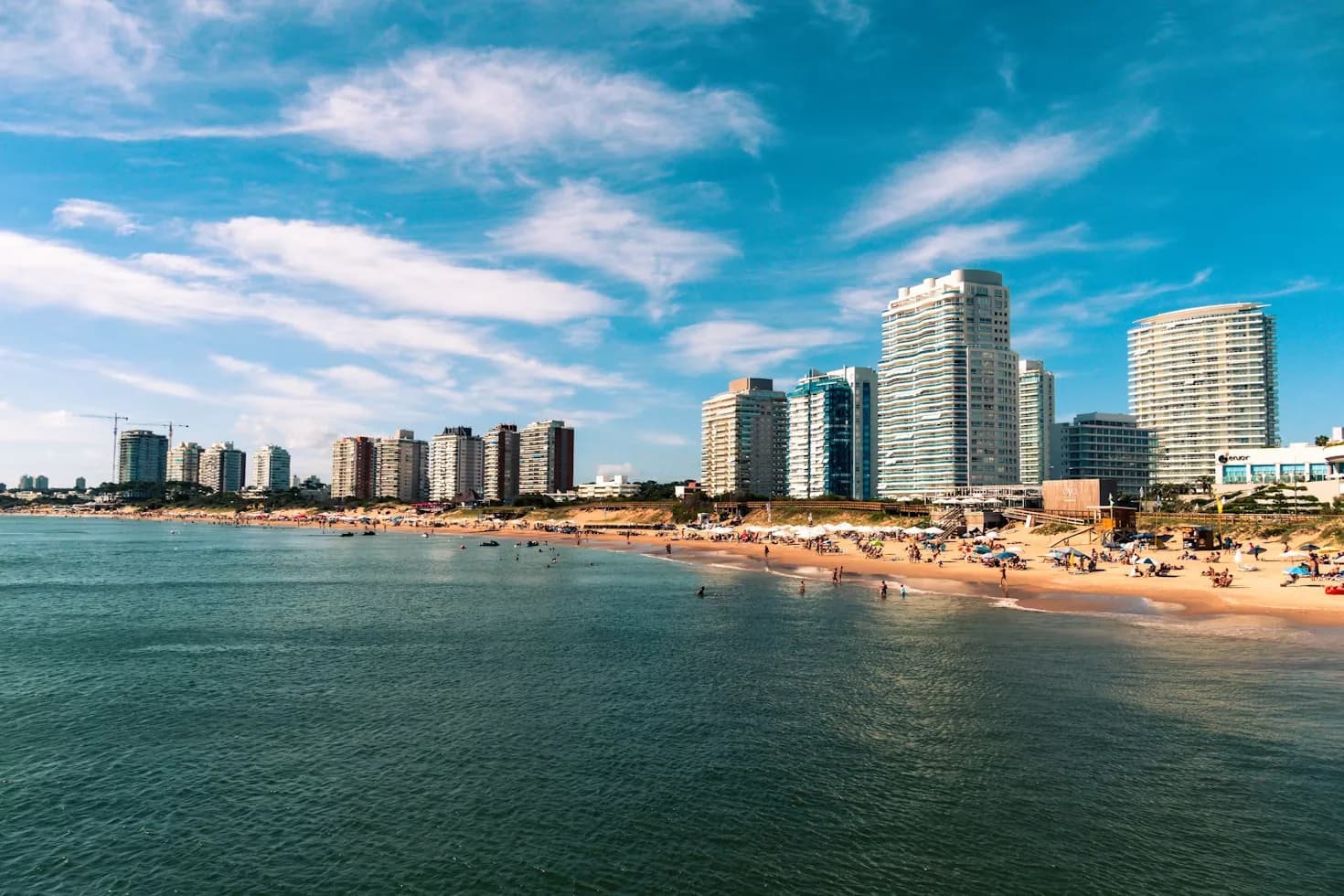
    Uruguay consistently leads Latin America on democracy, civil liberties, press freedom, and corruption-perception indices. Long-running social safety net, low violent-crime rates by regional standards, modern infrastructure in Montevideo, and a beach belt (Punta del Este, José Ignacio, La Pedrera) that delivers summer-resort living from December to March.

  4. Same time zone as US East Coast

    Uruguay sits one hour ahead of New York year round, no daylight saving. Remote work, US business operations, and family calls run on a clean schedule with no calendar gymnastics. Two-hour flight to São Paulo; eleven hours from New York.

  5. Family on the same application

    Spouse and dependent children qualify under the principal applicant's residency with modest income-threshold scaling per dependent. Family-inclusion mechanics are among the cleanest in the region; everyone in the household moves on the same timeline.

  6. Path to a strong Latin American passport

    The Uruguayan passport grants visa-free or visa-on-arrival access to roughly 155 destinations, including the Schengen Area, the UK, Japan, South Korea, and most of Latin America. Among the strongest Latin American passports for global mobility, and one of the fastest to acquire from a residency baseline.

Financial requirements

The financial threshold to qualify, with the documentation we walk every client through.

Most popular

Passive-income demonstration

$1,500/month

Demonstrate at least $1,500/month in stable foreign-source income via six-to-twelve months of bank statements and supporting documentation (Social Security letters, pension statements, dividend records, rental agreements, contractor invoices, interest statements). Threshold scales modestly per dependent. The standard route for US retirees and remote-income holders.

Choosing the right route is half the work. We model the comparison against your portfolio in the Consult.

How the process works

  1. Contact us

    Reach out and tell us about your situation. From there, you'll either book a 60-minute Freedom Consult (if you're weighing options across countries) or get started on this route directly (if you already know it's the right fit).

  2. Engagement and document gathering

    We coordinate the document pack: passport, FBI background check (apostilled), birth and marriage certificates, twelve months of bank statements, income source documentation (SSA letter, pension statements, dividend records, etc.), Uruguayan accommodation proof, and the Uruguayan-counsel power of attorney. Typically 6 to 10 weeks.

  3. Filing with Migración

    Our Montevideo partner counsel files the residency application with the Dirección Nacional de Migración. Filing includes biometric capture and the formal income-demonstration submission. The clock to permanent-residency issuance begins here.

  4. Provisional residency and arrival

    Upon filing, a provisional residency cédula is issued, allowing legal stay in Uruguay during the processing period. Most clients use this window to establish accommodation, open Uruguayan bank accounts, and begin building the 183-day effective-residency record required for naturalization.

  5. Government review and permanent grant

    Migración processes the application, typically running 8 to 12 months from filing. Upon approval, permanent residency is granted (no renewal required). The cédula is reissued in permanent form.

  6. Building the naturalization clock

    Spend at least 183 days per year in Uruguay during the qualifying period (three years for married applicants, five for single). Build the Spanish-language proficiency for the B1-equivalent assessment, and the basic Uruguayan-civics knowledge for the exam. Most clients use Montevideo's Pocitos, Carrasco, or Punta Carretas districts as base.

  7. Citizenship petition

    File the naturalization petition at the three-year or five-year mark. Petition-to-decision typically runs 9 to 12 months. Uruguay permits dual citizenship; the United States permits it as a matter of practice. You hold both passports indefinitely.

Processing

Permanent residency

Naturalization clock

Citizenship

8-12 months

Year 1+

Years 3-5

Year 4-7

Residency versus the alternatives

How this program stacks against the closest credible options for the same visitor. We don’t earn more if you choose one over another.

DimensionUruguay ResidencyParaguay Permanent ResidencyLearn moreArgentina RentistaLearn more
Minimum financial bar$1.5K/mo passive income$70K business or $5K deposit$2K-3K/mo passive income
Processing8-12 months4-6 months8-12 months
Presence required183+ days / yearLight (one visit/year)183+ days / year
Time to citizenship3 yrs married / 5 single3 years2 years
Local tax position10-yr foreign-income holidayTerritorialWorldwide (with treaty)
Quality-of-life rankTop in Latin AmericaMid-tier, low-frictionWorld-class cities, macro volatility
Passport strength~155 destinations~145 destinations~170 destinations

Uruguay is the stability play – top-tier quality of life, the ten-year tax holiday, and rule of law. Paraguay leads on cost and presence-flexibility. Argentina leads on naturalization speed (two years) and passport strength but with macro volatility most US clients prefer to avoid. We don't earn more if you pick one over another.

Want a four-page Uruguay PDF covering everything on this page plus the comparison framework we use internally?

No spam ever! Unsubscribe in one click.

Why clients work with us

Three reasons families pick Freedom Files over the do-it-yourself path or a single-jurisdiction agent.

First-hand experience

We know which Migración examiners weight which documentation types, which Montevideo neighborhoods clear the 'effective residency' showing cleanest, and which language schools build B1 Spanish in a workable timeframe. The naturalization clock looks simple until the documentation gets requested in detail.

Honest recommendations

About a third of Uruguay inquiries end with our recommendation against engagement. We tell you when Paraguay fits cleaner on cost and presence, when Argentina is the better passport play, or when Mexico's Economic Solvency Visa is a closer cost match.

Pro counsel from the start

Every engagement runs with US-licensed counsel from the first call. The ten-year tax holiday interacts with US worldwide-income filing in ways that need to be modeled before the residency triggers; we plan transparently before the move.

How does the ten-year tax holiday work?

Uruguay's updated new-resident regime, extended in 2024-2026 from a previous six-year window to ten, exempts foreign-source income from Uruguayan tax for the first ten years after becoming a Uruguayan tax resident. After the holiday, foreign-source dividends and interest are taxed at a flat 12% (with foreign-tax-credit elections available). Foreign-source capital gains and most other foreign-sourced earnings remain exempt indefinitely. We coordinate with US-licensed counsel on the structure.

How is the $1,500/month income threshold proven?

Applicants submit documentation showing consistent foreign-source income (typically employment, contract, pension, dividend, rental, or interest income) at or above $1,500 per month, demonstrated over a six-to-twelve-month period via bank statements and supporting documents. The threshold is per principal applicant; family inclusion scales the minimum modestly. We package the documentation during the engagement.

How long until I can hold a Uruguayan passport?

Three years of legal residency for married applicants and five years for single applicants. The application requires a Spanish-language assessment at B1-equivalent and a basic Uruguayan-civics exam. Petition-to-decision typically runs 9 to 12 months after the clock matures. Uruguay permits dual citizenship; the United States permits it as a matter of practice.

Do I have to live in Uruguay full-time?

Uruguay requires demonstrated 'effective residency' rather than a fixed day-count rule. In practice, spending at least 183 days per year in Uruguay during the qualifying period establishes a strong residency claim. Some clients structure shorter visits with documented Uruguayan economic ties; the position is fact-specific and we map it during the consult.

Do I have to learn Spanish?

Daily life in Montevideo's Pocitos, Carrasco, and Punta Carretas districts, plus the Punta del Este resort zone, runs comfortably in English at most professional and service contexts. Outside those zones, Spanish becomes essential. The naturalization application requires a Spanish-language assessment, which most clients build through immersion plus formal tutoring during the qualifying residency window.

What happens to my US taxes once I move?

The United States taxes citizens on worldwide income regardless of residency. During Uruguay's ten-year tax holiday, foreign-source income is exempt from Uruguayan tax but remains US-federally taxable. After the holiday, the 12% flat tax on foreign-source dividends and interest interacts with US foreign-tax-credit mechanics. The position is technical; we coordinate with US-licensed counsel.

Will I have to give up my US citizenship?

No. The United States and Uruguay both permit dual citizenship. You can hold both passports indefinitely after Uruguayan naturalization.

Ready to talk?

Two paths in. If the Residency is clearly the right program for your family and you’re ready to engage, contact our team directly. If you’re weighing this against other programs and want an honest read on the right move, the Freedom Consult is the sixty-minute conversation that ends the loop.

Contact our team →

We take a small number of new families each quarter.

Get your custom Plan B Blueprint

Most people spend 100+ hours researching residency and citizenship options before they realize they were looking at the wrong programs. We compress that into 10 questions, 90 seconds, and a single report.